
You have read the generic "get your ex back" advice: make them jealous, show them what they are missing, reach out with heartfelt messages about your feelings. With an avoidant ex, every single one of these tactics will backfire spectacularly.
If you want to know how to get an avoidant ex back, you need strategies specifically designed for how avoidant attachment works. Standard relationship advice assumes your ex processes emotions and responds to connection attempts the way most people do. Avoidants do not.
Ready to Start Your No Contact Journey?
Track your progress, get AI coaching when the urge to text hits, and become the strongest version of yourself.
Free to start • No credit card required
Understanding avoidant attachment is your foundation. But understanding alone will not bring them back. This guide provides the specific strategies that create conditions where reconciliation becomes possible—while being honest about when it is not.
The Honest Truth About Avoidant Reconciliation
Before diving into strategies, you need realistic expectations.
The good news: Avoidant exes are actually more likely to come back than other attachment types. Their departure was often driven by fear of intimacy, not lack of feelings. Once that pressure lifts, they frequently realize what they lost.
The challenging news: Their return happens on their timeline, not yours. You cannot accelerate their emotional processing. Pressure makes things worse, not better. And even if they come back, the relationship requires significant work to become healthy.
The hardest truth: Some avoidant exes will not return regardless of what you do. Their avoidance is too severe, the relationship had too much conflict, or they have simply moved on. No strategy guarantees success.
With that reality established, let us look at what actually works.
Why Standard "Get Ex Back" Advice Fails with Avoidants
Most general ex back strategies are designed for securely attached or anxiously attached exes. Here is why they fail with avoidants:
"Show Them What They're Missing"
Standard advice: Post amazing life updates, show you are thriving, make them see your value.
Why it fails: Avoidants already know your value—that is partly why intimacy scared them. Dramatic displays of your amazing life feel like pressure. They may interpret it as attention-seeking or manipulation.
"Make Them Jealous"
Standard advice: Be seen with other people, hint at dating, create competition anxiety.
Why it fails: Avoidants use jealousy as confirmation that leaving was the right choice. "See, they have already moved on—good thing I left." Unlike anxious attachers who respond to jealousy with pursuit, avoidants respond with further detachment.
"Express Your Feelings"
Standard advice: Write a heartfelt letter, tell them how much you miss them, be vulnerable about your love.
Why it fails: Emotional intensity is exactly what triggered their avoidance in the first place. Your feelings, no matter how genuine, feel like pressure and obligation. They will withdraw further, not move closer.
"Stay in Contact"
Standard advice: Maintain connection, stay on their radar, do not let them forget about you.
Why it fails: Avoidants need space to process. Constant presence prevents the longing that eventually brings them back. They need to miss you—and that requires your absence.
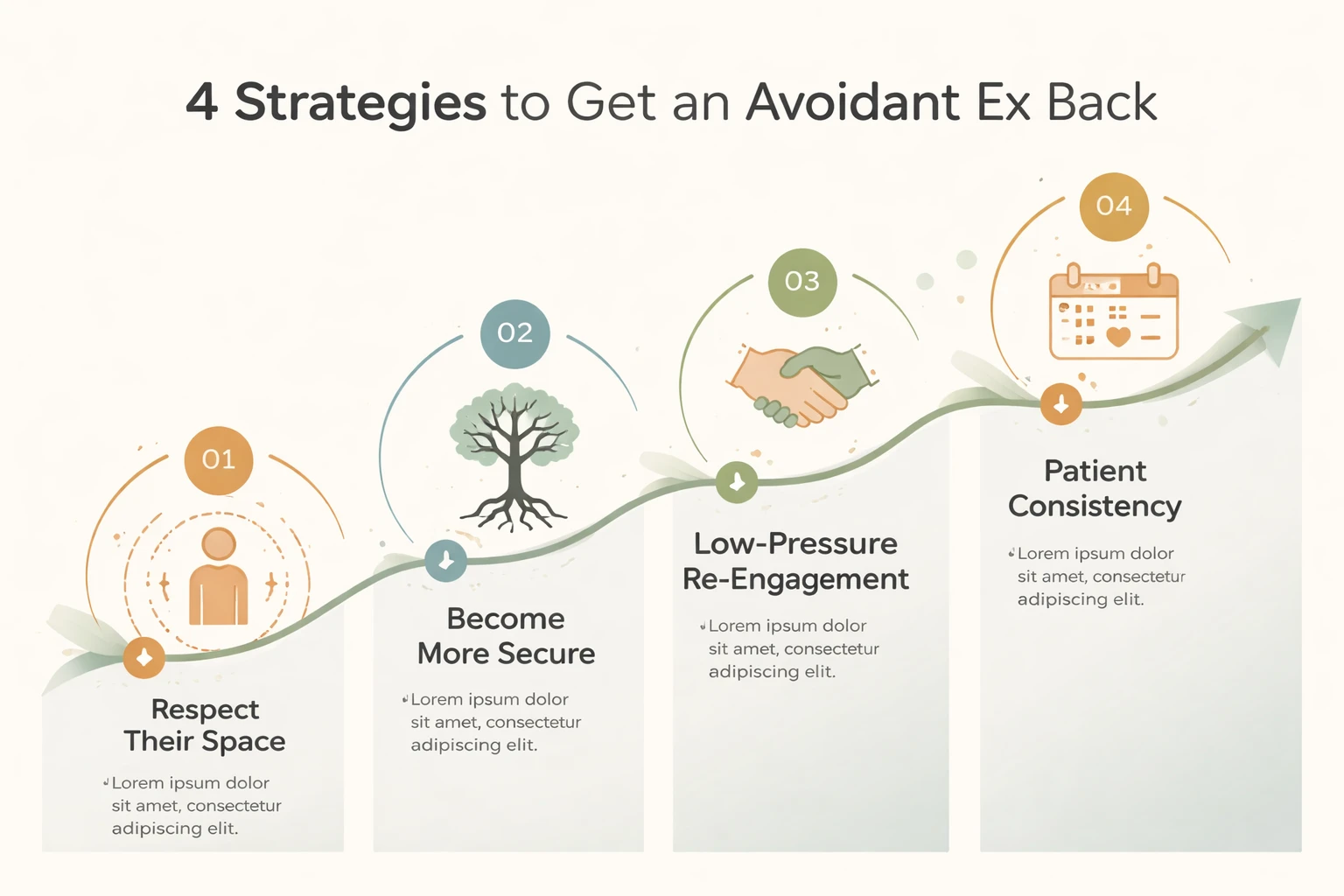
Strategy 1: Respect Their Need for Space
This is the foundation. Get this wrong, and nothing else matters.
Why Space Works with Avoidants
Avoidants have heightened nervous systems around emotional closeness. During the relationship, they likely felt constant low-level stress from the intimacy demands. Your presence—no matter how loving—represented pressure.
When you disappear, something shifts:
- Their nervous system calms
- The "threat" of intimacy removes itself
- They can process emotions without feeling hunted
- Longing has space to develop
How to Implement Modified No Contact for Avoidants
Standard no contact works, but with avoidants, the approach requires nuance:
Do:
- Stop all initiated contact
- Remove yourself from their daily awareness
- Give them genuine space without games
- Focus on your own life authentically
Do not:
- Block them dramatically (feels like punishment)
- Announce your no contact (feels manipulative)
- Post passive-aggressive content
- Use mutual friends to send messages
Duration: With avoidants, expect longer timelines. Dismissive avoidants may need 3-6 months before feelings surface. Fearful avoidants might reach out sooner (1-3 months) but in more chaotic patterns.
If They Reach Out During No Contact
Respond warmly but briefly. Match their energy—if they send a casual message, send a casual response. Do not immediately escalate to relationship discussions. Show you are available without being desperate.
Strategy 2: Become Secure (Or More Secure)
This is not just about getting them back—it is about becoming someone who can have a healthy relationship with an avoidant if they return.
Why Security Attracts Avoidants
Avoidants are drawn to emotional stability. Their nervous system calms around people who are:
- Self-contained rather than needy
- Emotionally regulated rather than reactive
- Independent rather than dependent
- Calm rather than anxious
If you previously showed anxious behaviors (frequent checking in, need for reassurance, emotional intensity during conflict), those patterns pushed them away. Becoming more secure makes you genuinely more attractive to them.
What Security Looks Like
Emotional regulation:
- You can feel difficult emotions without acting impulsively
- You do not need immediate reassurance from others
- You can sit with uncertainty without spiraling
- Your mood is not dependent on their behavior
Healthy independence:
- You have your own friends, interests, and goals
- Your identity is not wrapped up in the relationship
- You can be alone without being lonely
- Your happiness comes from within, not from them
Secure communication:
- You express needs clearly without manipulation
- You can hear difficult feedback without defensiveness
- You do not punish with silence or drama
- You take responsibility for your part in problems
How to Develop Security
This is real work, not a performance. Consider:
- Therapy focused on attachment patterns
- Reading about secure attachment
- Practicing self-soothing techniques
- Building strong friendships and support systems
- Work on yourself with AI guidance during this process
The goal is genuine growth, not faking security to get them back. Avoidants can sense inauthenticity—and they will withdraw from it.
Strategy 3: Low-Pressure Re-engagement
If and when you re-engage, the approach must feel completely safe to their nervous system.

When to Reach Out
Signs it might be time:
- Significant time has passed (2+ months minimum for dismissive, potentially sooner for fearful)
- You have genuinely worked on yourself
- You feel emotionally stable, not desperate
- They have shown some signs of openness (viewing stories, not blocking, etc.)
Signs to wait longer:
- You feel urgency or desperation
- They have specifically asked for space
- They are in a new relationship
- You have not addressed your own patterns
How to Reach Out
First contact principles:
- Keep it light and casual
- No relationship discussion
- No emotional weight
- Give them easy exit points
Good first messages:
- Something that reminded you of them (shared interest, inside joke)
- A genuine question about something they care about
- Reacting to something they posted (if they post publicly)
- A practical reason to connect (returning belongings, shared logistics)
Bad first messages:
- "I miss you"
- "Can we talk about us?"
- "I have been thinking about what went wrong"
- Long paragraphs about your feelings
If They Respond
Mirror their pace. If they are brief, be brief. If they warm up, gradually warm up. Do not escalate faster than they do.
Keep conversations light. Focus on shared interests, intellectual discussions, current events. Avoid heavy emotional territory initially.
Let them lead. When they pull back, you pull back. When they engage more, you can engage more. This creates safety.
Do not bring up the relationship until they do. If they want to discuss it, they will. Forcing the conversation triggers avoidance.
Strategy 4: Patience Without Desperation
Getting an avoidant ex back is often measured in months, not weeks. Your ability to maintain composure during this period directly affects the outcome.
What Patient Consistency Looks Like
Consistent availability: You respond when they reach out. You are friendly and warm. You do not play games or make them chase.
Without desperation: You do not initiate constantly. You do not analyze their every word. You do not pressure for relationship clarity. You have your own life happening.
The energy you project: "I am open to reconnection, but I am fine either way. I am living my life. If you want to be part of it, the door is open."
Managing Your Own Emotions
This waiting period is difficult. Support yourself by:
- Processing feelings with friends or a therapist, not with them
- Distracting yourself with meaningful activities
- Limiting social media checking
- Remembering that their timeline is not personal rejection
If Progress Stalls
If you have been in contact for a while without deepening:
- Pull back slightly and see if they re-engage
- Gently test for more meaningful connection
- If they consistently keep distance, accept the message
When to Accept It Is Not Working
Not every avoidant ex comes back. Knowing when to stop waiting protects your wellbeing.
Signs Reconciliation Is Unlikely
- Clear communication: They have explicitly said they do not want to reconcile
- New serious relationship: They are invested in someone else
- Consistent avoidance: Every attempt to connect is met with distance
- No signs of growth: They have not changed the patterns that ended things
- Significant time with no movement: 6-12 months of no progress is telling
Signs to Continue Hoping (Cautiously)
- They maintain connection in small ways
- They show signs of personal growth
- They have not entered a serious new relationship
- Your interactions, though limited, are warm
- Time is still within reasonable range (under 6 months)
The Hardest Decision
If you have done everything right—given space, worked on yourself, re-engaged appropriately, been patient—and nothing is progressing, it is time to prioritize yourself.
Waiting indefinitely for someone who may never be ready is not self-respect. It is self-abandonment.
Is Getting Them Back Even Worth It?
Before investing more energy, honestly consider this question.
What Would Be Different?
If you reunited today, what would change? Have they addressed their avoidant patterns? Have you addressed your patterns? Without real work from both sides, you will recreate the same dynamic.
What You Deserve
You deserve someone who:
- Can show up consistently
- Expresses love in ways you can feel
- Works on their issues actively
- Makes you feel secure, not anxious
Can your avoidant ex become this person? Perhaps—with significant effort. But they must choose that path themselves.
The Question Beneath the Question
Sometimes the desire to get them back is less about them and more about avoiding the pain of moving on. Be honest with yourself about what is driving you.
Getting an avoidant ex back is possible. But the process requires becoming someone who does not need them back in order to be whole. Paradoxically, that very wholeness is what makes you most attractive to them.
Focus on your growth. Give them genuine space. Re-engage with patience and low pressure. And be prepared to accept whatever outcome unfolds—knowing that you showed up as the best version of yourself.
That is a win regardless of whether they return.
Ready to Start Your No Contact Journey?
Track your progress, get AI coaching when the urge to text hits, and become the strongest version of yourself.
Free to start • No credit card required
Related topics