
The silence is over. Thirty days, forty-five days, maybe even ninety days of no contact—and now you're left wondering: what's actually going on in the male mind after no contact?
If you've been following the no contact rule process, you know the point wasn't just to make him miss you. It was to give both of you space to process, heal, and potentially transform. But now that the dust has settled, what's he actually thinking?
Here's what research and real-world patterns reveal about where his head is at—and what it means for you.
Ready to Start Your No Contact Journey?
Track your progress, get AI coaching when the urge to text hits, and become the strongest version of yourself.
Free to start • No credit card required
What's Changed in His Mind During No Contact
Before we dive into what he's thinking now, let's understand what he went through during no contact. Because his current state is shaped by that entire journey.
The typical male progression during no contact:
- Relief phase (Days 1-7): Initial freedom, maybe even confidence in the breakup decision
- Curiosity phase (Days 8-21): Noticing your absence, checking your social media, wondering why you haven't reached out
- Ego challenge (Days 21-30): His expectations of you breaking first aren't met; this creates psychological dissonance
- Reflection phase (Days 30+): Real introspection begins, often accompanied by regret or idealization
Research from Binghamton University found something striking: while women tend to feel breakup pain more intensely at first, they recover more completely. Men, on the other hand, experience a delayed but prolonged emotional impact—and often never fully "get over" significant relationships.
This means that by the time no contact ends, he's likely in a very different mental space than when it began.
The Three Scenarios: What Happens Next
After no contact ends, his behavior will typically fall into one of three patterns. Understanding which one you're dealing with is crucial for knowing how to respond.
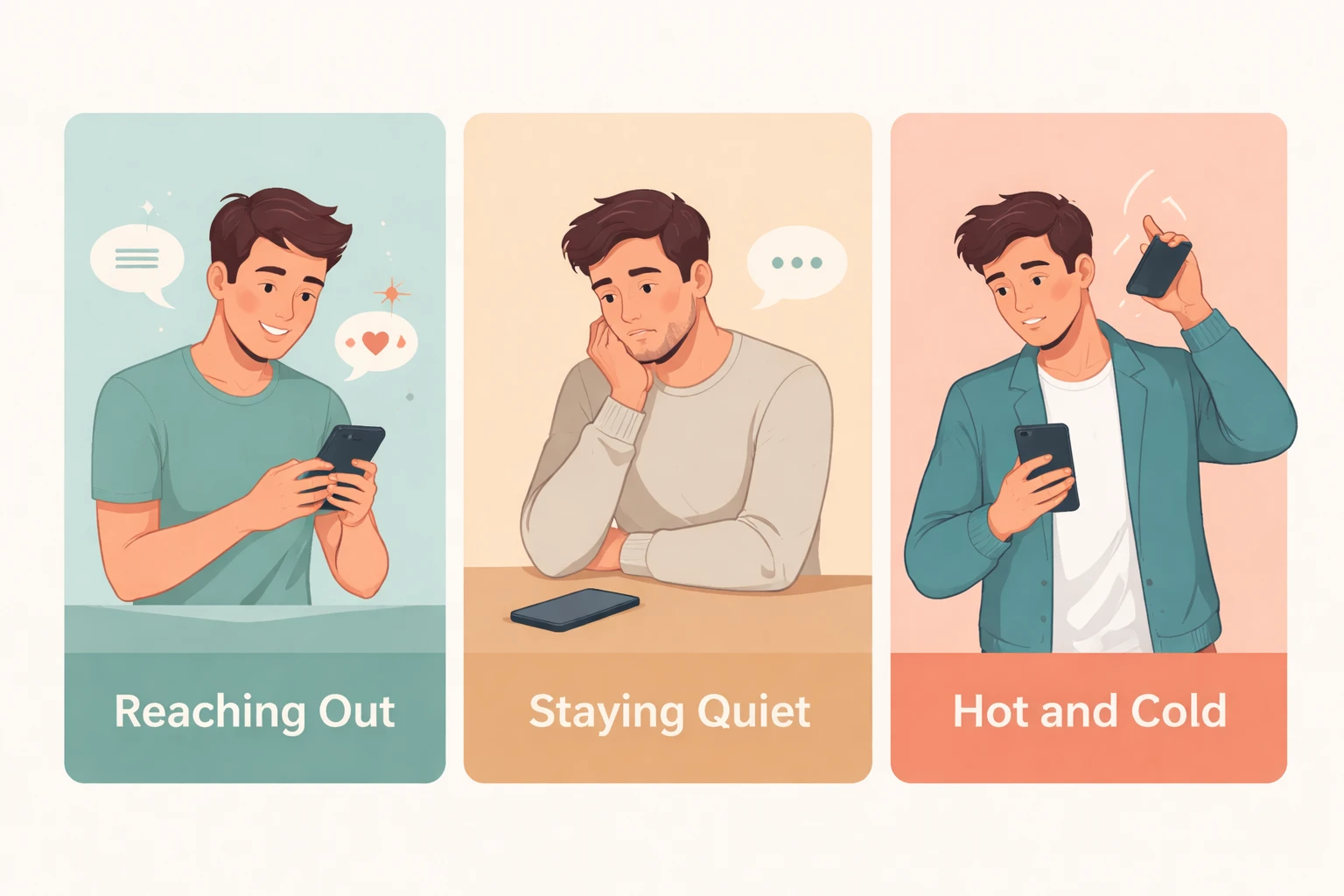
Scenario 1: He Reaches Out
What it looks like: He sends a text, calls, or finds a reason to contact you. It might be direct ("I've been thinking about you") or indirect ("Hey, saw this and thought of you").
What it typically means:
The no contact period worked as intended—your absence created enough space for him to process his feelings and realize something is missing. He's made a conscious choice to break the silence, which requires overcoming ego and fear of rejection.
However, pay attention to:
- Timing: Did he reach out early in no contact (sign of anxiety) or after the full period (sign of genuine reflection)?
- Content: Is his message thoughtful and personal, or generic and low-effort?
- Consistency: Does he follow up, or was it a one-time impulse?
What he might be thinking:
- "I miss what we had and want to explore if things could be different"
- "I need to know if she's moved on"
- "I made a mistake and need to test if there's still a chance"
- "I'm lonely and she's familiar" (less ideal, but honest)
Red flags in his reach-out:
- Late-night "you up?" messages (seeking comfort, not connection)
- Immediately asking to meet up without rebuilding rapport
- Acting like nothing happened
- Bringing up the relationship too fast without acknowledging the past
Scenario 2: He Stays Silent
What it looks like: No contact ends, and... nothing. No text, no call, no social media interaction. Radio silence continues.
What it typically means:
This is harder to interpret because silence can mean many things:
- He's moved on: He used the no contact period to process and close the chapter
- He's waiting for you: His ego won't let him reach out first
- He's avoidant: Fear of vulnerability is keeping him away despite missing you
- He's in a rebound: He's distracting himself with someone new
- He's still processing: Some men need longer than the "standard" NC period
What he might be thinking:
- "If she wanted to talk, she would have reached out"
- "I can't risk being rejected again"
- "I miss her but I don't know how to fix what broke us"
- "It's probably for the best even though it hurts"
- "I need to prove I can live without her" (even if he's struggling)
Important context: Studies show that avoidant individuals—common among men due to socialization—are most likely to miss you after you've genuinely moved on. If he has avoidant tendencies, his silence doesn't necessarily mean indifference.
Ready to Start Your No Contact Journey?
Track your progress, get AI coaching when the urge to text hits, and become the strongest version of yourself.
Scenario 3: He's Hot and Cold
What it looks like: Mixed signals galore. He reaches out, then disappears. Views all your stories but doesn't engage. Responds warmly one day, coldly the next. Makes plans then cancels.

What it typically means:
He's genuinely conflicted. Part of him wants to reconnect; part of him is scared. This push-pull behavior often indicates:
- Internal conflict: His feelings haven't resolved into a clear direction
- Fear of vulnerability: Getting close triggers his defenses
- Testing the waters: He's gauging your response before fully committing
- Unresolved attachment issues: This pattern may have existed in your relationship too
What he might be thinking:
- "I want her but I'm scared of getting hurt again"
- "Maybe I should try, but what if nothing has changed?"
- "I don't know what I want"
- "I need to protect myself but I can't stop thinking about her"
The frustrating truth: Hot and cold behavior is often about him, not you. It reflects his internal state, not your worth or even necessarily his feelings for you.
What Men Typically Regret After No Contact
Understanding what he's likely reflecting on can help you interpret his behavior:

Common male regrets post-no contact:
1. Taking you for granted During the relationship, he might have assumed you'd always be there. Your silence shattered that assumption. Many men report that no contact made them realize how much they relied on their partner's presence—emotionally, practically, and socially.
2. Not communicating better The space of no contact often reveals communication failures he didn't recognize in real-time. He may regret shutting down during conflicts, not expressing his feelings, or dismissing your concerns.
3. Letting ego drive decisions Whether he initiated the breakup or responded poorly to it, many men regret choices made from pride rather than genuine feeling. No contact gives ego time to quiet down.
4. Not fighting for the relationship This is especially common in men who initially felt relieved by the breakup. As time passes, relief can transform into regret about giving up too easily.
5. Specific moments of failure Research shows men tend to hold onto specific instances where they failed their partner—moments that replay during the reflection phase of no contact.
How to Read His Post-NC Behavior
Decoding his signals requires looking at patterns, not individual actions. Here's your interpretation guide:
Positive indicators:
- Consistent communication: Not just reaching out once, but maintaining contact
- Genuine curiosity about your life: Asking questions, remembering details
- Accountability: Acknowledging his role in what went wrong
- Patience: Not rushing to meet up or define things
- Changed behavior: Actually demonstrating growth, not just claiming it
Concerning patterns:
- Breadcrumbing: Minimal effort contact that keeps you engaged without commitment
- Blame-shifting: Making the breakup or problems entirely your fault
- Love-bombing: Sudden intense attention that feels performative
- Avoiding depth: Keeping things surface-level to prevent real conversation
- The "miss you" without action: Words without follow-through
Neutral signals (need more context):
- Social media viewing without engagement
- Liking old photos
- Asking mutual friends about you
- Being extra friendly when you run into each other
Want personalized help interpreting his specific signals? You can decode his signals with our AI coach for guidance tailored to your situation.
What to Do Next Based on His Response
If he reached out positively:
- Respond warmly but not desperately. Match his energy initially
- Keep early conversations light. Rebuild rapport before diving into heavy topics
- Let him do some pursuing. Don't immediately become more available than you were during NC
- Watch for consistency. One good conversation doesn't mean things are fixed
- Have the important conversation eventually. If reconciliation is the goal, you'll need to address what went wrong
If he's staying silent:
- Consider reaching out once (if you want to). Your silence proved a point; one message won't undo that
- Make it low-pressure. Something light that doesn't demand a response
- Accept his answer (including silence as an answer)
- Focus on your own closure. His response doesn't determine your worth or future happiness
- Set a mental deadline. If there's no positive movement by a certain point, commit to moving forward
If he's hot and cold:
- Don't mirror his inconsistency. Stay grounded in your own behavior
- Name the pattern (gently). "I've noticed our communication is pretty inconsistent. What's going on?"
- Set a boundary. Decide what level of inconsistency you're willing to tolerate
- Protect your peace. Hot-cold cycles are emotionally exhausting—don't let them consume you
- Consider what this reveals. If this pattern existed in your relationship, it may not change easily
The Bigger Picture
Here's what most articles won't tell you: obsessing over the male mind after no contact can become its own trap.
Yes, understanding his psychology is useful. Yes, it helps to know what you might be dealing with. But at some point, the focus needs to shift back to you:
- What do you want?
- What behavior are you willing to accept?
- What kind of relationship would actually make you happy?
No contact was partly about gaining perspective—not just on him, but on the relationship itself. Use that perspective now.
If reconciliation is your goal and his behavior suggests openness, explore it carefully. If you're ready to pursue that path, consider reading your next steps to reconciliation for a complete guide.
But if his behavior suggests he's not ready, not interested, or not capable of the relationship you deserve—that's valuable information too. The male mind after no contact will reveal itself through actions, not just words.
Trust what he shows you.
Ready to Start Your No Contact Journey?
Track your progress, get AI coaching when the urge to text hits, and become the strongest version of yourself.
Free to start • No credit card required
Related topics