It's 2am. You're staring at your phone, wondering what's going through his head right now. Is he thinking about you? Missing you? Has he already moved on? Does he even care?
If you're following the no contact strategy, this obsessive wondering is completely normal. And while I can't read your ex's specific mind, psychology and behavioral patterns give us a remarkably consistent picture of what he's thinking during every day of no contact.
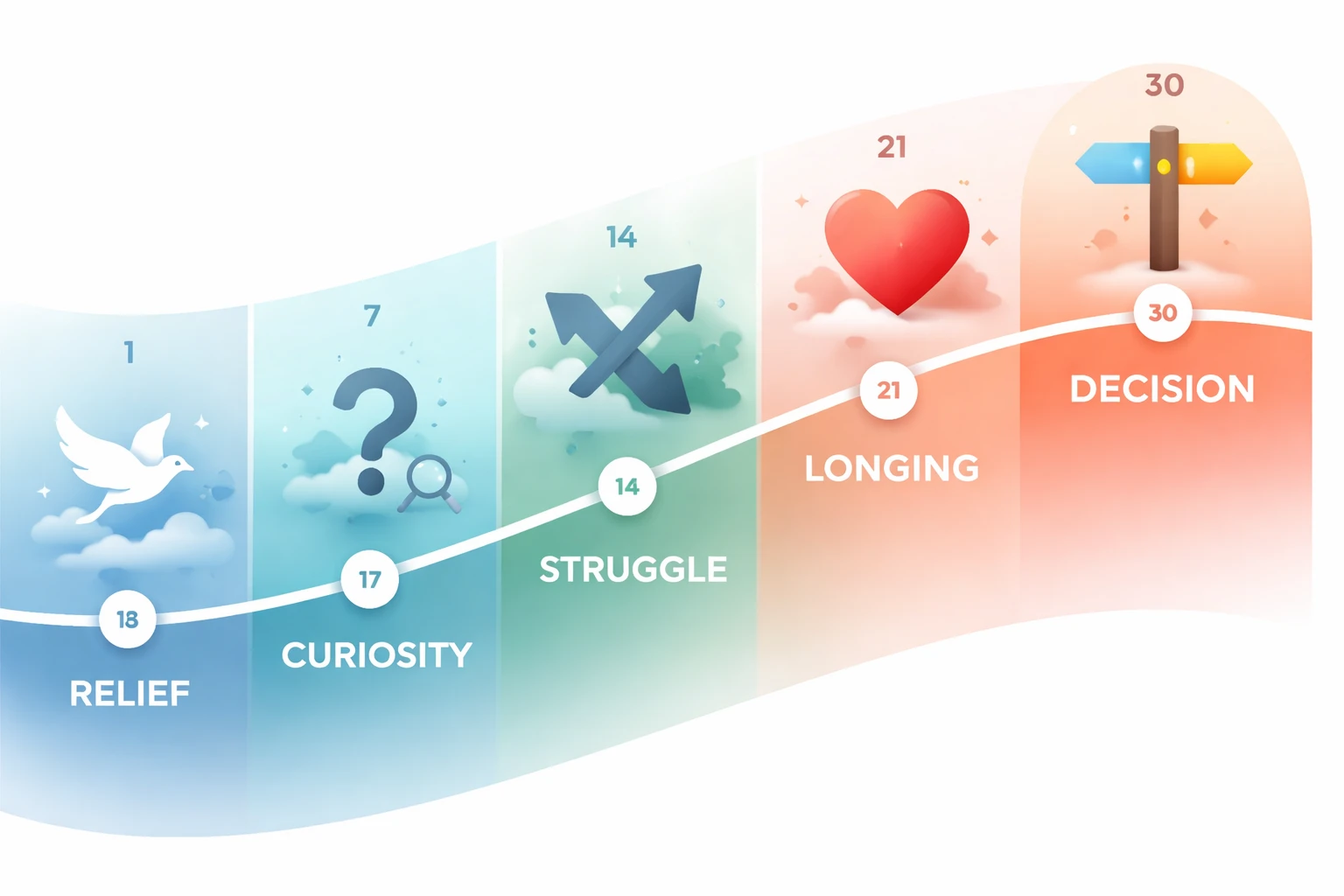
Here's the day-by-day breakdown of the typical male mind during no contact—and what it means for you.
Ready to Start Your No Contact Journey?
Track your progress, get AI coaching when the urge to text hits, and become the strongest version of yourself.
Free to start • No credit card required
Days 1-3: Relief and Breathing Room
What's happening in his head:
The immediate aftermath of a breakup—especially if he initiated it—often brings a surprising emotion: relief.

Day 1:
"I feel... lighter? Maybe this was the right decision. I can finally breathe."
He's validating his choice. The tension of the ending relationship is gone, and that absence of conflict feels like freedom. He might tell friends he's "doing great" or "so much better."
Day 2:
"This is nice. I can do whatever I want. No obligations. No checking in."
He's testing his independence. Maybe he goes out, stays up late, does things you didn't love him doing. He's proving to himself (and maybe others) that he's fine.
Day 3:
"She hasn't texted. That's... good, right? That's what I wanted."
Here's the first crack. He expected you to reach out by now—most people do. Your silence is registering, even if he's dismissing it.
What you should know: This relief phase is real, but it's also shallow. He's not actually processing the breakup yet—he's avoiding it. The feelings will come.
Days 4-7: Starting to Notice the Silence
What's happening in his head:
The initial relief is fading. Your absence is becoming tangible.
Day 4:
"Still nothing from her. Okay. I guess she's really doing this."
He's starting to feel something he can't quite name. It's not sadness yet—more like... disorientation. The rhythm of his days included you, and that rhythm is broken.
Day 5:
"I wonder what she's doing right now. Not that I care. Just curious."
The first real thoughts about you are surfacing. He might check your social media "just to see." He tells himself it means nothing.
Day 6:
"Why hasn't she tried to reach out? Is she really okay with this?"
Your silence is challenging his ego. He expected you to be the one to break. The fact that you haven't is unsettling.
Day 7:
"Maybe I should just check in. Just to make sure she's okay. No, that's stupid. Right?"
One week in, the urge to contact you is real. He might type a message and delete it. He's fighting an internal battle between pride and the growing discomfort of your absence.
What you should know: This is exactly why no contact works. Your silence is creating psychological space he has to fill with his own thoughts about the relationship—thoughts he was avoiding.
You can track each day with NoContact AI to stay accountable during these difficult first weeks.
Week 2 (Days 8-14): Ego vs. Longing
This is when the real internal battle begins.
Day 8-10:
"I'm fine. Totally fine. I just keep... thinking about her for some reason."
The denial phase is cracking. He's noticing how often you cross his mind. Songs remind him of you. Places you went together feel different. He's still telling himself he's fine, but the evidence is mounting.
Day 11-12:
"Okay, I miss her. But I'm not going to be the one to reach out first. If she cared, she would have texted by now."
His ego is constructing a narrative: if you loved him, you'd fight for him. Your silence becomes evidence of your indifference—which, ironically, makes him think about you more.
Day 13-14:
"What if she's already moved on? What if there's someone else?"
Fear enters the picture. The possibility that you're okay without him—that you might be thriving—is deeply unsettling. This isn't about genuine concern for you; it's about his place in your life.
For a deeper dive into male psychology during this phase, understanding attachment styles can help explain why he's reacting the way he is.
Ready to Start Your No Contact Journey?
Track your progress, get AI coaching when the urge to text hits, and become the strongest version of yourself.
Week 3 (Days 15-21): The Peak of Missing You
This is the "sweet spot"—the period when missing you typically peaks.

Day 15-17:
"I can't stop thinking about her. The good times keep replaying in my head."
Nostalgia has arrived in full force. His mind is doing something called "positivity bias"—filtering out the problems and amplifying the good memories. The relationship is being idealized in his memory.
Day 18-19:
"Did I make a mistake? What if I threw away something real?"
Real doubt is setting in. The confident decision he made feels less certain now. He's questioning himself, maybe for the first time.
Day 20-21:
"I need to talk to her. I should reach out. But what would I even say? What if she rejects me?"
This is typically when men are most likely to break and reach out. The combination of missing you, doubting their decision, and fearing they've lost you for good creates a powerful urge to make contact.
Watch for signs he's reaching his breaking point—he might be closer to contacting you than you think.
What you should know: If he reaches out during this window, it's often driven by emotion rather than genuine reflection. That's why many coaches advise responding carefully—he might not have actually processed what went wrong.
Week 4+ (Days 22-30): Decision Time
The intensity of week 3 can't last forever. By week 4, he's arriving at a crossroads.

Day 22-25:
"I've been thinking about what actually happened. Maybe there were problems I didn't want to see."
If he's emotionally mature, real reflection is happening. He's moving past nostalgia into actual analysis. What went wrong? What was his part in it? What would need to change?
Day 26-28:
"I either need to reach out or accept this is over."
The limbo is becoming unbearable. Living in uncertainty is exhausting. He's pushing himself toward a decision.
Day 29-30:
Decision made: Either "I'm going to contact her and see if there's a chance" or "I need to accept this and move forward."
By day 30, most men have arrived at one of two places:
- The reach-out: He's processed enough to know he wants to try, and he makes contact
- The acceptance: He's processed enough to know it's over, and he begins genuinely moving on
What you should know: The decision he makes at this point is more meaningful than an earlier reach-out. He's had time to actually think, not just react emotionally.
Factors That Affect His Daily Thoughts
This day-by-day timeline is typical, but several factors can accelerate or slow the process:
Factors that intensify his experience:
- He initiated the breakup: He may feel guilt on top of everything else
- The relationship was long-term: Deeper attachment means more intense processing
- He has anxious attachment: He'll feel the absence more acutely and sooner
- His life isn't fulfilling independently: Without distractions, he'll dwell more
- Mutual friends keep mentioning you: External reminders accelerate the process
Factors that slow or dampen his experience:
- He has avoidant attachment: He's skilled at suppressing and may take longer to feel
- He's immediately in a rebound: Distraction delays processing (but doesn't eliminate it)
- You initiated the breakup: He may feel justified in moving on
- The breakup was conflict-heavy: Negative emotions can override missing you initially
- He has a busy, fulfilling life: More distractions mean slower emotional processing
His personality matters:
- Emotionally aware men process faster but more intensely
- Suppressive men take longer but often crash harder later
- Men with strong egos struggle more with the blow to their pride
- Men who've been through breakups before may have healthier coping mechanisms
What If He Doesn't Think About You Daily?
Let's be honest: not every man follows this pattern. Some genuinely move on quickly. Some were already emotionally checked out before the breakup. Some have avoidant attachment styles that let them compartmentalize effectively.
Signs he may genuinely not be thinking about you much:
- He was already emotionally distant in the relationship
- He shows no curiosity about your life (even through mutual friends)
- He moves into a new relationship that seems genuinely healthy, not a rebound
- Months pass with zero attempts at contact, even indirect
What this means:
It doesn't mean you weren't worth thinking about. It might mean:
- He processes differently
- He was already done before the actual breakup
- He's very avoidant and suppressing
- The relationship meant something different to him than it did to you
This information isn't meant to hurt you—it's meant to help you calibrate your expectations. Not every no contact period ends with him desperately missing you. And that's okay, because no contact is ultimately about your healing, not his reaction.
The Bottom Line
Here's what you need to remember: while it's natural to wonder what he's thinking, obsessing over his daily thoughts can become its own trap.
The truth is:
- He probably is thinking about you
- But his thoughts don't determine your worth
- His timeline isn't your responsibility
- Your healing shouldn't depend on his process
Use this guide as a general map, not a guarantee. Every person is different. Every relationship is different. And ultimately, what matters most is what's happening in your head—not his.
Focus on your own day-by-day journey. The clearer you become, the less his thoughts will matter. And ironically, that clarity is often what makes people most attractive to those they've lost.
Whether he comes back or not, you're becoming someone who doesn't need him to.
Ready to Start Your No Contact Journey?
Track your progress, get AI coaching when the urge to text hits, and become the strongest version of yourself.
Free to start • No credit card required
Related topics