
You've done the hard part. Weeks—maybe months—of silence. No texts at 2am. No "accidental" likes on their Instagram. No driving past their apartment hoping to catch a glimpse.
But now a different question keeps you up at night: when is it actually time to break no contact?
Here's the uncomfortable truth most articles won't tell you: there's no magic number of days. Thirty days, forty-five days, ninety days—these timeframes are just guidelines. The real answer depends on something much harder to measure: your readiness and theirs.
If you're following the complete no contact rule guide, you already know that silence isn't the goal—it's the tool. The goal is transformation. And knowing when to end that silence is just as important as maintaining it.
Ready to Start Your No Contact Journey?
Track your progress, get AI coaching when the urge to text hits, and become the strongest version of yourself.
Free to start • No credit card required
Let's break down exactly how to know when the time is right.
The Goal of Breaking No Contact
Before we talk about when, let's talk about why. Because breaking no contact with the wrong intention almost guarantees failure.
Breaking no contact is NOT about:
- Testing if they still care
- Relieving your anxiety
- Getting validation
- Proving you've "won"
Breaking no contact IS about:
- Opening a door for potential reconnection
- Demonstrating growth (not just claiming it)
- Starting a completely new dynamic
Think of it this way: you're not picking up where you left off. You're introducing yourself again—the evolved version of yourself—to someone who may or may not be ready to meet that person.
Research on relationship dissolution shows that successful reconnection requires both parties to have processed the original issues. Without that processing, you're just setting up the same failure with a different start date.
Signs You're Ready to Break No Contact
Your internal readiness matters more than any calendar date. Here are the 5 signs that suggest you've done the inner work:

1. You Can Think About Them Without Pain
Not numbness—peace. There's a difference. When you think about your ex, do you feel a stab of longing or a gentle neutrality? Can you recall good memories without spiraling? Can you acknowledge what went wrong without blaming or defending?
If thinking about them still triggers emotional flooding, you're not ready.
2. You've Built a Life You Actually Like
This is crucial. Have you filled the space they left with meaningful activities, connections, and goals? If you're reaching out because your life feels empty without them, that's desperation—not readiness.
True readiness means you want them in your life, but you don't need them.
3. You've Identified Your Contribution to the Breakup
Not just their mistakes—yours. What patterns did you bring? What needs did you expect them to meet that were really your responsibility? This isn't about blame. It's about awareness.
If you're still convinced they were 100% wrong and you were 100% right, you haven't grown enough to create something different.
4. You're Okay With Any Outcome
Here's the hardest test: can you genuinely handle them saying no? Not "I'll deal with it if I have to" but "I'll be genuinely okay either way."
If their response will determine your emotional state for the next month, wait longer.
5. You Have Clarity About What You Want
Not "I miss them" but specific clarity. Do you want:
- A committed relationship?
- To explore if things could work differently?
- Just closure and friendship?
Vague intentions lead to vague conversations that lead to vague situationships. Know what you're walking toward.
Signs They're Ready for Contact
Your readiness is only half the equation. Here's how to gauge theirs (without breaking no contact to find out):
Indirect positive signals:
- They've stopped social media behaviors that seemed designed to provoke you
- Mutual friends mention they've asked about you casually (not obsessively)
- They've shown signs of personal growth in their own life
- Enough time has passed for emotions to settle (usually 6-8 weeks minimum)
You may also notice some of the confirmed signs it worked—like them reaching out through indirect channels or showing up places they know you'll be.
However, be careful not to interpret:
- Silence as "they're definitely thinking about me"
- One social media like as "they want me back"
- Mutual friends' offhand comments as secret messages
The truth is, you can't fully know their readiness without contact. That's why your own readiness is the more important variable—it's the only one you control.
When NOT to Break No Contact
Sometimes the urge to reach out is a red flag in itself. Pause if any of these apply:

Don't break no contact if:
It's a significant date (their birthday, your anniversary, Valentine's Day). These feel meaningful but are actually the worst times. You'll seem calculated, and emotions run high.
You just saw them on social media doing something that triggered you. That's reactivity, not strategy.
You're drunk, lonely, or having a bad day. If you wouldn't send the same message tomorrow morning sober and calm, don't send it tonight.
They're in a new relationship. Respect the boundary. Reaching out now will only push them further away.
You want to "win" the breakup. If your primary motivation is showing them what they lost, you're not ready.
You haven't completed your minimum timeframe. If you committed to 30 days and you're on day 22, wait. The discipline itself is part of the growth.
You broke no contact recently. Each time you restart, the rule loses effectiveness. If you've already broken it once, you need even longer before trying again.
How to Break No Contact the Right Way
So you've checked all the boxes. You're genuinely ready. How do you actually do this?
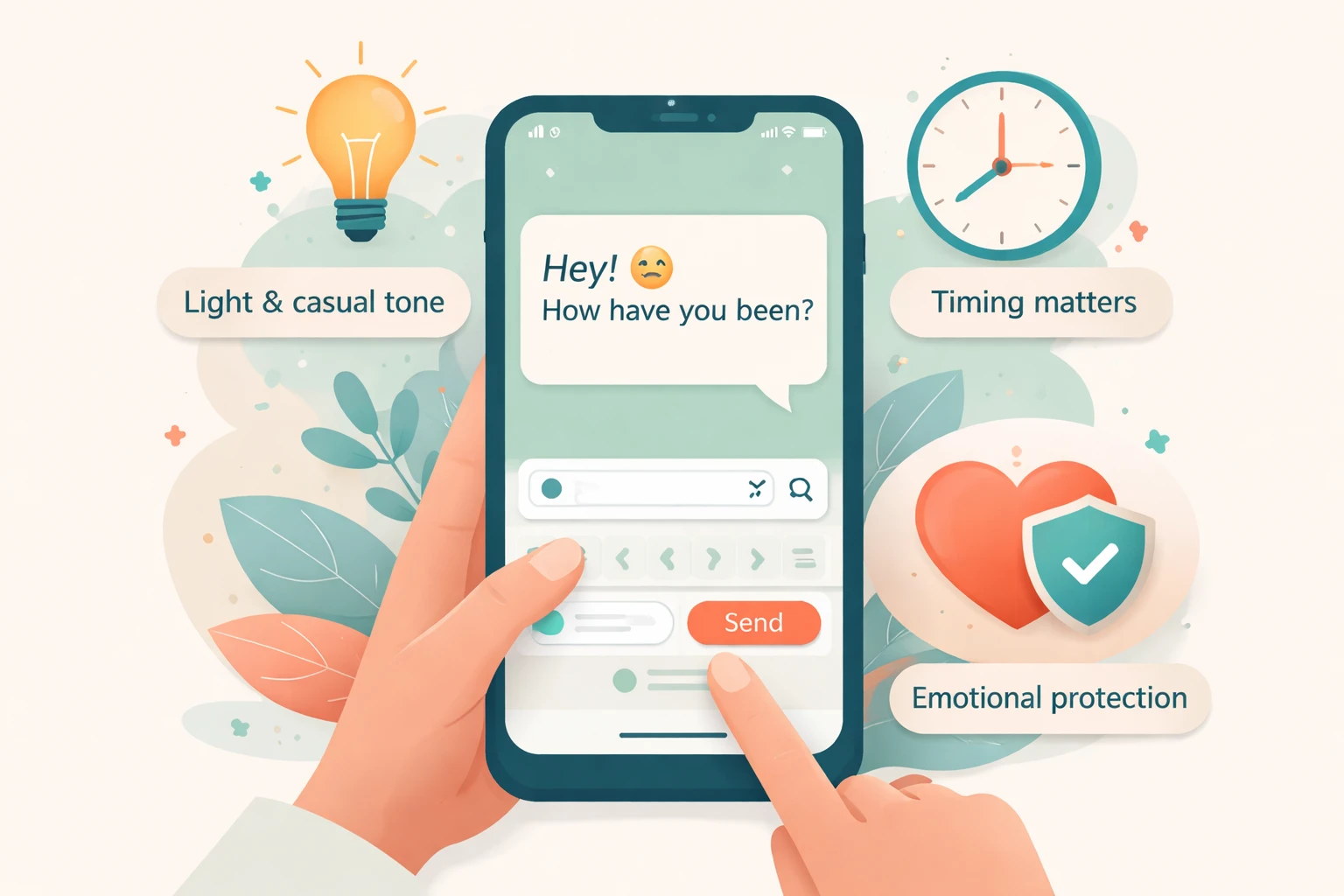
The First Message Formula
Your first contact should be:
Light, not heavy. No "we need to talk" energy. No emotional dumps. Think: opening a door, not storming through it.
Personal, but not desperate. Reference something specific to your relationship—an inside joke, a shared memory, something you genuinely thought of them about.
Low-pressure. Give them an easy out. Don't demand a response or ask for a meetup immediately.
Example messages:
"Just saw [relevant thing] and it made me think of that time we [specific memory]. Hope you're doing well."
"Hey, I know it's been a while. I was thinking about [shared interest] and wondered if you ever [related question]. No pressure to respond, just wanted to say hi."
What NOT to Say
- "I miss you" (too heavy as an opener)
- "Can we talk?" (creates pressure)
- "I've changed" (show, don't tell)
- Anything longer than 2-3 sentences
- Anything that requires explanation
Timing Matters
Send your message at a neutral time—weekday afternoon or early evening. Not late night (looks desperate), not early morning (looks calculated), not Friday/Saturday (they might be busy socializing).
Need help crafting the perfect first message? You can craft your first message with AI help using tools designed specifically for post-breakup communication.
What to Expect After Breaking No Contact
Let's set realistic expectations. Breaking no contact can go several ways:
Best Case
They respond warmly within a day or two. Conversation flows naturally. You eventually meet up and things feel different—better.
Common Case
They respond, but it's cautious. Messages are shorter than you'd like. There's a dance of re-establishing trust. This is actually normal and healthy—it shows they're being thoughtful, not impulsive.
Difficult Case
They don't respond immediately, or they respond briefly and don't continue the conversation. This doesn't necessarily mean it's over forever—but it does mean they need more time or space.
Worst Case
They respond negatively, set a firm boundary, or tell you they've moved on. While painful, this is actually valuable information. Now you can truly move forward.
Important: After sending your first message, give them at least 3-5 days to respond before drawing conclusions. People have lives, and a thoughtful response takes time.
If Breaking No Contact Goes Wrong
Maybe they didn't respond. Maybe they responded coldly. Maybe you made a mistake and broke no contact too early. What now?
First: Don't panic.
One unsuccessful attempt doesn't doom everything. But your response to this moment matters enormously.
Do:
- Return to no contact immediately
- Process your feelings without reaching out again
- Give it significantly more time (2-3 months minimum)
- Focus intensely on your own growth and healing
Don't:
- Send follow-up messages
- Ask mutual friends to intervene
- Post pointed things on social media
- Spiral into self-criticism
Here's a truth that might actually comfort you: the fact that this attempt didn't work might mean the timing wasn't right—not that you weren't right for each other. Some couples need multiple no contact periods before successful reconciliation.
If getting back together is still your goal, you might benefit from reading the full guide to getting back together for a comprehensive strategy.
The Bottom Line
Breaking no contact is a significant moment—but it's just one moment in a much longer process. The pressure you're feeling to get it "perfect" is understandable, but it's also somewhat misplaced.
What matters most is:
- Your genuine growth during the no contact period
- Your emotional readiness to handle any outcome
- Your clarity about what you actually want
- Your respect for their autonomy and timeline
If those four things are in place, the specific message matters less than you think. And if they're not in place, no perfect message will save you.
Trust the process. Trust your growth. And when the time is right—you'll know.
Ready to Start Your No Contact Journey?
Track your progress, get AI coaching when the urge to text hits, and become the strongest version of yourself.
Free to start • No credit card required
Related topics