
He walked away from the relationship looking completely fine. Meanwhile, you have been crying into your pillow for weeks. Now you are wondering: will he ever actually feel this? Does the pain just not register for him?
Here is what the research consistently shows about male breakup behavior patterns: yes, breakups do hit guys later. Often much later. And when it finally hits, it tends to hit hard.
This article explains exactly why this delayed reaction happens, when you can typically expect it, and what signs indicate he is finally starting to feel the weight of losing you.
Ready to Start Your No Contact Journey?
Track your progress, get AI coaching when the urge to text hits, and become the strongest version of yourself.
Free to start • No credit card required
The Short Answer: Yes, Often
Do breakups hit guys later? In most cases, absolutely.
Research from Binghamton University studying over 5,000 people across 96 countries found a consistent pattern: women experience more intense immediate pain after breakups, but they tend to recover more fully over time. Men, on the other hand, often appear fine initially but struggle with complete recovery.
The key finding: men do not skip the pain—they delay it.
While women are crying, talking to friends, and actively processing their grief in the first weeks, men are typically:
- Feeling relieved that relationship tension is over
- Distracting themselves with work, dating, or socializing
- Convincing themselves (and others) that they are fine
- Suppressing emotions to maintain their self-image
This creates a false impression that men "get over breakups faster." In reality, they are just getting to the starting line later.
Why Men Delay Processing Breakups
The delayed impact is not random—it stems from specific psychological and social factors.
Social Conditioning Against Vulnerability
From childhood, men receive messages that emotional expression equals weakness. Phrases like "man up" and "boys do not cry" become internalized beliefs that make processing grief feel shameful.
After a breakup, this conditioning activates. Rather than facing painful emotions, many men instinctively suppress them to maintain their sense of strength and control.
Distraction as Default Coping
Men are more likely to use "avoidant coping"—strategies that keep emotions at bay rather than processing them. Common distractions include:
- Throwing themselves into work
- Hitting the gym obsessively
- Rebound dating for validation
- Going out and partying more
- Picking up new hobbies or projects
These activities are not inherently unhealthy, but when used to avoid emotional processing, they simply postpone the inevitable.
Fewer Emotional Support Networks
A 2024 study in Behavioral & Brain Sciences revealed that men typically rely more heavily on romantic partners for emotional intimacy than women do. Women usually have broader support networks—close friends, family members, therapists—they feel comfortable being vulnerable with.
When a relationship ends, men lose their primary emotional outlet. Without alternative support systems, processing becomes much harder.
The "Winning the Breakup" Mentality
Many men feel pressure to appear like they are handling the breakup better than their ex. Looking unbothered becomes a goal in itself, even if it requires suppressing genuine feelings.
This performance can be convincing—both to others and to themselves—until reality eventually breaks through.
The Timeline of Male Delayed Reaction
While every individual is different, research suggests a general timeline for when breakups typically hit guys later.
Week 1-2: Relief Phase
- Immediate relief from relationship stress
- Apparent calm or even happiness
- Minimal emotional processing
- "I'm fine" becomes the default response
Week 3 to Month 2: Distraction Phase
- Active avoidance through busy schedules
- Possible rebound dating
- Social media performance of "living his best life"
- Emotions kept firmly at bay
Month 2-4: The Crash
- Distractions stop being effective
- Reality of the loss becomes undeniable
- Intense emotions surface—sadness, regret, loneliness
- May reach out unexpectedly
Month 4+: Processing or Prolonged Struggle
- Either begins genuine emotional work
- Or continues avoiding, carrying unresolved feelings
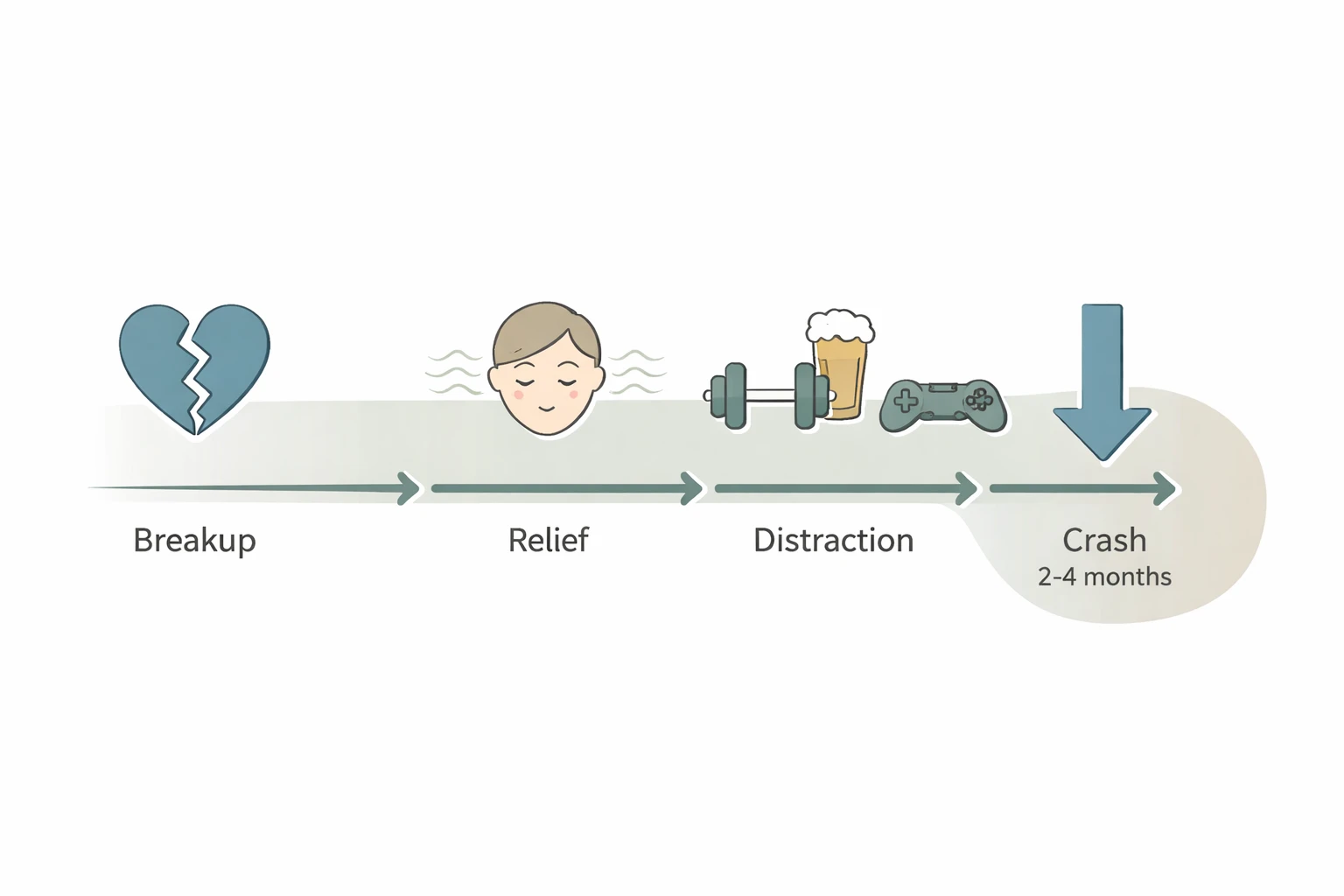
You can monitor the timeline with our app to track behavioral patterns and understand where he might be in this process.
What Triggers the Delayed Hit
The crash does not happen randomly. Specific triggers often break through the emotional walls men build after breakups.
Trigger 1: The Rebound Fails
When a rebound relationship ends—or reveals itself as emotionally empty—the distraction disappears. The original grief, still unprocessed, comes flooding back.
Many men report feeling even worse after a failed rebound because they now face the original loss plus the additional disappointment.
Trigger 2: Seeing You Move On
Nothing shatters the "I'm fine" narrative like seeing you thriving—especially if you start dating someone new. Your happiness challenges his assumption that he "won" the breakup and forces him to confront what he actually lost.
Trigger 3: Meaningful Dates and Memories
- Your birthday
- Anniversaries
- Holidays you spent together
- Visiting places you used to go
- Hearing "your song"
These triggers are unavoidable. Each one chips away at the emotional suppression until it cannot hold.
Trigger 4: Late Night Loneliness
When the busy schedule stops and he is alone with his thoughts—usually late at night—suppressed emotions surface. The 2am drunk text is a cliché for a reason.
Trigger 5: Life Changes and Stress
Major life events—job changes, moving, family issues—often trigger emotional vulnerability. When defenses are down, the delayed grief finds an opening.

Ready to Start Your No Contact Journey?
Track your progress, get AI coaching when the urge to text hits, and become the strongest version of yourself.
Signs He is Starting to Feel It
How do you know when the breakup is finally hitting him? Look for these behavioral shifts:
Communication Changes
- Reaches out with random or unnecessary messages
- Responds faster or more enthusiastically to your texts
- Brings up shared memories or inside jokes
- Asks how you are doing with genuine interest
Social Media Behavior
- Watches all your stories (especially late at night)
- Likes old photos or posts about you
- Posts less "living my best life" content
- Becomes quieter online overall
Through Mutual Friends
- Asks about you
- Talks about the relationship or mentions regrets
- Seems down or withdrawn in ways he was not before
- Admits he has been thinking about you
Direct Signs
- Admits he misses you or made a mistake
- Gets emotional when discussing the relationship
- Tries to see you in person
- Shows interest in reconciliation
For a deeper dive, read about when men start missing you and the specific patterns to watch for.
What This Means for No Contact
Understanding the delayed impact has strategic implications if you are implementing no contact.
Why No Contact Works With Delayed Processing
The strategic use of no contact becomes even more powerful when you understand male timing. Here is why:
During his relief/distraction phase (weeks 1-6):
- Your absence may not register strongly
- He is busy with distractions anyway
- No contact prevents you from seeming desperate
During his crash phase (months 2-4):
- Your absence becomes very noticeable
- He cannot use you for emotional comfort
- He has to sit with his feelings alone
- Missing you intensifies without contact
The key insight: no contact is not about making him miss you immediately. It is about being absent when the delayed impact finally hits.
Common Mistakes
- Breaking no contact too early: His relief phase behavior is not his real emotional state. Reaching out during weeks 1-4 often backfires.
- Assuming he does not care: Early indifference is usually suppression, not genuine lack of feeling.
- Timing reconciliation attempts wrong: The crash phase (months 2-4) is when he is most emotionally open, but also most vulnerable. Proceed thoughtfully.
Will He Reach Out When It Hits?
This is the question everyone wants answered: when the breakup finally hits him, will he contact you?
Factors That Increase Likelihood
- He was emotionally invested in the relationship
- The breakup was not caused by major incompatibility
- He has a history of reaching out to exes
- You are maintaining some social media presence
- He has secure or anxious attachment style
Factors That Decrease Likelihood
- Strong pride or ego investment
- Avoidant attachment style
- He ended the relationship and fears rejection
- Too much time has passed (6+ months)
- He has started a serious new relationship
What Reaching Out Usually Looks Like
When men do reach out after the delayed hit, it often comes in indirect forms first:
- Liking or reacting to your social media
- "Accidental" contact (sending something to wrong person, etc.)
- Asking mutual friends about you
- Finding excuses to message (returning items, asking questions)
- Direct but casual messages ("just thinking about you")
Only after testing the waters do most men move to more direct expressions of wanting to reconnect.
Understanding that breakups hit guys later provides crucial perspective. His apparent indifference in the early weeks says nothing about whether he cared or whether he will eventually miss you. It simply reflects how men are conditioned to handle emotional pain.
Whether you are hoping for reconciliation or simply seeking validation that the relationship mattered, know this: the calm exterior rarely lasts. When it breaks, all those suppressed feelings come due—often with interest.
Ready to Start Your No Contact Journey?
Track your progress, get AI coaching when the urge to text hits, and become the strongest version of yourself.
Free to start • No credit card required
Related topics