

He went from texting you good morning every day to complete radio silence. Or maybe he is already posting pictures with someone new while you are still struggling to get out of bed. His behavior seems impossible to decode—cold one moment, then liking your old photos at 2am.
If you are trying to understand male behavior after breakup, you are not alone. The way men process the end of a relationship often looks completely different from how women handle it. But here is the thing: different does not mean easier. And that emotionless exterior? It is rarely the full story.
Whether you want closure, hope to reconnect, or simply need to understand what is happening in his head, this guide breaks down the psychology behind how men really behave after a breakup—and what those behaviors actually mean. You can also use our no contact app to get personalized insights and support based on your specific situation.
Download No Contact AI
No contact day counter, private journal, and chat support to get through a breakup.
Download the app
Scan with your phone
Automatic redirect to iOS or Android
How Men Process Breakups Differently
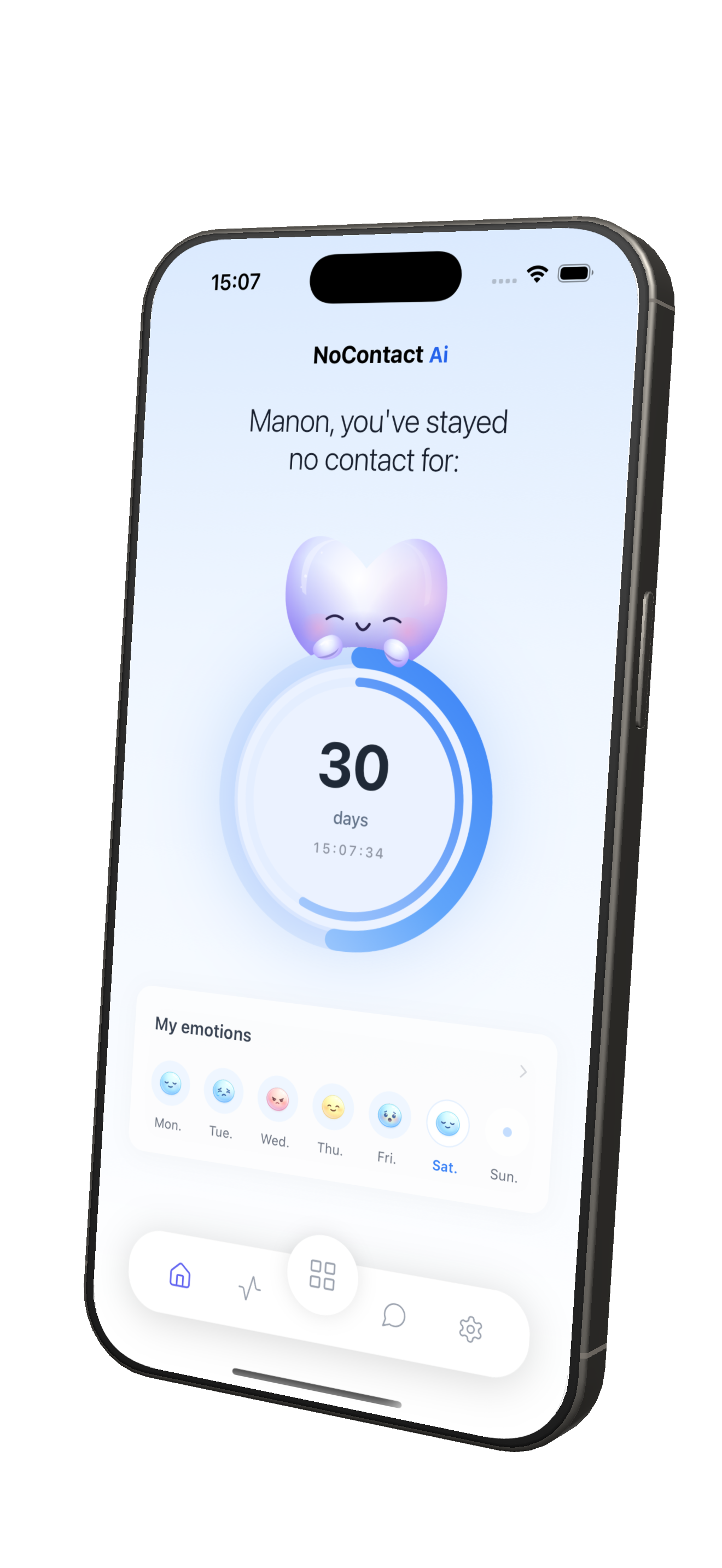
Let us address the elephant in the room: no, men do not "get over it faster." Research from Binghamton University surveying over 5,000 people across 96 countries found that while women report higher immediate emotional pain after breakups, men struggle significantly more with long-term recovery.
The difference is not in the depth of feeling—it is in the expression and processing.
Women tend to:
- Seek social support immediately
- Process emotions verbally with friends and family
- Experience intense pain early, then gradually heal
- Build emotional resilience through connection
Men typically:
- Suppress emotions to appear "strong"
- Avoid discussing feelings due to social stigma
- Distract themselves through work, dating, or activities
- Experience delayed but prolonged emotional impact
A 2024 study published in Behavioral & Brain Sciences revealed something surprising: romantic relationships are actually more central to men's emotional wellbeing than women's. Men are less likely to cultivate emotionally supportive friendships outside their romantic partnerships, making breakups hit harder in ways that are not immediately visible.
The Typical Male Breakup Timeline
Understanding the stages men go through after breakup helps decode behavior that might otherwise seem confusing or hurtful.
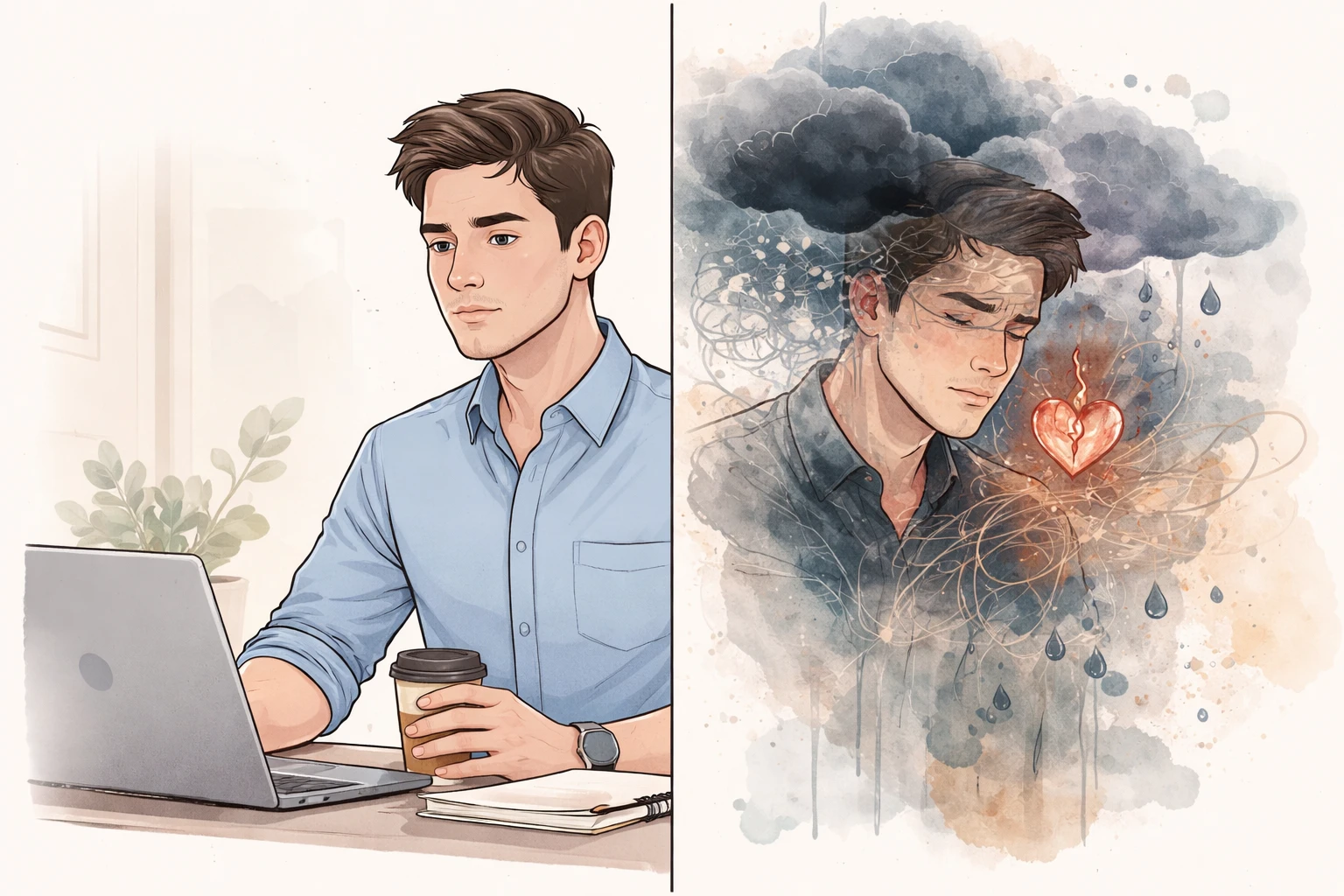
Week 1-2: The Relief Phase
Immediately post-breakup, many men experience what researchers call a "liberation effect." This is not genuine happiness—it is the sudden release of relationship tension and conflict. During this phase, he might:
- Seem unusually cheerful or carefree
- Go out more with friends
- Post actively on social media
- Appear to have moved on instantly
What it actually means: He is riding an adrenaline wave of newfound "freedom." The real emotional processing has not started yet.
Week 3-6: The Distraction Phase
This is when classic male coping mechanisms kick in:
- Throwing himself into work or gym
- Jumping into rebound dating
- Picking up new hobbies or old vices
- Maintaining a "winning the breakup" image
What it actually means: He is actively avoiding his emotions. Every distraction is a shield against feelings he does not want to face.
Month 2-4: The Reality Phase
Research indicates that men often hit their emotional low point 2-4 months after a breakup. This is when:
- The distractions stop working
- Loneliness becomes undeniable
- Memories resurface unexpectedly
- Regret and "what ifs" take over
What it actually means: The breakup is finally sinking in. He is experiencing what you felt in week one—just delayed.
Month 4+: The Processing Phase
How he handles this phase determines his long-term recovery:
- Some finally seek support and process emotions
- Others continue suppressing, carrying baggage into future relationships
- Many experience waves of wanting to reach out
Common Male Behaviors After a Breakup
Let us break down the specific behaviors you are probably noticing—and what psychology tells us they really mean.
1. The Cold Shoulder
He acts like you never existed. No contact, no acknowledgment, complete emotional shutdown.
The psychology: This is classic emotional suppression. A study from the Journal of Youth and Adolescence found that social withdrawal after separation is particularly common among men as a way to manage overwhelming emotions. He is not feeling nothing—he is feeling too much to handle.
2. The Rebound Speedrun
He is dating someone new within days or weeks.
The psychology: Relationship expert Emily Holmes Hahn explains this is about external validation: "The rebound helps him signal to the world and himself that 'I am okay,' 'I am strong,' and 'I did not let my feelings get the best of me.'" The faster the rebound, often the deeper the pain he is avoiding.
3. The Social Media Performance
Suddenly his Instagram is full of "living my best life" content.
The psychology: This ties into the "winning the breakup" mentality. He is curating an image of success and happiness—often specifically for you to see. Increased social media activity post-breakup is a documented form of self-soothing through external attention.
4. The Hot and Cold Treatment
One day he is reaching out, the next he is ignoring you completely.
The psychology: This reflects genuine internal conflict. He misses you but fears vulnerability. He wants connection but values his pride. Each hot moment is him giving in to emotion; each cold spell is him reasserting control.
5. The Anger and Blame
He becomes hostile, critical, or positions himself as the victim.
The psychology: The Binghamton study found men report more feelings of anger post-breakup and engage in more self-destructive behaviors. Anger is often a "safer" emotion for men to express than sadness or longing.
Download No Contact AI
No contact day counter, private journal, and chat support to get through a breakup.
Download the app
Scan with your phone
Automatic redirect to iOS or Android
Why Men Seem to "Move On" Faster
Here is the truth that research consistently confirms: they do not. The appearance of quick recovery is largely performance.
The Illusion of Speed
When a man immediately starts dating, goes out constantly, or seems unbothered, he is typically engaging in what psychologists call "avoidant coping." He is not processing the breakup—he is postponing it.
Women, by contrast, tend to practice "approach coping"—actively confronting and working through difficult emotions. This looks messier in the short term but leads to more complete healing.
The Statistics Tell a Different Story
- Men are less likely to initiate breakups (approximately 70% of divorces are initiated by women)
- Men report lower life satisfaction when single
- Men are more likely to experience prolonged loneliness after breakups
- Men discuss heartbreak significantly more than women on anonymous forums
That last point is telling. When men can be anonymous—removed from social expectations—they reveal the emotional depth they hide in person.
The Delayed Breakup Effect in Men
One of the most consistent findings in breakup research is that men experience the delayed breakup effect. But why does this happen?
Emotional Suppression Backfires
When emotions are suppressed rather than processed, they do not disappear—they accumulate. Every avoided feeling becomes psychological debt that eventually comes due.
The man who seemed fine at week two often crashes at month three when:
- A song triggers a memory
- He sees you moving on
- The rebound fails
- A holiday or anniversary arrives
- He faces being alone with his thoughts
Fewer Support Systems
Women typically have broader emotional support networks—close friends, family members, therapists—they feel comfortable being vulnerable with. Men often rely primarily on their romantic partner for emotional intimacy.
When that partnership ends, men lose their primary (sometimes only) emotional outlet. Processing alone takes longer and often feels impossible.
Social Conditioning
From childhood, men receive messages that emotional expression equals weakness. This conditioning does not disappear during a breakup—it intensifies. The pressure to appear unaffected delays authentic emotional processing.
Male Behavior Based on Who Initiated
How he acts depends significantly on whether he ended things or you did.
If He Was the Dumper
Initial phase: Relief, confidence in his decision, possibly excitement about freedom.
Later phase: Doubt creeps in. Was he wrong? Did he give up too easily? Seeing you move on or thrive often triggers regret.
Common behaviors:
- Checking your social media frequently
- Reaching out with "just checking in" messages
- Getting upset if you start dating someone new
- Romanticizing the relationship in hindsight
If He Was the Dumpee
Initial phase: Shock, denial, possibly desperate attempts to reconcile.
Later phase: The processing journey depends heavily on his attachment style. He may cycle through anger, bargaining, and sadness before reaching acceptance.
Common behaviors:
- Withdrawal and isolation
- Trying to "win you back" initially
- Eventually, anger or bitterness as a protective mechanism
- Taking longer to open up in future relationships

What His Behavior Actually Means
Let us decode some specific scenarios:
"He said he needs space but keeps watching my stories"
Translation: He wants distance from the relationship but is not ready to lose you completely. He is keeping tabs while protecting himself from full engagement.
"He is already in a new relationship but it seems so fast"
Translation: Speed often indicates avoidance, not genuine connection. Rebound relationships serve as emotional band-aids, not replacements.
"He acts fine but his friends told me he is struggling"
Translation: What he shows the world—especially you—is curated. What he reveals to close friends or in private moments is closer to reality.
"He got angry when I started moving on"
Translation: He was not prepared for you to heal faster than him. Your progress threatens his narrative and forces him to confront his own unresolved feelings.
"He reaches out when he is drunk"
Translation: Alcohol lowers inhibitions, including emotional walls. Drunk texts reveal what sober pride suppresses.
Will He Come Back? Behavior Indicators
While no behavior guarantees reconciliation, certain patterns suggest he is not as "over it" as he appears:
Signs he is still emotionally invested:
- Maintains contact (even if inconsistent)
- Gets jealous or upset about your dating life
- Keeps mutual friends updated on his life
- Has not returned your belongings (or keeps asking for his)
- References shared memories or inside jokes
- Checks in during meaningful dates (birthdays, anniversaries)
Signs he may be moving toward reaching out:
- Increases social media interaction with your content
- Finds excuses to contact you (questions, "reminders")
- Shows up in places he knows you will be
- Asks mutual friends about you
Understanding how men respond to no contact can also help you predict his next moves.
FAQ: Understanding Male Breakup Behavior
Do men hurt after breakups?
Absolutely. Research consistently shows men experience equal or greater emotional pain than women after breakups—they just express it differently. The suppression of this pain often leads to longer recovery times and unresolved emotional issues.
Why do guys act like they do not care?
Social conditioning teaches men that emotional vulnerability is weakness. Acting unbothered is a defense mechanism, not an accurate reflection of internal experience. The more a man insists he is "fine," the more likely he is struggling.
How long until a man feels the breakup?
While individual timelines vary, research suggests men typically hit their emotional low point 2-4 months after a breakup. The initial "relief phase" usually lasts 2-6 weeks before reality sets in.
Do men move on faster than women?
No. They appear to move on faster due to avoidant coping mechanisms (rebounds, distraction, suppression), but research shows men often take longer to fully recover and are more likely to carry unresolved baggage into future relationships.
Why does he seem happier without me?
What you see publicly is rarely the full picture. Post-breakup social media activity and social behavior are often performances designed to project success. Private moments—late nights, quiet mornings—tell a different story.
Will he regret the breakup?
Most people experience some regret after ending a significant relationship, especially once the initial relief fades. Whether he acts on that regret depends on his emotional maturity, pride, and circumstances.
Understanding male behavior after breakup does not mean excusing hurtful actions or waiting around indefinitely. It means recognizing that his confusing behavior usually stems from his own pain and limitations—not your worth.
Whether you are hoping for reconciliation or simply seeking closure, the most powerful thing you can do is focus on your own healing. His journey is his to walk. Yours is about becoming the strongest, most fulfilled version of yourself—regardless of what he does next.
Download No Contact AI
No contact day counter, private journal, and chat support to get through a breakup.
Download the app
Scan with your phone
Automatic redirect to iOS or Android