
Three months since the breakup. Radio silence. Your avoidant ex seems to have moved on completely, showing no signs of looking back. Meanwhile, you are left wondering: will they ever return, or should you accept that this is truly over?
Here is the truth that might surprise you: avoidant exes are actually more likely to come back than other attachment types. But—and this is crucial—their return follows a different timeline and reveals itself through subtle signs that most people miss entirely.
Ready to Start Your No Contact Journey?
Track your progress, get AI coaching when the urge to text hits, and become the strongest version of yourself.
Free to start • No credit card required
Understanding avoidant breakup psychology is essential for interpreting what is happening behind their silence. This article will show you the specific signs an avoidant will come back, the typical timeline for their return, and help you decide whether waiting is wise.
Do Avoidants Ever Come Back?
Let us address the core question directly: yes, avoidants often come back. But they do so on their own terms and timeline.
Research shows that avoidants want connection just as much as anyone else—sometimes more, because they have spent their lives protecting themselves from it. Their departure was not about lacking feelings. It was about feeling too much and needing distance to regulate.
What makes avoidants likely to return:
- They genuinely connected with you
- They feel safer once the relationship pressure lifts
- Their emotions catch up with them after initial relief fades
- They realize what they lost when it is no longer available
What makes avoidants stay gone:
- They feel you are still pursuing them
- They perceive anger or blame from you
- They entered a new relationship during the distance
- The relationship had significant unresolved conflict
The key insight: an avoidant's silence does not necessarily mean they do not care. It often means they are processing in the only way they know how—alone.
Sign 1: They Have Not Fully Blocked You
An avoidant who is completely done will cut ties cleanly. Blocking, deleting, removing all traces—avoidants are experts at emotional cutoff when they truly want to move on.
So pay attention if they have not:
- They keep you on social media
- Your number remains unblocked
- Your photos together are still visible
- Shared playlists, cloud access, or accounts remain connected
This maintained access is not accidental. Avoidants are deliberate about their boundaries. If they wanted you completely gone, you would be completely gone.
What this means: They are keeping a door open, even if unconsciously. They want the option of connection to exist, even while maintaining distance.
Important note: Do not mistake "not blocked" for "coming back soon." This sign indicates possibility, not certainty or timeline. Many avoidants maintain these connections for months or years without acting on them.
Sign 2: They Check Your Social Media
Avoidants who are moving on do not monitor their ex. They genuinely detach and redirect their attention elsewhere. But an avoidant with lingering feelings will watch from the digital shadows.
Signs they are watching:
- They view your stories (even if quickly or inconsistently)
- They like or react to posts, especially older or less visible ones
- Mutual friends mention they asked about you
- They post content that seems directed at you
- Their posting patterns change after you post something significant
This behavior reveals investment they are not ready to express directly. An avoidant who truly moved on would not waste emotional energy tracking your life. Their attention—even silent attention—is meaningful.
Caveat: Some avoidants check social media out of habit or curiosity rather than genuine interest in reconciliation. Look for patterns over time rather than isolated instances.
Sign 3: They Reach Out Periodically
The avoidant reach-out is rarely dramatic. No grand declarations, no lengthy messages about missing you. Instead, it looks like:
- A text about something trivial ("Did you ever watch that show we talked about?")
- Reacting to something you posted with a direct message
- Forwarding a meme, article, or video "that reminded them of you"
- Questions that do not really need to be asked
- Holiday or birthday messages that feel slightly more personal than necessary
These breadcrumbs might frustrate you—they are not the emotional honesty you want. But for an avoidant, these small reaches represent significant vulnerability. They are testing whether you are still receptive, whether the door remains open, whether connection is safe.
What this means: They are thinking about you and cannot fully resist acting on it, even if they cannot bring themselves to be direct about their feelings.
How to respond: Warm but not desperate. Match their energy without overwhelming them. A brief, positive response keeps the door open without triggering their avoidance.
Sign 4: They Get Nostalgic
When an avoidant starts mentioning memories from your relationship, pay close attention. Nostalgia is significant for someone whose default is emotional suppression.
Signs of nostalgia:
- Bringing up inside jokes or shared experiences
- Mentioning places you went together
- Referencing songs, movies, or shows from your relationship
- Saying things like "Remember when we..." unprompted
- Expressing that certain things remind them of you
This nostalgia indicates that their emotional processing has begun. The relief phase has passed, and they are now confronting what they lost. When an avoidant allows themselves to remember—and shares those memories with you—they are revealing attachment they cannot easily dismiss.
The phantom ex phenomenon: Research shows avoidants often idealize past relationships once safe emotional distance exists. Your relationship may be becoming a "phantom ex"—an idealized memory they compare future partners against. While this can fuel their return, be aware it may represent fantasy rather than readiness for real reconciliation.
Sign 5: They Are Not in a New Relationship
If your avoidant ex quickly entered a new relationship, their return becomes significantly less likely—at least in the short term. Avoidants often rebound to avoid processing the breakup, and they may stay in that new relationship for an extended period.
However, if they remain single:
- They have space to process their feelings about you
- They are not using someone new to suppress missing you
- Their eventual return becomes more plausible
What single means for avoidants: Avoidants are comfortable alone. Being single does not distress them the way it might distress someone with anxious attachment. So their continued singleness does not guarantee they are pining for you. But it does mean you are not competing with a new attachment for their emotional attention.
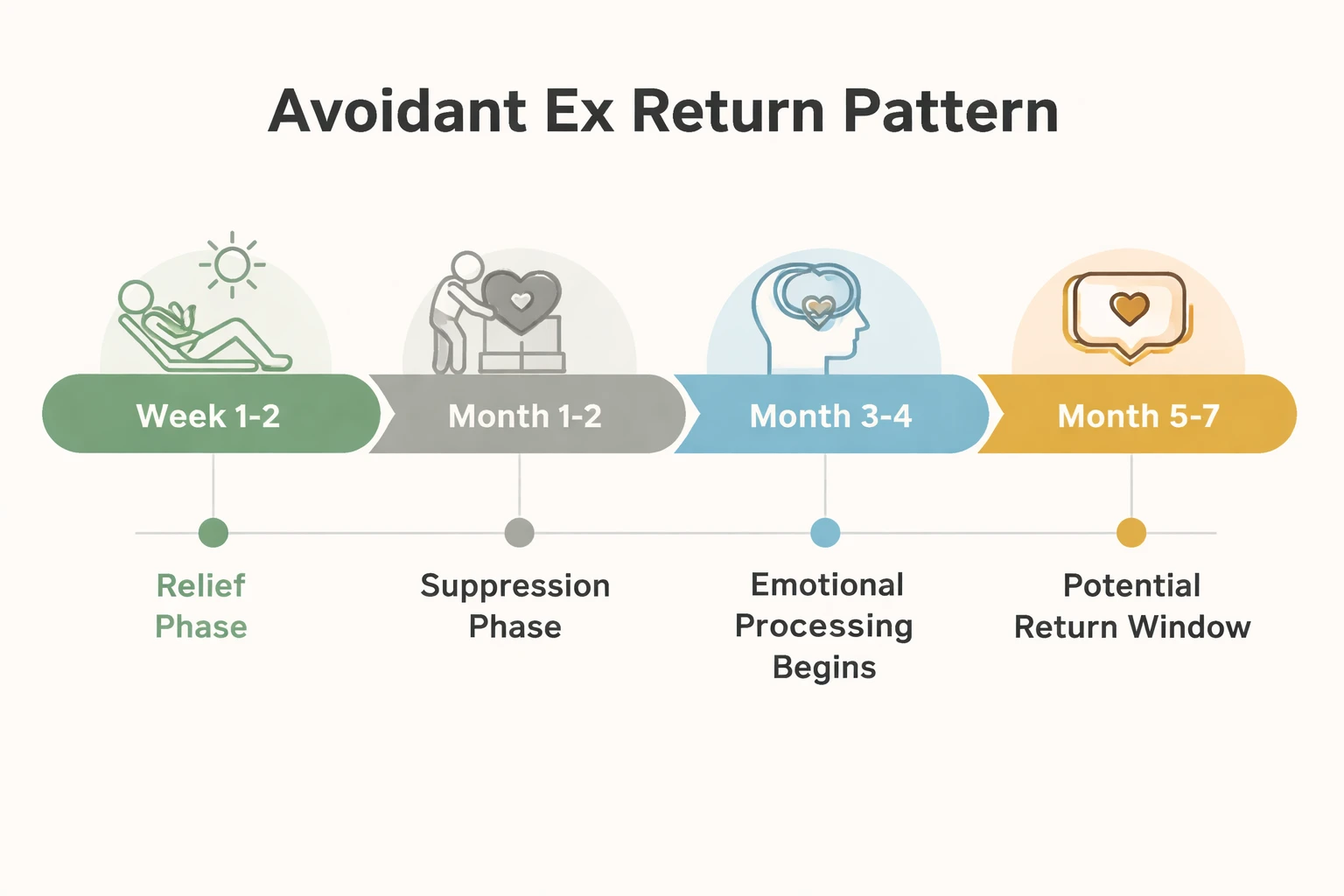
The Avoidant Return Timeline
Understanding when avoidants typically return can save you months of anxious waiting and misinterpreted signals.
Dismissive Avoidant Timeline
- Weeks 1-4: Relief phase. They feel free and may seem completely fine. Minimal to no contact.
- Months 1-2: Suppression phase. Keeping busy, avoiding emotional processing. May seem like they have moved on entirely.
- Months 2-4: Feelings begin surfacing. May experience unexpected sadness, longing, or regret. Still unlikely to reach out directly.
- Months 4-7: Potential return window. If they are going to come back, this is often when it begins. Subtle reaches, increased social media engagement.
- Month 8+: Either they initiate clear reconnection or the window begins closing.
Fearful Avoidant Timeline
Fearful avoidants often move faster because they experience both avoidance AND anxiety:
- Weeks 1-3: Immediate relief mixed with anxiety. May reach out impulsively then withdraw.
- Months 1-3: Critical window. If reconnection does not happen here, they may move on emotionally or start dating others.
- Months 3-6: Secondary window. If they stayed single and did not reconnect in the first phase, this becomes another possibility.
- Month 6+: Chances decrease significantly unless they have done substantial personal work.
Important: These timelines are averages, not guarantees. Some avoidants return after years. Others never do. Use this as a general guide, not a countdown.
What Triggers an Avoidant to Come Back
Understanding triggers can help you avoid accidentally pushing them away—and recognize when their walls might be lowering.
Internal Triggers
- Loneliness hits: Eventually, avoidants feel the absence. Their independence starts feeling like isolation.
- Failed rebound: If they dated someone new and it did not work, they may reassess what they lost.
- Personal growth: Therapy, self-reflection, or life changes can make them reconsider past patterns.
- Stress or crisis: Difficult times sometimes make avoidants reach for familiar comfort.
External Triggers
- Your apparent moving on: Seeing you thriving without them can trigger loss realization.
- Significant time passing: Distance allows their nervous system to calm and feelings to surface.
- Mutual connections: Hearing about you through friends keeps you present in their mind.
- Life milestones: Birthdays, holidays, anniversaries often trigger nostalgic reaching out.
What Using No Contact with Avoidants Does
No contact is particularly effective with avoidants because:
- It gives them the space they crave
- It prevents your pursuit from triggering their avoidance
- It allows their emotions to catch up without pressure
- It creates the conditions where they can choose to return
The worst thing you can do is chase an avoidant. Every pursuit deepens their withdrawal. Space—real, sustained space—is what allows return to become possible.

Should You Wait or Move On?
This is the question beneath all the others: is waiting for an avoidant worth it?
Questions to Ask Yourself
About them:
- Have they shown capacity for emotional growth during the relationship?
- Are they in therapy or actively working on their attachment patterns?
- When they did show up emotionally, was it meaningful?
- Did they take responsibility for their part in problems?
About yourself:
- Can you wait without putting your life on hold?
- Are you waiting from hope or from fear of moving on?
- Would you be happy in a relationship that requires this much patience?
- Are your needs being met by someone who may never fully meet them?
The Healthy Approach to Waiting
If you choose to remain open to their return:
Do:
- Focus on your own healing and growth
- Date others if you want to
- Set a mental timeline for how long you will wait
- Use the time to process the waiting period productively
- Evaluate whether they are actually changing, not just reaching out
Do Not:
- Put your life on hold
- Obsess over interpreting their every move
- Respond immediately to every breadcrumb
- Sacrifice your self-respect for crumbs of connection
- Wait indefinitely without progress
When to Stop Waiting
Consider moving on if:
- More than a year has passed with no meaningful progress
- They have entered a serious new relationship
- Their reaching out is inconsistent and never deepens
- You realize you deserve more than someone can offer
- Waiting is causing more pain than hope
The Honest Conclusion
Signs an avoidant will come back exist, and many avoidants do return. But here is the truth you need to hear: their return does not guarantee a different outcome.
An avoidant can come back and still:
- Struggle with the same patterns
- Withdraw again when intimacy increases
- Leave you feeling the same confusion and pain
If they have not done real internal work—therapy, self-reflection, genuine behavioral change—their return may simply restart the same cycle.
You deserve more than waiting for someone who might come back. You deserve someone who stays. Whether that person is your avoidant ex transformed by growth, or someone entirely new, is something only time will reveal.
For those considering whether to actively try to get them back, remember: the best approach attracts rather than pursues. Become the person who thrives regardless—and let them choose whether they want to be part of that thriving life.
Ready to Start Your No Contact Journey?
Track your progress, get AI coaching when the urge to text hits, and become the strongest version of yourself.
Free to start • No credit card required
Related topics