


I miss my ex. Four words that feel like they weigh a thousand pounds. You wake up reaching for someone who is not there. You pick up your phone to text them before remembering you cannot. A song comes on, a scent drifts by, and suddenly you are right back in the wreckage, gasping for air.
If you are reading this, you are in pain. Real, consuming, I-cannot-think-about-anything-else pain. And I want you to know something before we go any further: what you are feeling is not weakness. It is not being dramatic. It is your brain responding to the loss of a deep human bond in exactly the way it was designed to. In our complete guide to getting over a breakup, we cover the full recovery journey. Here, we are going to dive into the heart of what missing your ex really is, why it hurts so much, and the exact steps to move through it.
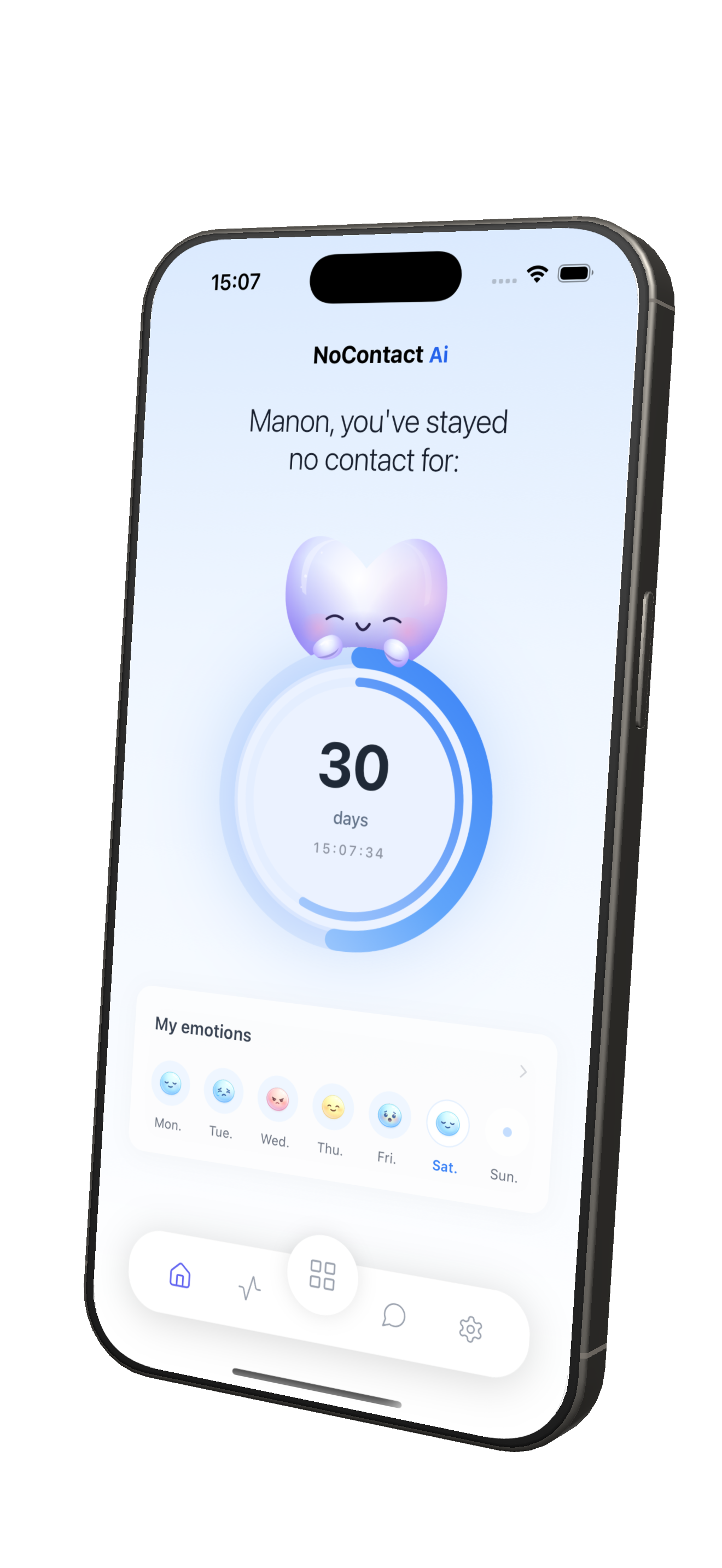
Download No Contact AI
No contact day counter, private journal, and chat support to get through a breakup.
Download the app
Scan with your phone
Automatic redirect to iOS or Android
Why You Miss Your Ex So Much: What the Science Says
You are probably asking yourself why this feels so unbearable. Why you cannot stop thinking about them even when you know, logically, that the relationship was not perfect. The answer is not in your heart. It is in your brain.
Your brain is going through withdrawal
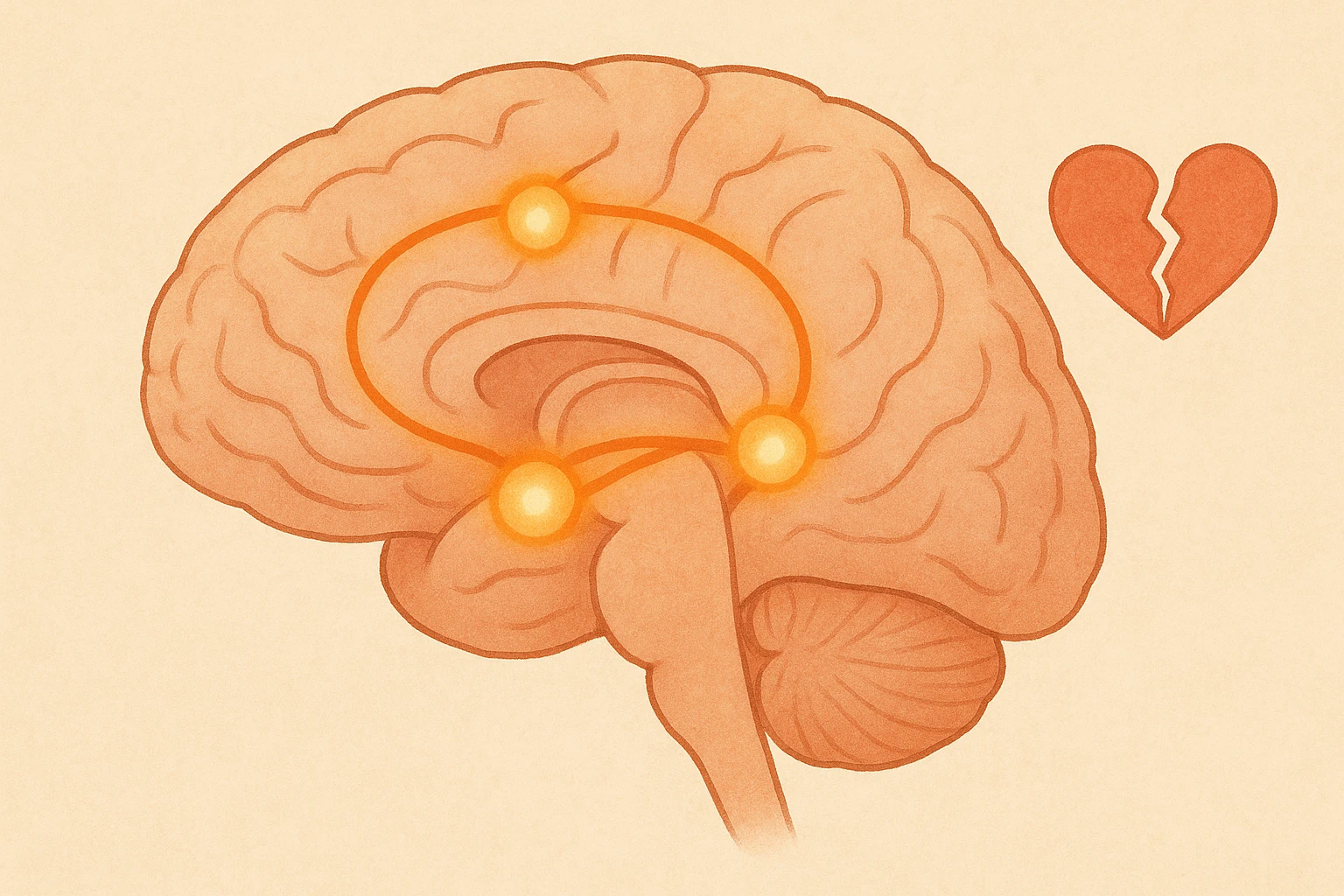
Research in affective neuroscience, particularly the work of Dr. Helen Fisher at Rutgers University, has revealed something striking: a romantic breakup activates the exact same neural circuits as drug withdrawal. The anterior cingulate cortex and the right ventral prefrontal cortex, the regions that process physical pain, light up intensely when you think about your ex.
During your relationship, your brain was flooded with a cocktail of dopamine, oxytocin, and serotonin. Every text, every touch, every moment together reinforced those pleasure circuits. Now that your source has disappeared, your brain is literally in withdrawal. It is craving its fix.
The missing is not linear
A 2025 study published in the Journal of Affective Disorders scanned the brains of 94 young adults after a breakup. The result: simply viewing a photo of their ex triggered increased activation in the hippocampus and amygdala, neural patterns comparable to those seen in trauma victims viewing images of their traumatic experience.
This explains why some days you feel almost fine, and then a song or a smell sends you spiraling. Your dopamine systems need 6 to 18 months to fully rebalance after a significant relationship loss. You are not weak. It is chemistry.
What You Actually Miss: The Person or the Idea?
Before we get to the actionable steps, there is a critical question you need to sit with. Because the answer changes everything.
You might be missing:
- The actual person — their flaws, their quirks, the way they really were day to day, including the fights and the frustrating moments
- The idea of the relationship — the security, the status of being "in a relationship," the future plans, the comfort of not being alone
- An idealized version — your brain, in withdrawal mode, tends to erase the bad memories and amplify the good ones. This is a well-documented cognitive bias called "rosy retrospection"
Be honest with yourself. If you find yourself only remembering the beautiful moments while completely forgetting why you broke up, that is a sign you are idealizing. It is normal, but becoming aware of it is the first step toward healing.
7 Steps to Stop Missing Your Ex So Much
Here are the 7 steps that will help you weather this storm. These are not magic fixes. This is a process, and every step matters.
- Accept the missing without fighting it
- Cut contact (actually)
- Break the memory loop
- Rebuild your daily routine
- Reconnect with yourself
- Transform the pain into momentum
- Choose to look forward
Step 1: Accept the missing without fighting it
This is counterintuitive, but it is the foundation. The harder you fight the feeling of missing your ex, the more it consumes you. Psychology calls this the "ironic process theory" or the white bear problem: try NOT thinking about a white bear for 30 seconds. Impossible, right?
Missing your ex is not your enemy. It is a signal that you loved deeply, and that is beautiful. Instead of telling yourself "I should not feel this way," try: "I feel this missing, and it is proof that I have a heart that works."
What to do:
- Give yourself 15 to 20 minutes of "missing time" each day where you let the emotions flow without judgment
- Keep an emotional journal. Writing about your feelings reduces amygdala activation by nearly 50 percent, according to neuroscience research
- Cry if you need to. Emotional tears contain cortisol, the stress hormone. You are literally flushing it out of your system
Step 2: Cut contact (actually)
Every notification, every story you watch, every "quick check" of their profile is the equivalent of a micro-dose of drugs for your withdrawing brain. You restart the dopamine circuit, and you reset the clock.
No contact is not punishment for your ex. It is an act of love toward yourself. It is the time your brain needs to build new neural connections that no longer run through that person.
What to do:
- Delete or archive your conversations. You do not have to erase everything forever, but get them out of your daily view
- Unfollow them on social media. No need for dramatic blocking if that feels too harsh: a simple "mute" or "unfollow" works
- Remove objects that trigger memories. Put them in a box, store them at a friend's place if needed
- If you slip and check their profile, do not punish yourself. Note it, observe how you feel afterward, and remember that feeling next time the urge hits
To understand the deeper mechanics of how distance helps you heal, see our article on the 5 stages of grief after a breakup.
Step 3: Break the memory loop
Your brain has a frustrating tendency to replay the same scenes on loop: your first kiss, that perfect evening, the way they looked at you. Psychologists call this "rumination," and it is rocket fuel for missing someone.
What to do:
- The "full movie" technique: When a beautiful memory surfaces, force yourself to play the entire scene, including the argument that followed, the discomfort you felt, or the reason it did not work out. Your brain is doing selective editing. Put the movie back in its uncut version
- The reality list: Write down 10 concrete reasons the relationship ended. Not vague generalities — specific facts. Reread this list when the missing overwhelms you
- The time reframe: Remind yourself that you do not miss your ex as they are today, but as they were in your best memories. That person may no longer exist
Download No Contact AI
No contact day counter, private journal, and chat support to get through a breakup.
Download the app
Scan with your phone
Automatic redirect to iOS or Android
Step 4: Rebuild your daily routine
The missing hits hardest in the gaps. The empty spaces: Sunday morning when you used to stay in bed together, Wednesday evening when you watched your show, the drive to work when you used to send them a voice message.
Your brain encoded those moments as "together time." Until you replace them, it will keep flagging them as anomalies.
What to do:
- Identify your "low hours," the times when you miss them most. It is usually evenings and weekends
- Plan those moments in advance. Nothing extraordinary required: a call with a friend, a walk, a gym session, a podcast episode
- Create new rituals that belong only to you: a coffee at a cafe you never went to with your ex, an activity you never shared with them
- Exercise is your number one ally. Thirty minutes of physical activity releases endorphins, serotonin, and dopamine — exactly what your brain is starving for
Step 5: Reconnect with yourself
When you are in a long relationship, part of your identity merges with the other person. You no longer know if you like sushi because YOU like it or because it was "your thing together." You abandoned hobbies to make room for the relationship. You adapted, molded yourself, sometimes erased yourself.
The missing, as painful as it is, carries an invitation. An invitation to rediscover who you are outside of that relationship.
What to do:
- Make a list of everything you loved BEFORE this relationship: activities, places, people you may have neglected
- Try one new thing each week. It does not have to be extreme. A new genre of book, a new cuisine, a new route to work
- Spend time alone intentionally. Not alone-waiting-for-someone-to-text-you alone, but chosen, savored, productive alone time
- Ask your close friends: "What changed about me since I was with [name]?" Their answers might be eye-opening
For a deeper dive into this rebuilding process, our article on how to heal from a breakup walks through each phase.
Download No Contact AI
No contact day counter, private journal, and chat support to get through a breakup.
Download the app
Scan with your phone
Automatic redirect to iOS or Android
Step 6: Transform the pain into momentum
There is a moment, somewhere between week 3 and month 3, where something shifts. The missing is still there, but it starts to make room for something else: a raw, almost feverish energy. That is your brain beginning to redirect its attachment circuits toward yourself.
This is the moment to capitalize.
What to do:
- Set a personal goal that has nothing to do with your ex: a fitness challenge, a creative project, a skill to learn, a trip to plan
- Use the emotional energy as fuel. Some of the greatest art, physical transformations, and career breakthroughs have been born from the pain of a breakup
- Document your progress. In 6 months, you will be stunned by how far you have come
- Surround yourself with people who pull you forward, not the ones who keep you anchored in nostalgia
Step 7: Choose to look forward
Healing from missing someone is not a single event. It is a series of daily choices. Every morning, you have the choice: stay in the past or take one step forward.
This does not mean forgetting. You will probably never forget this person, and that is not the goal. The goal is for the memory to lose its painful power and simply become a part of your story.
Signs you are healing:
- You think about your ex, but it no longer knocks the wind out of you
- You can see their photo without your heart racing
- You start making plans for yourself again
- You laugh without feeling guilty
- You can talk about the relationship without crushing anger or sadness
"I Have Moved On But I Still Miss My Ex" — Is That Normal?
This is one of the most painful and most common confessions: you have moved forward, maybe even met someone new, and yet you still miss your ex terribly. You feel guilty. You feel like you are betraying your new relationship, or like you have not "really" moved on.
Take a breath. This is far more common than you think.
Why it happens
Attachment theory, developed by psychologist John Bowlby, explains that significant attachment figures become emotional regulation anchors for our nervous system. When a relationship ends, that system does not shut off like a switch. It can remain active for years, sometimes a lifetime, especially if:
- The relationship was your first major love story
- The breakup was never fully processed emotionally
- You did not give yourself enough time to grieve before entering a new relationship
- Certain emotional needs your ex met are not being met in your current relationship
What it does NOT mean
- It does not mean you still love your ex
- It does not mean your current relationship is a mistake
- It does not mean you should go back to your ex
Often, what you miss is not the person — it is the feeling. The novelty of the beginning, the intensity of passion, or even the version of yourself you were back then.
What you can do
- Be honest with yourself about what exactly you miss. Is it your ex, or is it a feeling?
- If it is an unmet need in your current relationship, that is valuable information. Communicate it to your partner
- Give yourself grace. Having nostalgia does not make you a bad person
When Missing Your Ex Becomes a Red Flag
In most cases, the missing gradually fades. But sometimes it settles in and refuses to let go. Here are signs you might need professional support:
- The missing has not decreased after 6 months and remains as intense as day one
- You cannot function — work, friendships, basic self-care are all suffering
- You have constant intrusive thoughts that occupy most of your waking hours
- You are developing compulsive behaviors — stalking, repeated calls, contact attempts despite clear rejection
- You feel deep despair or dark thoughts
In these cases, a therapist specializing in relationship loss can help you unlock what is stuck. There is no shame in asking for help. It is one of the bravest things you can do.
In the meantime or as a complement, No Contact App can support you daily with practical tools to manage the missing.
What You Need to Remember
"I miss my ex" is not a life sentence. It is a passage. A painful, intense, sometimes unbearable passage — but a passage nonetheless.
Your brain is rewiring itself right now. Your neural circuits are under construction. And like any construction project, it takes time, it is messy, and it is uncomfortable. But on the other side of that work, there is a version of you who is stronger, more self-aware, and more free.
You will not always hurt like this. That is not wishful thinking — it is neuroscience. Your brain is biologically wired to heal. It just needs time and the right conditions.
So hold on. Not to your ex. Hold on to yourself.
Download No Contact AI
No contact day counter, private journal, and chat support to get through a breakup.
Download the app
Scan with your phone
Automatic redirect to iOS or Android
Related topics