


They text something vague. They like an old photo. They ask if you are seeing anyone, then disappear again. Now you are stuck wondering whether these are signs your ex is testing you or just random mixed signals.
Here is the direct answer: your ex may be testing you if they are trying to gauge your emotional availability, jealousy, boundaries, or willingness to reconnect without saying clearly what they want. But testing is not always romantic interest. Sometimes it is fear. Sometimes it is ambivalence. Sometimes it is breadcrumbing. And sometimes it is manipulation.
This guide will help you read the pattern without playing games back. If you are still deciding whether reconciliation even makes sense, start with the bigger how to get your ex back framework first.
What It Means When an Ex "Tests" You
Testing usually means your ex wants information without vulnerability.
Instead of saying, "I miss you and I want to know if you would talk," they send a small signal and watch what happens. They might want to know:
- Are you still emotionally attached?
- Will you reply immediately?
- Are you angry?
- Are you dating someone new?
- Can they still get access to you?
- Would you accept a conversation if they opened the door?
That does not automatically make them cruel. Breakups create fear, pride, shame, and uncertainty. A nervous ex may test the water because a direct conversation feels too exposed.
But the reason matters less than the effect. If their behavior keeps you anxious, reactive, or waiting around, you need a grounded response. You can stay kind without becoming available for confusion on demand.
Sign 1: They Send Vague Check-Ins
The classic test is a low-effort message that gives you almost nothing to work with.
Examples:
- "Hey."
- "How have you been?"
- "Just checking in."
- "Hope you are good."
- "You crossed my mind."
What it can mean: They may be opening the door to see whether you are receptive. If you respond warmly, they know contact is possible. If you respond coldly, they can retreat and pretend it was casual.
What to watch next: Do they continue the conversation with real effort, or do they vanish after you reply? A test can become genuine contact if they ask questions, share something real, and keep the exchange respectful.
How to respond: Keep it calm and brief. Do not punish them, but do not over-invest.
"Hey, I have been doing okay. Hope you are well too."
If they want a real conversation, they can build from there. You do not need to drag clarity out of one vague text.
Sign 2: They Ask About Your Dating Life
This is one of the clearest signs your ex is testing you because it often reveals jealousy, curiosity, or fear of replacement.
Examples:
- "Are you seeing anyone?"
- "So who was that in your story?"
- "I guess you moved on fast."
- "You dating now?"
What it can mean: They are checking whether the door is still open. Sometimes this comes from genuine interest. Sometimes it comes from ego. They may not want you back, but they may still dislike the idea of you being unavailable.
The difference: A sincere ex asks respectfully and can handle your answer. A possessive ex becomes sarcastic, guilt-trippy, or controlling.
If they are seeing someone else, the situation becomes more delicate. Do not compete, interfere, or accept secret emotional intimacy while they are with another person. Read the signs carefully in the context of whether your ex is seeing someone else.
How to respond: Be honest without over-explaining.
"I am keeping my personal life private right now, but I hope you are doing well."
That answer protects your dignity and avoids turning your dating life into a tool for jealousy.
Sign 3: They Bring Up Memories to See If You Still Feel Something
Nostalgia can be a bridge, but it can also be bait.
Examples:
- "Remember that trip?"
- "I heard our song today."
- "I found that photo of us."
- "Nobody gets that joke like you did."
What it can mean: They are testing emotional warmth. A positive memory lets them approach you without saying, "I miss you." If you respond with longing, they learn that the bond is still active.
When it is healthy: They bring up a memory, stay present, and let the conversation become mutual.
When it is breadcrumbing: They drop a nostalgic line, collect your emotional response, and disappear.
You are allowed to enjoy the memory without handing them full access to your heart.
"That was a good memory. I hope life has been treating you well."
Warm. Closed enough. No chase.
Sign 4: They Go Hot and Cold
Hot and cold behavior is where most people lose their center.
One day they are texting like the breakup never happened. The next day they are distant, slow, or silent. Then they come back again with another burst of attention.
What it can mean: Hot and cold contact often points to ambivalence. They may miss you, but not know whether they want reconciliation. They may want comfort, but fear commitment. They may enjoy connection, but panic when it feels too real.
Ambivalence is not the same as love. It is an unstable internal state. If you treat every warm moment as proof they want you back, you will be pulled into their uncertainty.
Look for consistency over at least 2 to 3 weeks:
- Do they initiate more than once?
- Do they follow through?
- Do they respect your pace?
- Do they become clearer over time?
- Do their actions match their words?
If the answer is no, you are not dealing with a clear reconciliation signal. You are dealing with emotional weather.
Sign 5: They Push for a Reaction
Some tests are designed to provoke you.
Examples:
- Posting obvious jealousy bait
- Mentioning people they are dating
- Saying, "You probably do not care anyway"
- Making little digs about how you handled the breakup
- Acting cold until you chase, then warming up again
What it can mean: They are trying to see whether they still have emotional power over you. This can come from hurt, insecurity, or a desire for control.
Do not react hot. A reactive reply gives the test exactly what it wants: proof that they can still pull you off balance.
Before responding, wait at least 20 minutes. If you are shaking, angry, or desperate, wait longer. Write the reply in your notes app first. Read it once. Then ask: "Would I be proud of this tomorrow?"
Better response:
"I do not want to argue or guess at meanings. If there is something you want to talk about directly, I am open to a calm conversation."
That is not cold. It is adult.
Sign 6: They Check Whether You Still Have Boundaries
An ex may test you by seeing if the old access still exists.
Examples:
- Late-night texts
- Asking for emotional support without commitment
- Wanting to meet "just to see what happens"
- Ignoring your no contact request
- Bringing up intimacy before trust is rebuilt
What it can mean: They may want closeness without responsibility. Or they may be impulsively reaching for comfort because you used to be their safe place.
This is where boundaries matter. A boundary is not a punishment. It is a clear condition for access to you.
Try this:
"I am not available for late-night emotional conversations. If you want to talk properly, we can choose a time when we are both calm."
Or:
"I am open to respectful contact, but I am not comfortable with mixed signals."
Healthy interest can handle a boundary. Manipulation usually resents one.
Sign 7: They Ask Mutual Friends About You
Indirect information gathering is another common test.
They may ask friends whether you seem happy, whether you are dating, whether you still talk about them, or whether you would be open to hearing from them.
What it can mean: They are curious, but not ready to contact you directly. It can be fear of rejection. It can also be a way to monitor you without accountability.
How to read it: One question to a friend is not enough. A pattern of repeated questions, especially combined with direct contact, matters more.
If mutual friends bring you updates, do not turn them into messengers. That creates drama and distorts the signal.
"I appreciate you telling me, but I do not want to communicate through friends. If they want to talk to me, they can reach out directly."
That keeps the situation clean.

Sign 8: They Hint at Regret Without Saying What They Want
Regret can sound promising, but vague regret is not the same as a reconciliation offer.
Examples:
- "I think about things sometimes."
- "Maybe we both made mistakes."
- "I wonder if things could have been different."
- "I miss how we used to talk."
What it can mean: They may be processing the breakup and testing whether you are willing to go deeper. This can be a good sign if they become more honest over time.
The key is whether regret turns into responsibility.
Green flag: "I have realized I shut down when things got hard, and I am working on that."
Weak signal: "Things were complicated."
Manipulative signal: "You made me leave, but I still care."
If they hint but never clarify, you can invite directness once.
"I hear you. If you want to talk about what that means, I am open to a real conversation. I do not want to keep guessing."
Then stop. Do not chase the meaning for them.
Testing vs Ambivalence vs Fear vs Breadcrumbing vs Manipulation
This distinction is the whole point.
Testing
Testing is a small bid for information. It may be immature, but it is not automatically malicious.
Pattern: They send a signal, watch your response, and gradually become clearer if the interaction feels safe.
Best response: Calm, warm, measured.
Ambivalence
Ambivalence means they genuinely do not know what they want.
Pattern: Warmth, retreat, warmth, retreat. The contact feels emotionally real but inconsistent.
Best response: Do not build your life around their uncertainty. Match consistency, not intensity.
Fear
Fear usually shows up when your ex wants contact but is afraid of rejection, conflict, or repeating the past.
Pattern: Careful messages, nervous energy, indirect hints, but increasing respect and honesty over time.
Best response: Make calm conversation possible, but do not do all the emotional labor.
Breadcrumbing
Breadcrumbing is giving just enough attention to keep you emotionally available without offering clarity.
Pattern: Random messages, nostalgia drops, likes, compliments, then disappearance. You feel hopeful for a day and anxious for a week.
Best response: Stop rewarding crumbs with full emotional access.
Manipulation
Manipulation is contact designed to control your feelings, choices, or self-worth.
Pattern: Guilt, jealousy bait, blame, pressure, disrespect for boundaries, or punishment when you do not react how they want.
Best response: Set a firm boundary. If the behavior continues, step back completely.
What to Do If You Think Your Ex Is Testing You
Your goal is not to win the test. Your goal is to stay regulated and respond from self-respect.
1. Do not test them back
Do not post jealousy bait. Do not delay replies as punishment. Do not pretend to be with someone else. Do not use silence to make them panic.
Testing them back may feel powerful for a moment, but it builds the exact dynamic that ruins trust. If reconciliation is possible, it will not be built on two people trying to outmaneuver each other.
2. Pause before every meaningful reply
If a message spikes your nervous system, do not answer immediately. A hot reply usually contains too much pain, too much hope, or too much accusation.
Write the response without sending it. Track what you wanted to say versus what you actually need to communicate. The gap between the two is where your clarity lives.
3. Match effort, not fantasy
If they send one vague text, send one grounded reply. If they initiate consistently and respectfully, you can open a little more. If they disappear, let the silence be information.
Do not respond to potential. Respond to behavior.
4. Ask for clarity once
If the pattern has gone on for weeks, directness is kinder than guessing.
"I am open to talking, but the mixed signals are not good for me. Are you interested in having a real conversation about where we stand?"
This is not pressure. It is a clear invitation.
If they dodge, mock the question, or keep the same pattern, you have your answer.
5. Know when no contact is the healthier move
If every interaction resets your healing, you may need to step back. No contact is not only a strategy to get an ex back. It is also a way to stop feeding an anxious loop.
If you are unsure whether a message is worth answering, use the criteria in when to break no contact. Practical contact, genuine accountability, or a calm reconciliation conversation are different from late-night confusion.
What If the Signs Look Positive?
If their behavior is consistent, respectful, and increasingly direct, it may overlap with real signs your ex wants you back.
Positive signs usually include:
- They initiate repeatedly
- They ask meaningful questions
- They respect your boundaries
- They acknowledge what went wrong
- They suggest a real conversation or low-pressure meeting
- They become clearer instead of more confusing
If that is happening, you do not need to rush. You can move slowly, keep your standards, and use calm language. If you need words for the first real conversation, use the scripts in what to say to your ex.
The important part is this: do not confuse being chosen with being tested. You want someone who can eventually speak plainly, take responsibility, and meet you in reality.
When Testing Is a Red Flag
Step back if testing includes:
- Insults or contempt
- Threats to date someone else if you do not respond
- Pressure for sex or intimacy
- Ignoring a clear boundary
- Rewriting the breakup to make everything your fault
- Punishing you for not replying quickly
- Contact only when they are lonely, drunk, or bored
These are not romantic mixed signals. They are signs the dynamic is unsafe or unhealthy.
You do not need to diagnose them. You only need to notice the effect: after contact, do you feel calmer and clearer, or smaller and more addicted to their approval?
Your body often knows before your mind admits it.
The Bottom Line
The biggest signs your ex is testing you are vague check-ins, jealousy questions, nostalgia drops, hot-and-cold contact, boundary pushes, indirect information gathering, and hints of regret without clear intention.
But the deeper question is not "Are they testing me?" It is "Does this contact lead to clarity, respect, and emotional safety?"
If the answer is yes, respond calmly and let consistency build. If the answer is no, stop feeding the pattern. You can care about your ex and still refuse to be managed by mixed signals.
You do not need to play games back. The strongest move is simple: stay steady, ask for clarity when needed, and let their behavior reveal whether they are capable of meeting you honestly.
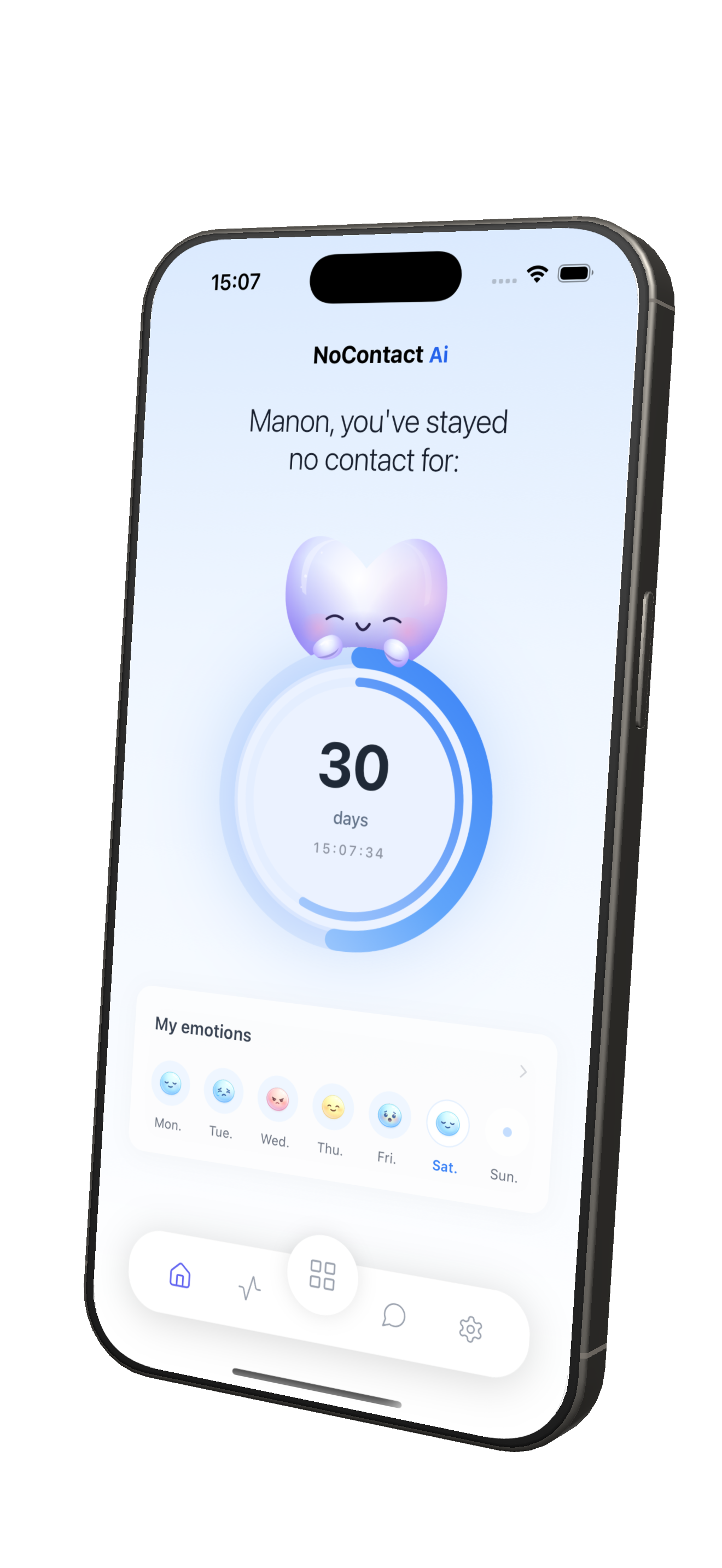
 No Contact AI
Before you try to win them back,find yourself again.
No Contact gives you perspective, whatever happens next. No Contact AI helps you hold it.
- A No Contact counter to stay on course
- An AI coach to think before you act
- A space to write to your ex without sending
Related topics