


You've done the hard part. Weeks, maybe months, of silence. No texts at 2am. No "accidental" likes on their Instagram. No driving past their apartment hoping to catch a glimpse.
But now a different question keeps you up at night: when is it actually time to break no contact, and how do you do it without acting from panic?
Here is the direct answer: breaking no contact is only worth considering when you have a calm, specific reason to reach out, you can handle no response, and your message does not try to force reassurance, closure, jealousy, or a relationship conversation before the other person is ready.
There is no magic number of days. Thirty days, forty-five days, ninety days: these timeframes are guidelines. The real answer depends on something harder to measure: your readiness, their likely readiness, and whether contact serves a mature purpose.
If you're following the complete no contact rule guide or you just started with the no contact rule after a breakup, you already know that silence isn't the goal. It's the tool. The goal is clarity, self-control, and enough emotional distance to choose your next move instead of reaching for relief.
Download No Contact AI
No contact day counter, private journal, and chat support to get through a breakup.
Download the app
Scan with your phone
Automatic redirect to iOS or Android
Let's break down when breaking no contact makes sense, when it is still too early, and how to break no contact the right way if you decide to send that first message.
The Goal of Breaking No Contact
Before we talk about when, let's talk about why. Because breaking no contact with the wrong intention almost guarantees failure.
Breaking no contact is NOT about:
- Testing if they still care
- Relieving your anxiety
- Getting validation
- Proving you've "won"
- Forcing a conversation because silence feels unbearable
Breaking no contact IS about:
- Opening a door for potential reconnection
- Demonstrating growth (not just claiming it)
- Starting a completely new dynamic
- Handling practical or emotional unfinished business with restraint
Think of it this way: you're not picking up where you left off. You're introducing yourself again—the evolved version of yourself—to someone who may or may not be ready to meet that person.
Research on relationship dissolution shows that successful reconnection requires both parties to have processed the original issues. Without that processing, you're just setting up the same failure with a different start date.
Before you send anything, test your readiness by writing the message and waiting 24 hours. If the message still feels calm tomorrow, you may be closer to ready. If it was just an anxiety release valve, keep it unsent. This is where a tool like NoContact can help: draft privately, track the urge, and avoid turning one emotional spike into a text you cannot take back.
Bad Reasons vs Better Reasons to Break No Contact
The reason behind the message matters more than the wording. Use this table before you decide.
| Bad reason to break no contact | Better reason | What to do instead |
|---|---|---|
| "I need to know if they miss me." | You want to open a low-pressure door after real emotional distance. | Wait 24 hours, write the message without sending, and ask whether you can handle silence. |
| "They posted something and I feel replaced." | There is a concrete, non-reactive reason to speak. | Mute their social media and return to no contact for at least a week. |
| "I need closure from them tonight." | You want one respectful closure conversation and can accept if they decline. | Journal the closure you want first, then send only if the request is calm and simple. |
| "I want to prove I've changed." | You have actually changed a pattern and can show it through how you communicate. | Do not announce growth. Let restraint, accountability, and patience show it. |
| "It's their birthday, so I have an excuse." | A neutral logistical or relational reason exists outside a high-emotion date. | Skip symbolic dates. Reach out only when the timing is ordinary and grounded. |
| "If I don't text now, I'll lose them forever." | You have accepted that pressure cannot create a healthy reunion. | Use an SOS pause, text a friend, or use NoContact's zero contact tools until the urgency drops. |
Signs You're Ready to Break No Contact
Your internal readiness matters more than any calendar date. Here are the 5 signs that suggest you've done the inner work:

1. You Can Think About Them Without Pain
Not numbness—peace. There's a difference. When you think about your ex, do you feel a stab of longing or a gentle neutrality? Can you recall good memories without spiraling? Can you acknowledge what went wrong without blaming or defending?
If thinking about them still triggers emotional flooding, you're not ready.
2. You've Built a Life You Actually Like
This is crucial. Have you filled the space they left with meaningful activities, connections, and goals? If you're reaching out because your life feels empty without them, that's desperation—not readiness.
True readiness means you want them in your life, but you don't need them.
3. You've Identified Your Contribution to the Breakup
Not just their mistakes—yours. What patterns did you bring? What needs did you expect them to meet that were really your responsibility? This isn't about blame. It's about awareness.
If you're still convinced they were 100% wrong and you were 100% right, you haven't grown enough to create something different.
4. You're Okay With Any Outcome
Here's the hardest test: can you genuinely handle them saying no? Not "I'll deal with it if I have to" but "I'll be genuinely okay either way."
If their response will determine your emotional state for the next month, wait longer.
5. You Have Clarity About What You Want
Not "I miss them" but specific clarity. Do you want:
- A committed relationship?
- To explore if things could work differently?
- Just closure and friendship?
Vague intentions lead to vague conversations that lead to vague situationships. Know what you're walking toward.
Signs They're Ready for Contact
Your readiness is only half the equation. Here's how to gauge theirs (without breaking no contact to find out):
Indirect positive signals:
- They've stopped social media behaviors that seemed designed to provoke you
- Mutual friends mention they've asked about you casually (not obsessively)
- They've shown signs of personal growth in their own life
- Enough time has passed for emotions to settle (usually 6-8 weeks minimum)
You may also notice some of the confirmed signs it worked—like them reaching out through indirect channels or showing up places they know you'll be.
However, be careful not to interpret:
- Silence as "they're definitely thinking about me"
- One social media like as "they want me back"
- Mutual friends' offhand comments as secret messages
The truth is, you can't fully know their readiness without contact. That's why your own readiness is the more important variable—it's the only one you control.
When NOT to Break No Contact
Sometimes the urge to reach out is a red flag in itself. Pause if any of these apply:

Don't break no contact if:
It's a significant date (their birthday, your anniversary, Valentine's Day). These feel meaningful but are actually the worst times. You'll seem calculated, and emotions run high.
You just saw them on social media doing something that triggered you. That's reactivity, not strategy.
You're drunk, lonely, or having a bad day. If you wouldn't send the same message tomorrow morning sober and calm, don't send it tonight.
They're in a new relationship. Respect the boundary. Reaching out now will only push them further away.
You want to "win" the breakup. If your primary motivation is showing them what they lost, you're not ready.
You haven't completed your minimum timeframe. If you committed to 30 days and you're on day 22, wait. The discipline itself is part of the growth.
You broke no contact recently. Each time you restart, the rule loses effectiveness. If you've already broken it once, you need even longer before trying again.
How to Break No Contact the Right Way
So you've checked the boxes. You're genuinely ready. Now the question is how to break no contact without undoing the progress you made.
The First Message Formula
Your first contact should be:
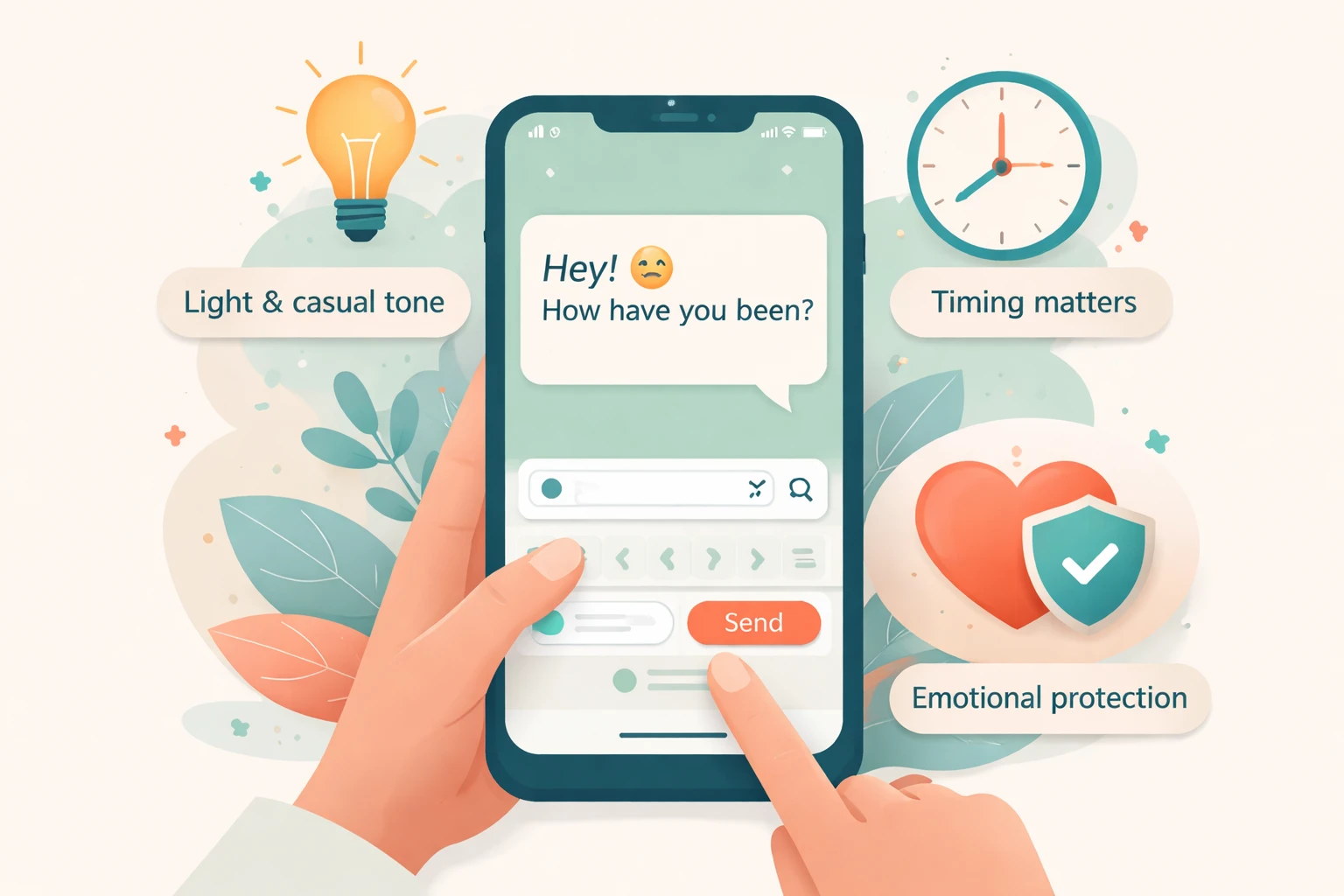
Light, not heavy. No "we need to talk" energy. No emotional dumps. Think: opening a door, not storming through it.
Personal, but not desperate. Reference something specific to your relationship—an inside joke, a shared memory, something you genuinely thought of them about.
Low-pressure. Give them an easy out. Don't demand a response or ask for a meetup immediately.
One clear purpose. Logistics, closure, reconnection, and accountability are different conversations. Do not mix all four in one text.
Short enough to breathe. Two to four sentences is usually enough. If you need five paragraphs, you are probably trying to regulate your emotions through their reaction.
For deeper wording guidance, read what to say to your ex and the guide to using text messages to get your ex back. Use scripts as a starting point, not a performance.
First Message Scripts for Breaking No Contact
Use the script that matches your actual reason. Do not send a reconnection message disguised as logistics, and do not send an apology if your real goal is to pull them back immediately.
1. Logistics
Use this when there is a practical issue that needs to be handled.
"Hey, I hope you're doing okay. I wanted to sort out [specific item/bill/document]. Would [option A] or [option B] work better for you?"
Why it works: it is clear, calm, and does not open an emotional side conversation.
2. Closure
Use this only if you can accept a no or no response.
"Hey. I've had some time to reflect, and I think one calm conversation could help me close this chapter respectfully. If you're open to it, I'd be willing to talk sometime this week. If not, I understand."
Why it works: it asks directly without making them responsible for your healing.
3. Reconnection
Use this when enough time has passed, the breakup was not abusive or chaotic, and you are open to a slow conversation.
"Hey, I saw [specific thing] and it reminded me of [light shared memory]. It made me smile. Hope you've been doing well."
Why it works: it is warm without demanding emotional labor.
4. Apology or Accountability
Use this when you genuinely need to own your part, not as a strategy to get an instant reply.
"Hey. I've had time to think about how I handled [specific situation], and I can see how that hurt you. I'm sorry. You don't need to respond, but I wanted to acknowledge it properly."
Why it works: it names the behavior, avoids excuses, and does not turn the apology into a request.
Before sending, paste your draft somewhere private and read it tomorrow. If you use NoContact, this is a good moment to test your readiness: save the message, let the urge pass, and only send if it still feels respectful when your nervous system is calm.
Simple Reconnection Examples
"Just saw [relevant thing] and it made me think of that time we [specific memory]. Hope you're doing well."
"Hey, I know it's been a while. I was thinking about [shared interest] and wondered if you ever [related question]. No pressure to respond, just wanted to say hi."
What NOT to Say
- "I miss you" (too heavy as an opener)
- "Can we talk?" (creates pressure)
- "I've changed" (show, don't tell)
- Anything longer than 2-3 sentences
- Anything that requires explanation
Timing Matters
Send your message at a neutral time—weekday afternoon or early evening. Not late night (looks desperate), not early morning (looks calculated), not Friday/Saturday (they might be busy socializing).
Need help crafting the perfect first message? You can use No Contact Pro to draft, pause, and review it with tools designed specifically for post-breakup communication.
What to Expect After Breaking No Contact
Let's set realistic expectations. Breaking no contact can go several ways:
Best Case
They respond warmly within a day or two. Conversation flows naturally. You eventually meet up and things feel different—better.
Common Case
They respond, but it's cautious. Messages are shorter than you'd like. There's a dance of re-establishing trust. This is actually normal and healthy—it shows they're being thoughtful, not impulsive.
Difficult Case
They don't respond immediately, or they respond briefly and don't continue the conversation. This doesn't necessarily mean it's over forever—but it does mean they need more time or space.
Worst Case
They respond negatively, set a firm boundary, or tell you they've moved on. While painful, this is actually valuable information. Now you can truly move forward.
Important: After sending your first message, give them at least 3-5 days to respond before drawing conclusions. People have lives, and a thoughtful response takes time.
If Breaking No Contact Goes Wrong
Maybe they didn't respond. Maybe they responded coldly. Maybe you made a mistake and broke no contact too early. What now?
First: Don't panic.
One unsuccessful attempt doesn't doom everything. But your response to this moment matters enormously.
Do:
- Return to no contact immediately
- Process your feelings without reaching out again
- Give it significantly more time (2-3 months minimum)
- Focus intensely on your own growth and healing
Don't:
- Send follow-up messages
- Ask mutual friends to intervene
- Post pointed things on social media
- Spiral into self-criticism
Here's a truth that might actually comfort you: the fact that this attempt didn't work might mean the timing wasn't right—not that you weren't right for each other. Some couples need multiple no contact periods before successful reconciliation.
If getting back together is still your goal, you might benefit from reading the full guide to getting back together for a comprehensive strategy.
Is Breaking No Contact a Mistake?
Breaking no contact is not automatically a mistake. It becomes a mistake when you do it from panic, loneliness, jealousy, guilt, or the need to control the outcome.
It may be the right move if:
- You have completed a meaningful period of distance
- You know exactly why you are reaching out
- Your message is respectful and low-pressure
- You can handle no response without chasing
- You are not using contact to avoid grief
It is probably a mistake if:
- You are checking whether they still care
- You are trying to stop them from moving on
- You feel frantic, rejected, or abandoned
- You plan to send multiple follow-ups
- You are ignoring a clear boundary they already set
The cleanest test is this: would you still respect yourself if they never replied? If the answer is yes, breaking no contact may be a grounded choice. If the answer is no, stay in no contact longer and focus on stabilizing yourself first.
The Bottom Line
Breaking no contact is a significant moment, but it is just one moment in a much longer process. The pressure you're feeling to get it "perfect" is understandable, but it's also somewhat misplaced.
What matters most is:
- Your genuine growth during the no contact period
- Your emotional readiness to handle any outcome
- Your clarity about what you actually want
- Your respect for their autonomy and timeline
If those four things are in place, the specific message matters less than you think. And if they're not in place, no perfect message will save you.
Trust the process. Trust your growth. And when the time is right—you'll know.
Download No Contact AI
No contact day counter, private journal, and chat support to get through a breakup.
Download the app
Scan with your phone
Automatic redirect to iOS or Android
Related topics