


It has been 1 month of no contact and no response. Not a single text, no missed call, not even a random like on your posts. Every day you check your phone, and every day it is the same silence staring back at you. You are starting to wonder if any of this was worth it.
We get it. This is one of the hardest moments in the entire no contact process. You followed our complete no contact guide to the letter, you stayed disciplined, and now the result is... nothing. Silence. And it feels like the universe is mocking you.
But here is what we need you to understand before you do anything rash: silence is not nothing. Silence is information, and in this article, we are going to decode exactly what it means, why your ex has not reached out, and what your next move should be.
Download No Contact AI
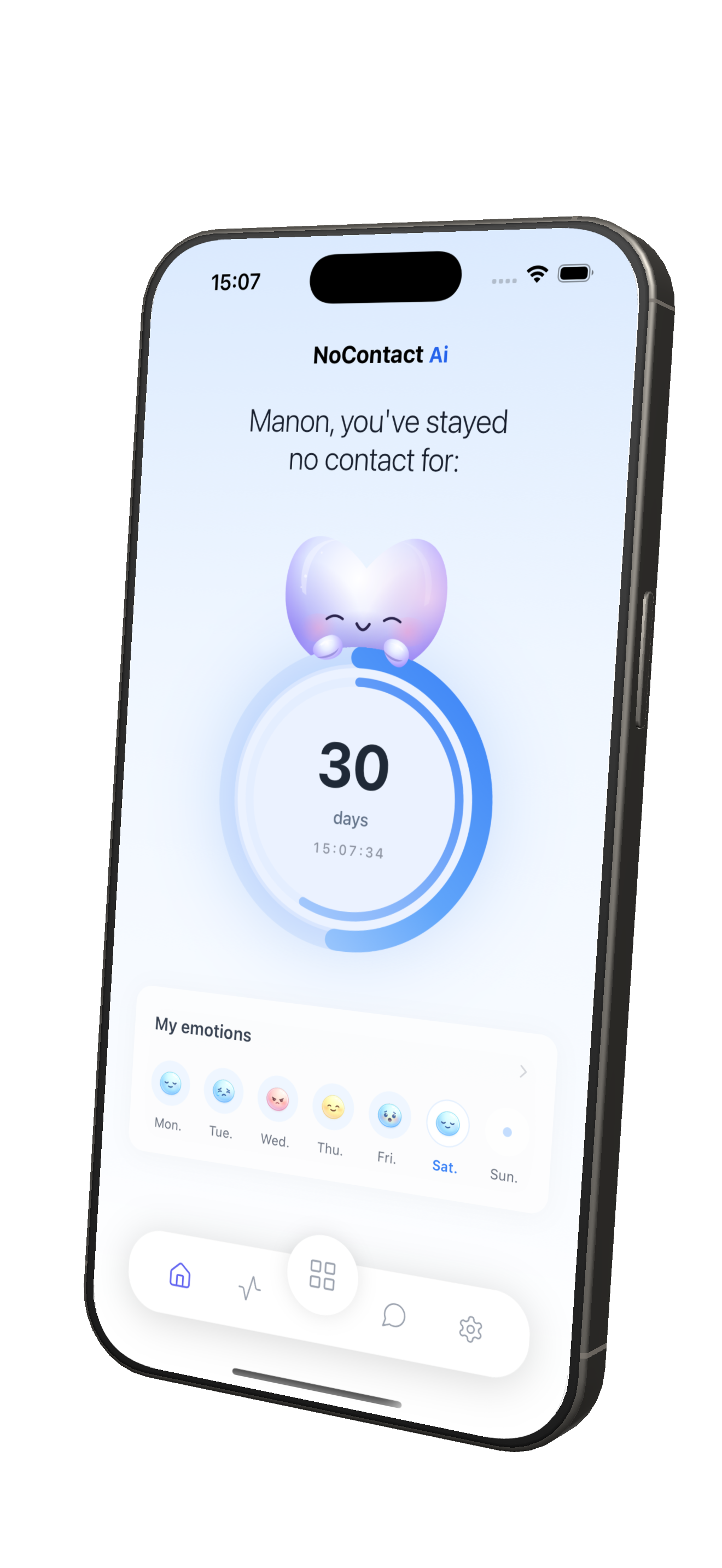
No contact day counter, private journal, and chat support to get through a breakup.
Download the app
Scan with your phone
Automatic redirect to iOS or Android
What Does 1 Month of No Contact With No Response Actually Mean?
Let us start with the most important thing: one month of no contact without hearing from your ex is not a failure. But it is not a guaranteed win either. It is a signal that requires careful interpretation.
The psychology of the 30-day mark
The 30-day threshold is significant in behavioral psychology. Research on habit formation suggests it takes roughly 21 days for a new pattern to become normalized. By day 30, your absence has become your ex's new reality.
This creates a dual effect:
- Your ex has adapted to life without you. The initial shock of your disappearance has worn off. They no longer check their phone expecting your name to appear.
- But adaptation is not the same as acceptance. The emotional residue of your relationship does not vanish in 30 days. Nostalgia, doubt, regret, these feelings settle in deeper over time, not shallower.
No message does not mean no thoughts
This is the critical mistake most people make. You are interpreting their silence as indifference. But in most cases, your ex thinks about you far more often than they will ever show.
Why do they not reach out? Because reaching out requires vulnerability. And vulnerability is the one thing most people run from after a breakup. Sending that first text means admitting they feel something, and that admission terrifies them.
The bottom line: 1 month of no contact with no response means you have crossed a major psychological threshold. Your ex has had time to feel the loss. Their silence does not mean they feel nothing. It means they are not ready to show it yet.
Why Has Your Ex Not Contacted You After 30 Days?
This is the question that keeps you up at night. Let us break down the most common reasons, from reassuring to difficult.
1. Pride and ego
This is the number one reason, by far. Your ex knows that contacting you is an admission. It means saying "I miss you" without actually saying it. And for someone trying to convince themselves they made the right decision, that admission feels like losing.
This is especially true for men. Social conditioning teaches them that going back is weakness. "If she hasn't texted me, she must be over it." These beliefs hold them back even when every fiber of their being wants to reach out.
2. Fear of rejection
Here is the irony: your ex may be terrified that YOU will reject THEM. After a full month of silence from your side, they may be thinking: "If she hasn't contacted me in 30 days, she clearly doesn't care anymore."
You are both caught in the same trap, a mirror standoff where each person interprets the other's silence as rejection.
3. They are processing at their own pace
Your ex is also grieving, just differently. Some people need far longer than 30 days to work through their emotions. If your ex tends toward avoidant attachment or intellectualizes rather than feels, they may need 45, 60, or even 90 days before they are ready to face what happened.
4. They are testing your resolve
Some exes deliberately wait to see if you will crack first. It is an unconscious power play: "If she contacts me first, it proves she needs me more than I need her." Recognizing this dynamic is crucial to not falling into the trap.
5. They have genuinely started moving on
This is the hardest possibility to consider, but honesty matters more than comfort. In some cases, your ex has begun turning the page. Not necessarily because they stopped caring, but because they decided not to look back.
Signs No Contact Is Working (Even Without a Response)
No response does not mean nothing is happening. Here are the subtle indicators that your silence is having an effect.
They view your social media
Social media does not lie. If your ex regularly watches your stories or visits your profile without liking or commenting, they are keeping tabs on you. They want to know without exposing themselves.
Mutual friends report they mention you
"He asked about you." "She brought up that trip you two took." These are not random mentions. Someone who has truly moved on does not keep talking about their ex to mutual friends.
They have not deleted your photos together
If they have kept the visible traces of your relationship, shared photos, old conversations, gifts, they are not ready to sever that symbolic connection. This is a sign they are still on the fence.
YOU have changed
The most important sign is not about them. It is about you. If these 30 days have helped you rebuild confidence, rediscover your identity, and refocus on your own life, then no contact has fulfilled its primary mission. No Contact App can help you track and measure that progress.
Download No Contact AI
No contact day counter, private journal, and chat support to get through a breakup.
Download the app
Scan with your phone
Automatic redirect to iOS or Android
Should You Continue No Contact or Break the Silence?
This is the moment of truth. And the answer depends entirely on your specific situation.
Keep going if...
- You are still emotionally fragile. If the mere thought of them not responding sends you into a panic, you are not ready. A message sent from a place of desperation will never be the right message.
- You have no natural reason to reach out. A "just checking in" text after 30 days of silence will feel forced and transparent. Wait until you have an organic reason.
- The breakup was highly volatile. The more explosive the breakup, the longer the cooling period needs to be. If things ended with screaming and accusations, how long no contact should last might be 45 or 60 days in your case.
- Your ex has avoidant tendencies. Avoidant personalities need more space, not less. Pushing contact too early can drive them further away.
Consider reaching out if...
- You feel genuinely stable. Not "stable because he might come back" but stable in your life regardless of him.
- You have a legitimate reason. An event, an item to return, a piece of practical information, something that naturally justifies the contact.
- You can handle any outcome. Including no response at all. If you can send that message and genuinely be okay no matter what happens, then you are ready.
What you should NEVER do
- Send a long emotional message recapping your feelings
- Issue an ultimatum ("If you don't respond, we're done forever")
- Orchestrate a "coincidental" run-in
- Use a mutual friend as a messenger to force communication
- Send a passive-aggressive text like "Guess you don't miss me at all"
How to Reach Out After 1 Month of No Contact (If You Decide To)
If you have decided the time is right, here is the step-by-step method.
Step 1: The opening message
Your first text should be:
- Short (2-3 sentences maximum)
- Light (no heavy emotional weight)
- Contextual (tied to a natural reason)
Examples that work:
"Hey! I just walked past [the restaurant / that spot] where we [specific positive memory] and it made me smile. Hope you're doing well."
"Hi, I just saw [an article / a show / an event] that reminded me of you. Have you seen it?"
Step 2: Reading their response
- They reply quickly and warmly: Good sign. Do not rush anything. Let the conversation flow naturally.
- They reply late but politely: They are interested but cautious. Respect their pace.
- They reply coldly or curtly: They still have walls up. Do not push. Try again in 2-3 weeks.
- They do not reply at all: That is an answer in itself. Give it one final week, then move toward acceptance.
Step 3: Gradual rebuilding
If the response is positive, do not skip stages. Rebuilding happens in phases:
- Occasional messages (1-2 per week)
- Longer, more regular conversations
- First phone or voice call
- First in-person meeting (neutral, public location)
Rushing the process is the fastest way to undo all your progress. Be patient.
The Psychology Behind Your Ex's Silence
To truly understand what is happening in their mind, let us look at the psychological mechanisms at play.
The reactance principle
In social psychology, reactance is the automatic resistance we feel when our freedom is threatened. Your silence triggered reactance in your ex: your unavailability increased your perceived value.
But this same principle can also hold them back. If they perceive your silence as a calculated "technique," their reactance may work against you: "I'm not going to give her what she wants."
The nostalgia bias
After the 30-day no contact rule, the brain does something remarkable: it beautifies memories. Arguments fade, good times take center stage. This is the nostalgia bias, and it works in your favor even when your ex stays silent.
The Zeigarnik effect
Psychologist Bluma Zeigarnik discovered that unfinished tasks stay in our memory longer than completed ones. Your relationship, interrupted by silence, remains an "unfinished story" in your ex's mind. It occupies mental real estate whether they want it to or not.
When Silence Becomes Too Long: The Real Warning Signs
Let us be honest: there is a point where silence stops being strategic and simply becomes reality.
Signals to take seriously
- They are in a new relationship (and not a short-lived rebound)
- Close friends confirm they explicitly say it is over
- They have deleted all traces of your relationship
- They have blocked you across all platforms
- They have explicitly refused contact when a third party mentioned your name
If multiple signals are present, no contact has given you its answer. And that answer, however painful, deserves your self-respect.
The difference between waiting and clinging
Waiting means staying open to a possibility while actively building your life. Clinging means putting your life on pause hoping someone else will restart it.
If you realize you are in the second category, that is not failure. It is the signal to redirect all of that energy back toward yourself.
Your Concrete Action Plan: What to Do Right Now
Regardless of your decision, whether to continue, reach out, or let go, here are the concrete steps for the coming weeks.
If you continue no contact
- Set a clear end date. For example, 45 or 60 days from the start. Having a horizon makes the wait bearable.
- Invest in your rebuild. Exercise, projects, friendships, personal development. This is not a distraction. It is your foundation.
- Journal your emotions. It will help you see your progress and prevent you from romanticizing the past.
- Use a tracking tool. Following your progress day by day makes the process tangible and motivating.
If you reach out
- Prepare your message in advance. Not in the impulse of a lonely Sunday evening.
- Send it at a neutral time. Midweek, middle of the day. Not Friday night. Not 2 AM.
- Detach from the outcome. Send, put your phone down, and go do something enjoyable.
- Wait at least 48 hours before drawing conclusions. They may need time to process the surprise.
If you decide to let go
- Acknowledge what you have been through. This month of no contact was an act of courage and discipline.
- Allow yourself to grieve. Crying, sadness, rough patches: all of it is part of the process.
- Surround yourself with support. Friends, family, a therapist if needed. You do not have to go through this alone.
- Look forward. Not tomorrow, not next week. At your own pace. But face forward.
Download No Contact AI
No contact day counter, private journal, and chat support to get through a breakup.
Download the app
Scan with your phone
Automatic redirect to iOS or Android
What to Remember
One month of no contact and no response is emotionally draining. There is no magic formula that transforms silence into a guaranteed reunion. But what you can control is how you respond to this situation.
You held on for 30 days. That is proof of strength, not weakness. Whether your ex comes back or not, these 30 days have taught you something essential: you can live without them. And that realization, as uncomfortable as it may be, is exactly what makes you stronger for whatever comes next.
Whether that next chapter is reconciliation or a fresh start, you will get through it. Because someone who can hold 30 days of no contact has the discipline and courage for anything that follows.
Related topics