


You committed to the no contact rule. You deleted the conversation thread, muted their Instagram, maybe even told a friend to hold you accountable. But weeks have gone by, and something feels off. No grand revelation. No desperate message from your ex. No lightning bolt of clarity. Just silence — and a growing suspicion that the signs the no contact rule is not working are staring you right in the face.
Before you spiral, take a breath. Not every quiet period means failure. But it is worth being honest with yourself about what is actually happening — and what might need to change.
Download No Contact AI
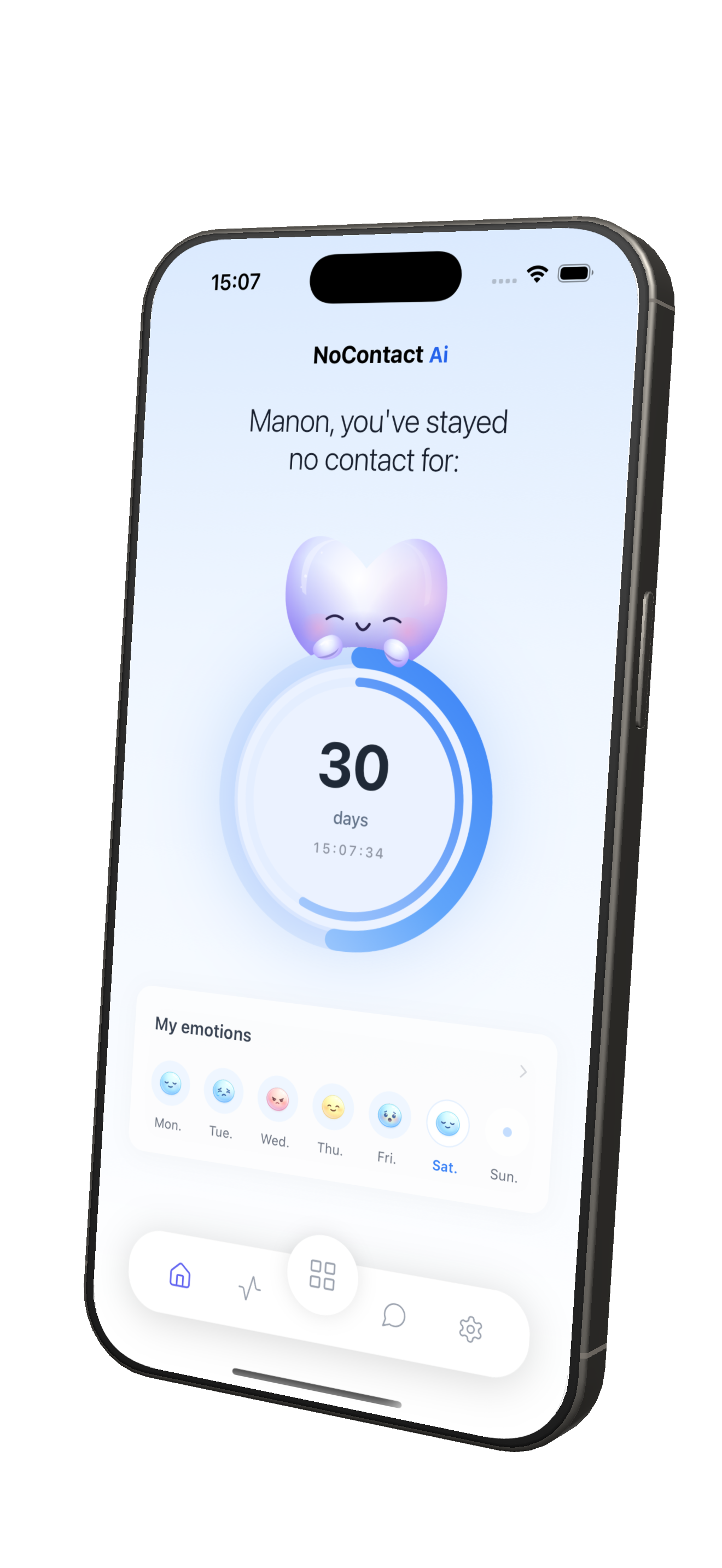
No contact day counter, private journal, and chat support to get through a breakup.
Download the app
Scan with your phone
Automatic redirect to iOS or Android
How to Tell if No Contact Isn't Working
Here is the thing most articles won't tell you: there is a critical difference between "not working yet" and "genuinely not working."
No contact is not a vending machine. You don't insert 30 days of silence and receive a reconciliation. The timeline depends on attachment styles, the nature of your breakup, and — most importantly — what you are doing with that silence.
If you want to compare your experience against positive indicators, check out the signs that no contact IS working. But if you recognize yourself in the signs below, it is time for an honest reassessment.
The five clearest signs no contact is failing:
- You keep breaking it (even in small ways)
- Your emotional state is deteriorating, not improving
- You are using silence as a manipulation tool, not a healing one
- Your entire life is on pause, waiting for a reaction
- The strategy doesn't fit your actual situation
Let's break each one down.
Sign #1: You Keep Breaking It
This is the most common reason no contact fails — and the hardest one to admit.
Breaking no contact doesn't always look like sending a long emotional text at midnight. Sometimes it is subtler:
- Watching their Instagram stories within minutes of posting
- "Accidentally" liking a photo, then unliking it
- Asking a mutual friend how they are doing
- Driving past their apartment or workplace
- Sending a "happy birthday" message as an excuse to reconnect
Each of these micro-breaks sends a signal: I'm still here. I'm still watching. I haven't actually gone anywhere. And that completely undermines the psychological mechanism that makes no contact effective in the first place.
The psychology: No contact works partly through the scarcity principle — when something familiar becomes unavailable, its perceived value increases. But if you are still visible, still orbiting, still present in small ways, there is no scarcity. Your ex knows you haven't truly moved on, and the emotional dynamic stays exactly the same.
What to do: Be brutally honest. Have you truly gone dark, or have you been maintaining a low-level presence? If the latter, your no contact period hasn't really started yet. Reset the clock — and this time, commit fully.
Sign #2: Your Emotional State Is Getting Worse, Not Better
No contact is supposed to give you breathing room. Space to think clearly, to grieve, to slowly start feeling like yourself again. If instead you feel worse with each passing day, that is a red flag worth paying attention to.
Warning signs include:
- Escalating anxiety: You are more anxious now than in week one, not less
- Obsessive thinking: Every waking thought revolves around your ex, what they are doing, who they are with
- Total isolation: You have withdrawn from friends, family, and activities — not by choice, but because nothing feels worth doing
- Physical symptoms: Trouble sleeping, loss of appetite, inability to concentrate at work
Some discomfort in the early days is completely normal. Breakups hurt, and no contact doesn't erase that pain — it gives you space to process it. But if you are weeks in and the trajectory is only downward, the strategy alone isn't enough.
Real talk: No contact is not a substitute for emotional support. If your mental health is suffering, that matters more than any breakup strategy. Talking to a therapist, a trusted friend, or using a tool designed to guide you through this process can make an enormous difference.
Sign #3: You're Using It as a Manipulation Tactic
This one requires serious self-reflection, because it is easy to fool yourself.
Ask honestly: why did you start no contact? If the answer is purely "to make them miss me" or "to punish them for leaving," you have built your entire strategy on a foundation of control rather than healing. And strategies rooted in manipulation tend to backfire.
Here is why. When no contact is motivated by the desire to trigger a specific reaction in your ex, you remain emotionally tethered to them. Every day becomes about their response, not your recovery. You check your phone constantly. You analyze their social media for signs of regret. You are not healing — you are playing chess with someone who doesn't know they are in a game.
The shift that matters: No contact works best when the primary goal is your wellbeing. Getting space to process the breakup. Rebuilding your identity outside the relationship. Regaining emotional stability. If your ex comes back as a result, that is a bonus — but it cannot be the entire point.

Sign #4: You've Put Your Entire Life on Pause
There is a version of no contact that looks like this: you stop texting your ex, but you also stop doing everything else. No new hobbies. No social plans. No goals. Just waiting — staring at your phone, counting the days, and hoping that on day 30 (or 45, or 60), something magical will happen.
This is what experts call "passive no contact," and it almost never works.
The reason is straightforward. If you are not growing, evolving, or living your life during this period, what exactly will be different when (or if) you reconnect? You will be the same person, in the same emotional state, with the same unresolved patterns. And your ex — if they are paying any attention — will see someone who is stuck, not someone who has become more attractive or more self-assured.
What active no contact looks like:
- Reconnecting with friends you neglected during the relationship
- Starting something new — a class, a project, a fitness routine
- Addressing personal issues that existed before the breakup
- Building a life that feels genuinely fulfilling, with or without your ex
The paradox is that the people who "succeed" at no contact are usually the ones who stopped measuring success by their ex's reaction.
Download No Contact AI
No contact day counter, private journal, and chat support to get through a breakup.
Download the app
Scan with your phone
Automatic redirect to iOS or Android
Sign #5: You're Misreading the Situation Entirely
Not every breakup responds to no contact the same way. The strategy has its roots in specific psychological dynamics, and when those dynamics don't apply, silence alone won't change anything.
Situations where standard no contact may not be effective:
- The breakup was mutual and amicable: If both of you agreed it was over, your ex may simply respect the distance. Silence won't create longing because there is no unresolved tension to activate.
- The relationship was toxic or abusive: No contact in these cases should be permanent — for your safety, not as a strategy to reignite anything.
- Your ex has an avoidant attachment style: Highly avoidant people can be surprisingly comfortable with distance. They may interpret your silence as confirmation that the breakup was the right call.
- It was a very short relationship: If you dated for a few weeks or months, the emotional investment may not have been deep enough for absence to create a strong pull.
- They have already moved on: If your ex is genuinely in a new relationship (not a rebound), no contact is unlikely to pull them back.
Understanding whether no contact truly works in your specific scenario is essential before deciding your next step.
Why No Contact Sometimes Fails
Beyond the personal signs above, there are structural reasons why no contact doesn't always deliver results:
Wrong duration: Too short (less than 21 days) and the emotional impact hasn't had time to develop. Too long (beyond 90 days) and your ex may have genuinely moved on and filled the space you left.
Wrong mindset: Approaching no contact as a "game" or a "rule" rather than a genuine period of self-investment sets you up for disappointment. The rigidity of "I must wait exactly 30 days" misses the entire point.
Wrong expectations: If your definition of "working" is strictly "my ex came crawling back," you are measuring the wrong outcome. The most valuable result of no contact is often internal — clarity about what you actually want, emotional resilience, and a stronger sense of self.
Unaddressed relationship issues: If the breakup happened because of deep incompatibilities, unresolved conflicts, or repeated patterns of harm, silence alone doesn't fix any of that. The underlying problems will still be there if you reconnect.
What to Do if No Contact Isn't Working
If you have recognized yourself in several of the signs above, here is what to do next — and it does not involve giving up.
1. Get honest about your version of no contact Have you truly committed, or have you been running a half-hearted version? If you have been breaking it in small ways, restart with full commitment.
2. Shift your focus from their reaction to your growth Stop measuring no contact by what your ex does. Start measuring it by how you feel, what you have learned, and who you are becoming.
3. Seek support You don't have to navigate this alone. Whether it is a therapist, a support group, or an app that walks you through the process day by day — having guidance makes a real difference. You can use No Contact App for AI-guided support to help you stay on track and process your emotions in a structured way.
4. Adjust the timeline if needed If 30 days feels arbitrary, that is because it is. Some people need more time, some less. The goal is emotional readiness, not a number on a calendar.
5. Redefine what "working" means Maybe no contact won't bring your ex back. But if it helps you heal, gain clarity, and build a stronger foundation for your next relationship — it worked. The outcome just looks different than you expected.
When to Accept It's Time to Move On
This is the part nobody wants to hear, but it matters.
Sometimes no contact reveals something you weren't ready to see: the relationship is truly over, and that is okay. Acceptance isn't failure. It is the beginning of something new.
If months have passed, you have genuinely invested in yourself, and there has been zero indication of interest from your ex — that is an answer. Not the one you wanted, but an honest one. And honoring that honesty is one of the strongest things you can do.
Moving on doesn't mean forgetting. It means choosing to stop waiting and start building a life that doesn't depend on someone else's decision to come back.
You deserve a relationship where you don't have to disappear to be valued. And sometimes, the most powerful thing no contact teaches you is exactly that.
Download No Contact AI
No contact day counter, private journal, and chat support to get through a breakup.
Download the app
Scan with your phone
Automatic redirect to iOS or Android
Related topics