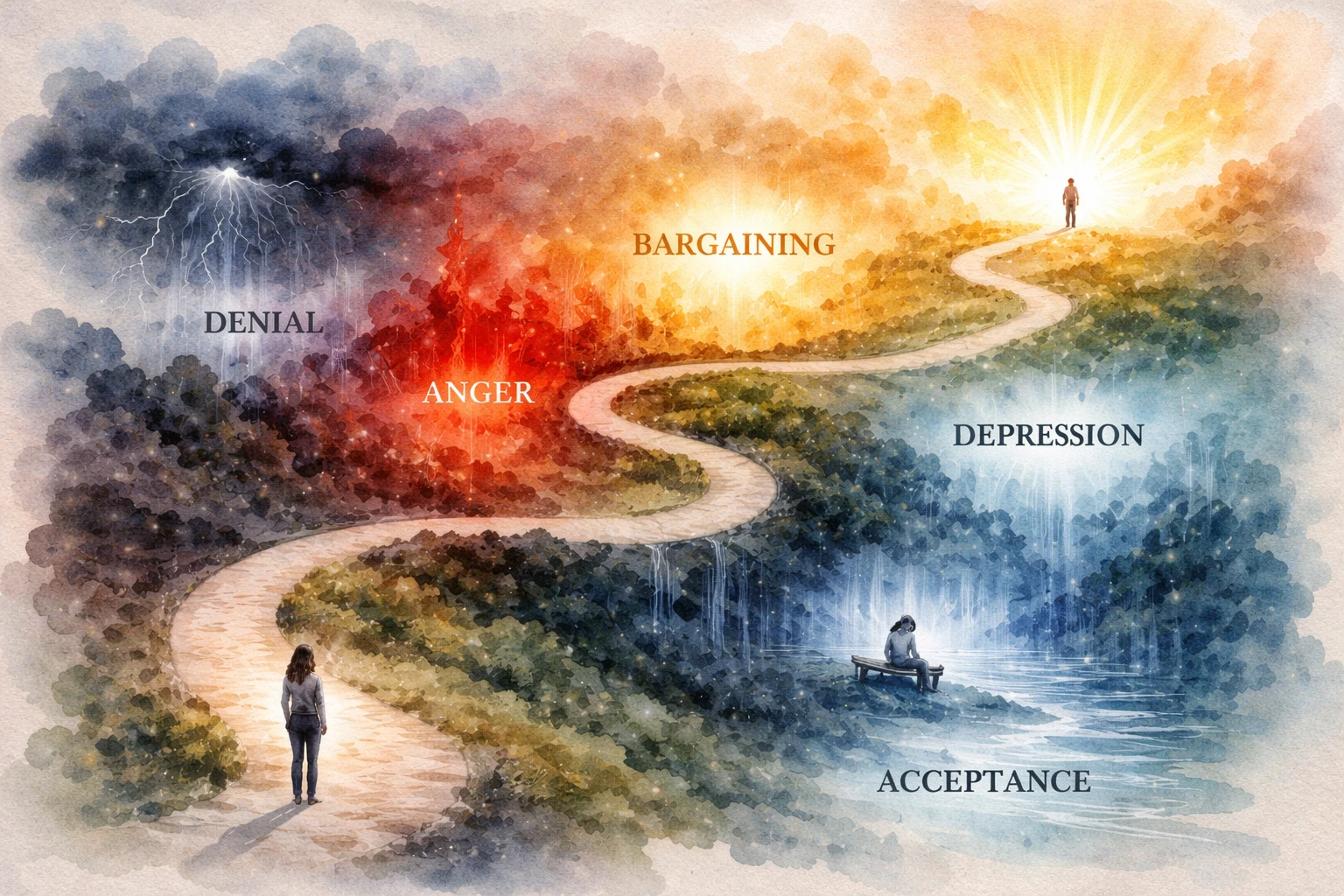
One moment you were planning a future together. The next, everything fell apart. And now you are caught in a whirlwind of emotions that make no sense—numb one minute, furious the next, bargaining with the universe at 3 AM.
If this sounds familiar, you are experiencing the 5 stages of grief after a breakup. And while it might feel like you are losing your mind, what you are going through is a well-documented psychological process that millions of people navigate every year.
Understanding these stages will not make the pain disappear, but it will help you make sense of it. In our complete guide to getting over a breakup, we cover the full healing journey. This article dives deep into the grief stages themselves—what they feel like, why they happen, and how to move through each one.
Ready to Start Your No Contact Journey?
Track your progress, get AI coaching when the urge to text hits, and become the strongest version of yourself.
Free to start • No credit card required
Why Breakups Feel Like Grief
Before we explore the stages, let us address something important: grieving a breakup is not dramatic or weak. It is biologically and psychologically appropriate.
When you lose a relationship, you are not just losing a person. You are losing:
- A daily routine and shared rituals
- Future plans and dreams
- Part of your identity (especially in long relationships)
- A sense of security and belonging
- Physical touch and intimacy
Swiss-American psychiatrist Elisabeth Kübler-Ross first introduced the five stages of grief in 1969 while studying terminally ill patients. She later adapted the model to encompass other forms of loss—including the end of relationships.
The grief you feel after a breakup activates the same neural pathways as mourning a death. Your brain genuinely cannot distinguish between the two types of loss in terms of emotional processing.
So yes, what you are feeling is real grief. And it deserves to be honored as such.
Stage 1: Denial
"This is not really happening."
The first stage of grief is denial—a protective mechanism your brain uses to buffer the immediate shock of loss.
What Denial Looks Like
- Checking your phone constantly, expecting them to text
- Convincing yourself this is just a "break" that will end
- Going through the motions of your day feeling disconnected
- Struggling to talk about the breakup because saying it out loud makes it real
- Rereading old messages looking for signs you misunderstood

Why Denial Happens
Denial is not delusion—it is survival. Your psyche knows you cannot process the full weight of the loss all at once, so it releases the pain in smaller, manageable doses.
During this stage, you might feel numb or strangely calm. People around you might comment that you are "handling it so well." Inside, part of you is simply waiting for everything to go back to normal.
How Long Denial Lasts
For most people, denial lasts a few days to a couple of weeks. It begins to lift as reality repeatedly confronts you: the empty side of the bed, the missing text messages, the plans that no longer exist.
Coping Tips for Denial
- Allow it. You do not need to force yourself to "face reality" immediately
- Avoid major decisions. Your judgment is impaired right now
- Tell at least one person. Speaking the truth helps it become real
- Be gentle with yourself. Shock is a legitimate physical state
Stage 2: Anger
"How could they do this to me?"
As denial fades, anger rushes in to fill the void. This is the stage where the pain transforms into rage.
What Anger Looks Like
- Blaming your ex for everything that went wrong
- Feeling furious at yourself for "wasting time" on the relationship
- Snapping at friends or family who have nothing to do with it
- Wanting your ex to suffer or regret their decision
- Obsessing over their flaws or the unfairness of the situation
Why Anger Happens
Anger feels better than sadness because it is active rather than passive. It gives you something to do with the pain—a target to direct it toward.
Psychologically, anger is also a way of maintaining connection to your ex. Hating them keeps them present in your mind, which can feel safer than the emptiness of letting go.
How Long Anger Lasts
The intensity of anger typically peaks within the first few weeks after denial lifts. However, anger can resurface throughout your healing journey, especially when triggered by reminders or new information.
Coping Tips for Anger
- Move your body. Exercise, punch a pillow, scream into a car
- Write an unsent letter. Get everything out without consequences
- Avoid social media stalking. It only fuels the fire
- Recognize the pain underneath. Anger is often sadness in disguise
Stage 3: Bargaining
"What if I had done things differently?"
The bargaining stage is defined by "what if" and "if only" thinking. Your mind becomes obsessed with rewriting the past.
What Bargaining Looks Like
- Replaying conversations and imagining different outcomes
- Making promises to yourself or a higher power ("If they come back, I will...")
- Analyzing every mistake you made in the relationship
- Reaching out to your ex hoping to "fix things"
- Believing that changing yourself will bring them back
Why Bargaining Happens
Bargaining is an attempt to regain control. The breakup made you feel powerless, so your brain searches for ways you could have prevented it—or might still reverse it.
It is also a form of delayed denial. If you can just find the right action, the right words, the right version of yourself... maybe this does not have to be real.
How Long Bargaining Lasts
Bargaining often overlaps with anger and can persist for several weeks. It tends to fade as you exhaust the mental possibilities and begin accepting that no amount of reimagining will change what happened.
Ready to Start Your No Contact Journey?
Track your progress, get AI coaching when the urge to text hits, and become the strongest version of yourself.
Coping Tips for Bargaining
- Limit rumination time. Set a daily limit for "what if" thinking
- Write down your bargains. Seeing them on paper often reveals their futility
- Focus on what IS in your control. Your healing, your future, your choices
- Avoid reaching out from this place. Messages sent from bargaining rarely lead anywhere good
Stage 4: Depression
"What is the point anymore?"
When bargaining fails to bring relief, the full weight of the loss arrives. This is the depression stage—often the most difficult but also the most important.
What Depression Looks Like
- Deep, pervasive sadness that colors everything
- Loss of interest in activities you used to enjoy
- Changes in sleep (too much or too little)
- Changes in appetite
- Difficulty concentrating or making decisions
- Feelings of emptiness or hopelessness
- Withdrawing from friends and family
Why Depression Happens
Depression in grief is not a mental illness—it is an appropriate response to significant loss. Your psyche is finally allowing you to feel the full impact of what happened.
This is actually progress, even though it does not feel like it. Depression means you have moved past denial, exhausted your anger, and stopped bargaining. You are finally facing reality.
How Long Depression Lasts
The depression stage varies enormously. Some people move through it in a few weeks; others spend months here. If symptoms persist beyond a few months or significantly impair daily functioning, consider professional support options.
Coping Tips for Depression
- Do not isolate completely. Even brief social contact helps
- Maintain basic routines. Shower, eat, sleep at regular times
- Lower your expectations. Getting through each day is enough right now
- Use tools to track your emotional progress. Seeing patterns can provide hope
- Seek help if needed. There is no shame in professional support
Stage 5: Acceptance
"It happened. And I will be okay."
Acceptance is not about being "happy" the relationship ended. It is about acknowledging reality and finding a way to move forward within it.
What Acceptance Looks Like
- Thinking about your ex without intense emotional pain
- Recognizing what the relationship was—both good and bad
- Making plans for your future that do not include them
- Feeling moments of genuine peace or even happiness
- Understanding that closure comes from within, not from them

Why Acceptance Matters
Acceptance does not mean the relationship did not matter or that you are "over" your ex completely. It means you have integrated the loss into your life story and can move forward without being defined by it.
This is where real healing happens. The pain has served its purpose—helping you process and honor what you lost—and now you can begin building something new.
How Long Until Acceptance
There is no fixed timeline. Some people reach acceptance within a few months; others need a year or more. What matters is movement, not speed.
Signs You Have Reached Acceptance
- You can have a conversation about them without your stomach dropping
- You genuinely wish them well (or at least do not wish them harm)
- You see the relationship clearly—both what worked and what did not
- Your identity no longer feels tied to being their partner
- You are curious about your future
The Reality: Grief Is Not Linear
Here is something crucial that Kübler-Ross herself emphasized: these stages do not happen in a neat, sequential order.
You might:
- Experience denial and bargaining simultaneously
- Reach acceptance, then get triggered and cycle back to anger
- Skip stages entirely
- Feel multiple stages in a single day
This is normal. Grief is messy and unpredictable. The stages are not a checklist to complete—they are a map that helps you recognize the terrain you are traveling through.
If you find yourself cycling back to earlier stages, it does not mean you have "failed" or "gone backwards." It means you are processing different layers of the loss. Trust the process.
How Long Each Stage Lasts
One of the most common questions is about timing. Here is what research suggests:
| Stage | Typical Duration | Varies Based On |
|---|---|---|
| Denial | Days to 2 weeks | Suddenness of breakup |
| Anger | 1-4 weeks | How it ended, betrayal involved |
| Bargaining | 2-6 weeks | Your attachment style |
| Depression | 4-12+ weeks | Relationship length, support system |
| Acceptance | Ongoing | Personal growth work done |
For a deeper look at timelines, see our article on realistic healing timeline.
Important: These are averages. Your timeline is your own. Comparing yourself to others will only add suffering.
Tips for Moving Through Each Stage
General Practices That Help at Every Stage
- Journal regularly. Externalizing emotions helps process them
- Move your body daily. Even a 10-minute walk shifts brain chemistry
- Maintain basic self-care. Sleep, nutrition, and hygiene matter more than you think
- Limit alcohol and substances. They delay processing and extend grief
- Talk to someone. Friends, family, or a therapist—do not isolate
Stage-Specific Strategies
Denial: Focus on accepting support from others, even if you feel fine Anger: Channel the energy physically; avoid acting on impulses Bargaining: Redirect mental energy toward what you CAN control Depression: Lower expectations and celebrate small wins Acceptance: Begin actively building your new life chapter
When to Seek Professional Help
While grief is natural, some situations benefit from professional support:
- Symptoms of depression lasting longer than 2-3 months
- Thoughts of self-harm or suicide
- Inability to function at work or maintain relationships
- Using substances to cope
- Being stuck in one stage for extended periods
A therapist who specializes in relationship issues can provide tools and perspectives you cannot access alone. There is strength in seeking help.
The 5 stages of grief after a breakup are not a punishment—they are a process. Each stage serves a purpose: denial protects you from shock, anger gives you energy, bargaining helps you search for control, depression allows you to fully feel, and acceptance frees you to move forward.
You will not be in this pain forever. One day, you will look back and see how these stages shaped you, strengthened you, and ultimately led you to something better.
Until then, be patient with yourself. You are exactly where you need to be.
Ready to Start Your No Contact Journey?
Track your progress, get AI coaching when the urge to text hits, and become the strongest version of yourself.
Free to start • No credit card required
Related topics