It is 2 AM and you are lying awake wondering: will this ever end? How long does it take to get over a breakup, really?
You have probably heard various rules—it takes half the relationship length to heal, or six months minimum, or you should be "over it" by now. The uncertainty is almost as painful as the heartbreak itself.
Here is the honest answer: there is no universal timeline. But research does give us some useful benchmarks, and understanding the factors that affect YOUR timeline can help you stop comparing yourself to others.
In our complete breakup recovery guide, we cover the full healing journey. This article focuses specifically on the question everyone asks: how long will this take?
Ready to Start Your No Contact Journey?
Track your progress, get AI coaching when the urge to text hits, and become the strongest version of yourself.
Free to start • No credit card required
What the Research Says
Let us start with what science actually tells us about breakup recovery time.
The 11-Week Finding
A widely cited study published in the Journal of Positive Psychology found that most people feel significantly better around the 11-week mark (approximately 3 months) after a breakup. At this point, 71% of participants reported noticeable improvement in their emotional state.
The 3-6 Month Average
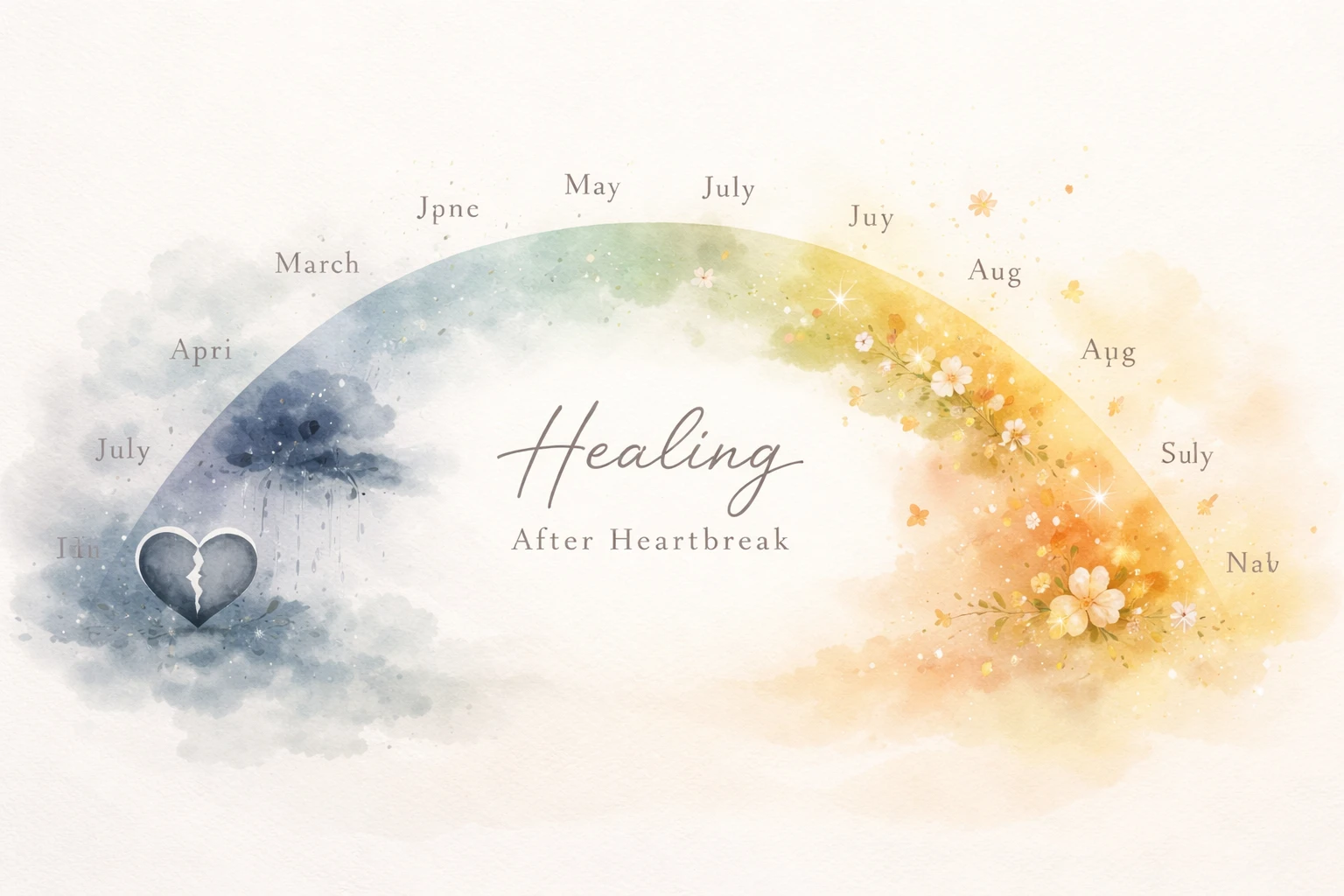
Multiple studies suggest that the average person requires 3 to 6 months to recover from a significant breakup. This does not mean you will be completely "over it"—it means the acute pain has subsided and you can function normally again.
The 18-Month Marker
Research on longer relationships shows that complete emotional recovery—where you can think about your ex without significant distress—often takes 12 to 18 months for relationships that lasted several years.
Important Caveat
These are averages. Some people heal in weeks; others need years. Neither is wrong. What matters is that you are moving forward, not how fast.
The "Half the Relationship" Rule - Myth or Reality?
You have probably heard this one: it takes half the length of your relationship to get over it. A two-year relationship? Expect one year of healing.
The truth: this rule is mostly a myth.
Here is why it does not hold up:
Intensity matters more than length. A passionate 6-month relationship can be harder to recover from than a lukewarm 3-year one.
How it ended matters. Being blindsided versus mutually deciding to part affects recovery dramatically.
Your attachment style matters. Anxious attachers often struggle longer than secure attachers, regardless of relationship length.
Your support system matters. Strong social connections accelerate healing; isolation extends it.
The "half the relationship" rule likely emerged because longer relationships typically involve more entanglement—shared memories, routines, identity, and sometimes logistics like shared homes or children. But the math is far from precise.
Factors That Affect Your Recovery Time
Understanding what influences your timeline can help you be more patient with yourself—and take targeted action.
Factors That EXTEND Recovery
| Factor | Why It Slows Healing |
|---|---|
| You were blindsided | No time to mentally prepare for loss |
| Betrayal involved | Trust wounds heal slower than love loss |
| Ongoing contact | Reopens wounds and creates false hope |
| Social media stalking | Keeps them present in your mind |
| Isolation | No external support or perspective |
| Rumination | Constantly replaying what went wrong |
| Unresolved questions | Lack of closure prolongs processing |
| Insecure attachment | Anxious or avoidant patterns complicate grief |
Factors That SHORTEN Recovery
| Factor | Why It Helps |
|---|---|
| You initiated the breakup | Already processed before it happened |
| Strict no contact | Allows brain to detach |
| Strong support system | External validation and distraction |
| Active coping strategies | Therapy, journaling, exercise |
| New experiences | Creates separation from relationship identity |
| Accepting it is over | Stops bargaining and hoping |
| Self-compassion | Reduces shame and self-criticism |
Ready to Start Your No Contact Journey?
Track your progress, get AI coaching when the urge to text hits, and become the strongest version of yourself.
Free to start • No credit card required
Average Timelines by Relationship Length
While individual variation is enormous, here is a general framework based on relationship length:
Relationships Under 6 Months
- Acute pain: 2-4 weeks
- Functional recovery: 1-2 months
- Full recovery: 2-4 months
Even short relationships can hurt intensely, especially if they were your first serious connection or if future plans were involved.
Relationships 6 Months to 2 Years
- Acute pain: 4-8 weeks
- Functional recovery: 2-4 months
- Full recovery: 4-8 months
This is where most people fall. Enough time to build real attachment, but not so long that complete identity entanglement occurred.
Relationships 2-5 Years
- Acute pain: 2-3 months
- Functional recovery: 4-6 months
- Full recovery: 8-18 months
Longer relationships involve more shared life—routines, friends, possibly living together. You are grieving not just a person but a lifestyle.
Relationships Over 5 Years
- Acute pain: 3-6 months
- Functional recovery: 6-12 months
- Full recovery: 1-2+ years
Very long relationships often require rebuilding significant portions of your identity and daily life. This is normal and expected.
For more specific insights, see our article on when the pain will ease.
Signs You Are Recovering (Even If It Does Not Feel Like It)
Healing is not linear, and progress often happens beneath conscious awareness. Here are signs that you are moving forward, even on bad days:
Early Recovery Signs (Weeks 1-4)
- You can go a few hours without thinking about them
- You are eating and sleeping somewhat normally again
- You have told at least one person what happened
- You stopped constantly checking their social media (or blocked them)
Mid Recovery Signs (Months 1-3)
- The crying comes less frequently
- You can talk about them without your voice breaking
- You have moments of genuine laughter
- You are starting to care about your appearance again
- Mornings are no longer the hardest part of the day

Later Recovery Signs (Months 3-6+)
- You can hear their name without your stomach dropping
- You have stopped hoping they will reach out
- You are curious about your future (not just dreading it)
- You can acknowledge what went wrong without obsessing
- You have started noticing other people
Full Recovery Signs
- You genuinely wish them well (or at least feel neutral)
- You rarely think about them unprompted
- You can see the relationship clearly—good and bad
- Your identity feels complete without them
- You are ready for something new
You can track your daily progress to see patterns that might not be obvious in the moment.
Why Some People Take Longer
If you feel like everyone else moves on faster than you do, you are not alone—and you are not broken.
Reasons You Might Need More Time
1. Complicated Grief Some breakups involve trauma—abuse, betrayal, abandonment. These require processing both the loss AND the wounds, which takes longer.
2. Anxious Attachment Style If you have an anxious attachment pattern, you may experience breakups more intensely and ruminate longer. This is not a character flaw—it is neurological wiring that can be worked on.
3. The Relationship Was Your Main Identity If most of your social life, hobbies, and self-concept revolved around the relationship, you are rebuilding more than others. This simply takes time.
4. Lack of Support Healing in isolation is slower. If you do not have friends or family to lean on, consider professional support.
5. Unprocessed Past Wounds Sometimes a current breakup triggers grief from older losses—previous relationships, childhood wounds, or other traumas. You may be processing more than one thing.
6. Avoidance Paradoxically, trying to "get over it" too quickly by avoiding feelings often extends the timeline. Suppressed emotions resurface later.
When to Be Concerned
While there is no "too long" in grief, certain signs suggest you might benefit from professional help:
- Suicidal thoughts or self-harm
- Inability to function at work/school after 3+ months
- Complete social withdrawal
- Substance abuse as coping
- No improvement whatsoever after 6 months
These are not signs of weakness—they are signs that additional support could help.
How to Speed Up Your Recovery
You cannot rush authentic healing, but you CAN avoid things that slow you down and lean into things that help.
Stop Doing These Things
Stalking their social media. Unfollow, mute, or block. Every peek resets your progress.
Reaching out "just to talk." No contact is not punishment—it is medicine.
Ruminating for hours. Set a daily limit for thinking about them (try 20 minutes).
Isolating yourself. Even brief social contact helps regulate your nervous system.
Waiting for closure from them. Closure is something you create, not something they give.
Start Doing These Things
Move your body daily. Exercise releases endorphins and processes stress hormones.
Journal your thoughts. Externalizing emotions helps process them faster.
Create new experiences. New memories gradually outnumber old ones.
Lean on your support system. Let people help you.
Invest in yourself. Career, hobbies, health—become someone you are proud of.
Consider therapy. A professional can offer tools you do not have access to alone.
The Fastest Path
Ironically, the fastest path through grief is not around it—it is through it. Allow yourself to feel everything. Process rather than suppress. Face rather than avoid.
Those who try to speed through by numbing or distracting often find the pain waiting for them later. Those who allow the process tend to emerge stronger and faster.
So how long does it take to get over a breakup? On average, 3-6 months to feel significantly better. But YOUR timeline depends on your specific situation, choices, and support.
Stop comparing yourself to others. Stop wondering if you are "taking too long." The question is not whether you are healing fast enough—it is whether you are healing at all.
And if you are reading this, if you are trying to understand your pain and move through it, you are already healing.
You will get through this.
Ready to Start Your No Contact Journey?
Track your progress, get AI coaching when the urge to text hits, and become the strongest version of yourself.
Free to start • No credit card required
Related topics