
The no contact rule is legendary in breakup recovery circles. Cut off all communication, focus on yourself, and let absence make the heart grow fonder. It works remarkably well with many exes—but dismissive avoidants are not like many exes.
If you are using the standard no contact rule with a dismissive avoidant, you might be wondering why it feels different. Why they seem completely unbothered. Why weeks pass without a single sign of missing you.
Understanding how dismissive avoidants specifically react to no contact can save you from misinterpreting their silence and help you decide whether to modify your approach. Let us break down what really happens when you go no contact with a DA—and whether it can work at all.
Ready to Start Your No Contact Journey?
Track your progress, get AI coaching when the urge to text hits, and become the strongest version of yourself.
For broader context, our avoidant attachment explained guide covers all avoidant types.
How Dismissive Avoidants View No Contact
Here is the uncomfortable truth: when you initiate no contact with a dismissive avoidant, you are often giving them exactly what they wanted.
Their Initial Perspective
Dismissive avoidants typically view no contact as:
- Relief from pressure: The relationship demands are finally gone
- Validation of independence: They can function perfectly alone
- Confirmation of their worldview: Relationships are messy, solitude is peace
- No big deal: They are excellent at emotional detachment
Unlike anxiously attached exes who spiral into panic during no contact, or even fearful avoidants who oscillate between relief and anxiety, dismissive avoidants often settle into comfortable contentment.
The Mirror Effect
Here is what most people do not realize: while you are using no contact on them, they are essentially using it on you.
Dismissive avoidants naturally default to ceasing contact after breakups. They drop off the map, stop responding, and retreat into their independent lives. Your no contact does not feel like a strategic move to them—it feels like mutual agreement that separation is best.
This creates a frustrating dynamic: you are working hard to maintain distance while they are effortlessly maintaining the same distance without trying.
The DA Reaction Timeline During NC
Despite their apparent indifference, dismissive avoidants do go through stages during no contact. The timeline is simply much longer than with other attachment styles.
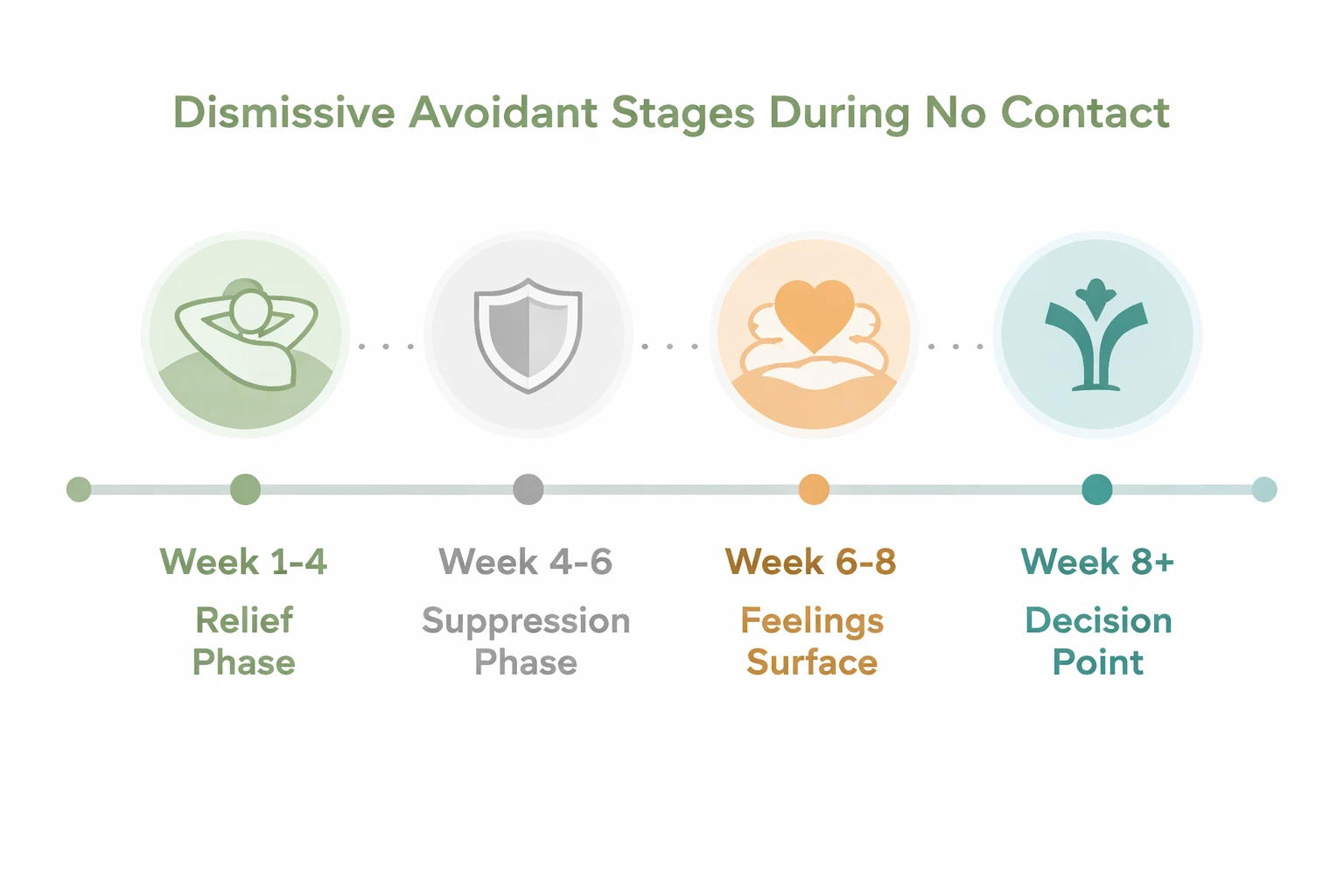
Weeks 1-4: The Relief Phase
Immediately after the breakup and into the first month, dismissive avoidants typically experience:
- Freedom: No more compromise, accommodation, or emotional labor
- Space: Time and energy redirected to personal interests
- Calm: Their nervous system settles without intimacy pressure
- Avoidance confirmation: "This is why relationships do not work for me"
During this phase, they genuinely feel fine. This is not an act. The relationship stressed them on a level they may not have consciously recognized, and its absence brings real relief.
What you will likely see: Complete silence, no social media engagement, seemingly moved on, possibly even dating casually.
Weeks 4-6: The Suppression Phase
As time passes, emotions that were immediately suppressed after the breakup begin stirring. But dismissive avoidants are experts at pushing feelings back down.
During this phase, they experience:
- Fleeting thoughts about you that get quickly dismissed
- Momentary loneliness reframed as "just being in my feelings"
- Mild curiosity about your life that does not translate to action
- Continued belief that being alone is better
What you will likely see: Still silence. Maybe occasional social media views. Nothing that indicates emotional engagement.
Weeks 6-8: Feelings Surface
This is when the delayed processing finally begins. Research and clinical experience suggest the 6-8 week mark is when dismissive avoidants actually start feeling the breakup.
They may experience:
- Unexpected sadness they cannot easily explain away
- Genuine missing that surprises them
- Nostalgia for positive relationship moments
- Recognition that something is actually lost
What you might see: Subtle engagement (viewing stories, liking old posts), reaching out with casual pretexts, showing up in spaces you frequent.
Week 8+: Decision Point
After emotional processing begins, dismissive avoidants face a decision:
- Reach out and risk vulnerability again
- Suppress further and recommit to independence
- Idealize from distance without taking action
Most dismissive avoidants will not reach out even when they miss you. Their pride, fear of vulnerability, and commitment to self-sufficiency often override their longing. But some do—and the 6-8 week window tends to be when this happens if it happens at all.
Does NC Create Missing in DAs?
This is the core question: does no contact actually make a dismissive avoidant miss you?
The Honest Answer: Sometimes
No contact can create missing in dismissive avoidants, but through a different mechanism than with other attachment styles.
With anxiously attached exes: Absence creates immediate panic and pursuit. Missing is intense and drives action.
With dismissive avoidants: Absence allows idealization. Once you are gone and no longer a "threat" to their independence, they can safely romanticize the relationship in memory.
The key insight: avoidants can only long for someone who is unavailable. Your presence during the relationship may have triggered their avoidance. Your absence allows their attachment needs to surface without the fear that closeness brings.
Why Missing Does Not Always Mean Action
Even when dismissive avoidants miss you, they often:
- Reframe missing as weakness
- Talk themselves out of reaching out
- Wait for you to make the first move
- Prefer longing from a distance to vulnerable connection
Missing you does not guarantee they will do anything about it. That is the frustrating reality of dealing with this attachment style.
Why NC Might Work (Eventually)
Despite its limitations, no contact can work with dismissive avoidants for specific reasons.
It Gives Them What They Need
Paradoxically, giving avoidants space is how you eventually draw them back. Pursuit pushes them away. Distance allows approach.
No contact works because it:
- Removes the intimacy pressure that triggered their avoidance
- Lets their nervous system calm completely
- Creates conditions for genuine (rather than pressured) longing
- Demonstrates you can function independently
It Triggers Idealization
Dismissive avoidants often struggle to appreciate partners while in the relationship. Once the relationship ends and enough time passes, they begin idealizing.
They remember:
- The good moments without the pressure
- Your positive qualities without the "demands"
- The connection without the vulnerability requirements
This idealization can motivate eventual reconnection—though usually only after significant time.
It Proves Your Independence
Dismissive avoidants are attracted to independence. By successfully implementing no contact (without desperation, without breaking it, without drama), you demonstrate exactly the emotional self-sufficiency they find attractive.
If you can survive without them—truly survive, not just pretend—you become more appealing.
Why NC Might Not Work
No contact is not a magic solution with dismissive avoidants. Here is why it often fails.
They Are Comfortable Alone
Unlike other attachment styles, dismissive avoidants genuinely enjoy solitude. Your absence does not create painful longing—it creates peaceful independence.
They can go months or even years without missing someone enough to act. No contact does not create the urgency it creates with other exes.
They Move On Completely
Some dismissive avoidants use the breakup as confirmation that relationships are not for them. Rather than eventually missing you, they recommit to singlehood or move into a new relationship without processing the previous one.
They Interpret NC Negatively
Some dismissive avoidants view your no contact as:
- Proof you were "too emotional" and they were right to leave
- Punishment, which confirms relationships bring drama
- Evidence that you have already moved on, which justifies their detachment
Rather than creating longing, your silence may simply confirm their avoidant beliefs.
Modified NC Approach for DAs
Given the unique ways dismissive avoidants respond, a modified approach may work better than strict no contact.
The "Soft No Contact" Alternative
Instead of complete silence:
- Remain friendly if paths cross: Do not be cold or punishing
- Keep social media connection open: Do not dramatically unfollow
- Respond briefly if they reach out: Warm but not desperate
- Do not initiate: Let them come to you
This approach maintains your dignity without triggering their "all or nothing" thinking.
Focus on Genuine Growth
The time apart works best when you authentically improve your life:
- Pursue interests that fulfill you
- Build meaningful friendships
- Work on your own attachment patterns
- Become genuinely happy, not performatively happy
Dismissive avoidants notice authentic growth. They see through performances. Your real transformation is more attractive than any strategic behavior.
Timeline Expectations
With dismissive avoidants, think in months rather than weeks:
- Minimum effective period: 6-8 weeks
- More realistic: 3-6 months
- Not unusual: 6-12 months before meaningful reconnection
If you cannot maintain composure for this timeline, you may need to accept that reconciliation with a DA requires patience you may not have—and that is okay.
You can manage NC with AI support to help process the waiting period constructively.
What to Do if DA Reaches Out
If your dismissive avoidant does eventually reach out, how you respond matters significantly.
Recognize What Their Reach-Out Means
A dismissive avoidant reaching out is significant—it means they:
- Overcame their natural impulse to stay distant
- Actually missed you enough to take action
- Are testing whether connection feels safe
However, it does not mean they are ready for full commitment or have resolved their attachment patterns.
Response Strategy
Do:
- Respond warmly but not eagerly
- Match their communication style and pace
- Keep initial conversations light
- Show you have been living your life
Do not:
- Immediately discuss the relationship
- Express how much you missed them
- Push for clarity on their intentions
- Overwhelm with emotion or expectations
Look for the Signs They Might Return
Their reach-out might be the beginning of gradual reconnection. Watch for:
- Increased frequency of contact over time
- Slightly deeper conversations
- Subtle hints about seeing you
- Nostalgia for your time together
Or it might be a one-off. Let their continued actions (not just initial contact) guide your expectations.
Protect Yourself
One reach-out does not mean reconciliation. A dismissive avoidant might:
- Test the waters then disappear again
- Enjoy connection at a distance without committing
- Cycle in and out without ever fully returning
Stay grounded in your own healing regardless of their behavior.
The Bottom Line
No contact with a dismissive avoidant is not a guaranteed strategy—it is a gamble with better-than-average odds but a longer timeline than you might want.
The real question is not whether no contact works, but whether waiting for a dismissive avoidant aligns with what you want for your life.
If you can genuinely focus on yourself, heal your own attachment wounds, and remain open to possibility without attachment to outcome—no contact can create conditions for reconnection.
If you are white-knuckling through no contact, obsessing over their behavior, and putting your life on hold—the strategy is costing more than it is worth, regardless of whether it "works."
Whatever you choose, choose it consciously. A dismissive avoidant requires patience that not everyone can or should give.
Ready to Start Your No Contact Journey?
Track your progress, get AI coaching when the urge to text hits, and become the strongest version of yourself.
Free to start • No credit card required
Related topics