


Your avoidant partner talks about their ex in ways that feel oddly reverent. They compare your relationship to a past one you can never quite measure up to. Or maybe you are the ex—someone they left but cannot seem to forget, reaching out months later as if time froze.
Welcome to the confusing world of avoidant phantom ex syndrome, a psychological pattern that keeps avoidants longing for past lovers while struggling to fully invest in present relationships.
Download No Contact AI
No contact day counter, private journal, and chat support to get through a breakup.
Download the app
Scan with your phone
Redirects to iOS or Android.
Understanding avoidant attachment patterns is essential context for this phenomenon. This article explains why phantom exes exist, how to know if you are competing with one—or if you have become one.
What Is Phantom Ex Syndrome?
Phantom ex syndrome refers to the persistent idealization of a past romantic partner, creating an emotionally significant presence despite the relationship being over.
The concept was introduced in the book Attached by Amir Levine and Rachel S. F. Heller, identifying it as a deactivating mechanism particularly common in avoidant attachment.
Key characteristics of a phantom ex:
- An idealized memory rather than a realistic person
- Someone the avoidant compares new partners against
- A past relationship remembered for its peaks while its problems are forgotten
- An emotional presence that prevents full investment in current relationships
Here is the crucial insight: a phantom ex does not even need to have been a real person. They can be a romanticized idea of how love is "supposed to" feel—an impossible standard no actual relationship could meet.
Why Avoidants Develop Phantom Exes
Avoidants are particularly prone to phantom ex syndrome due to their unique psychological wiring.
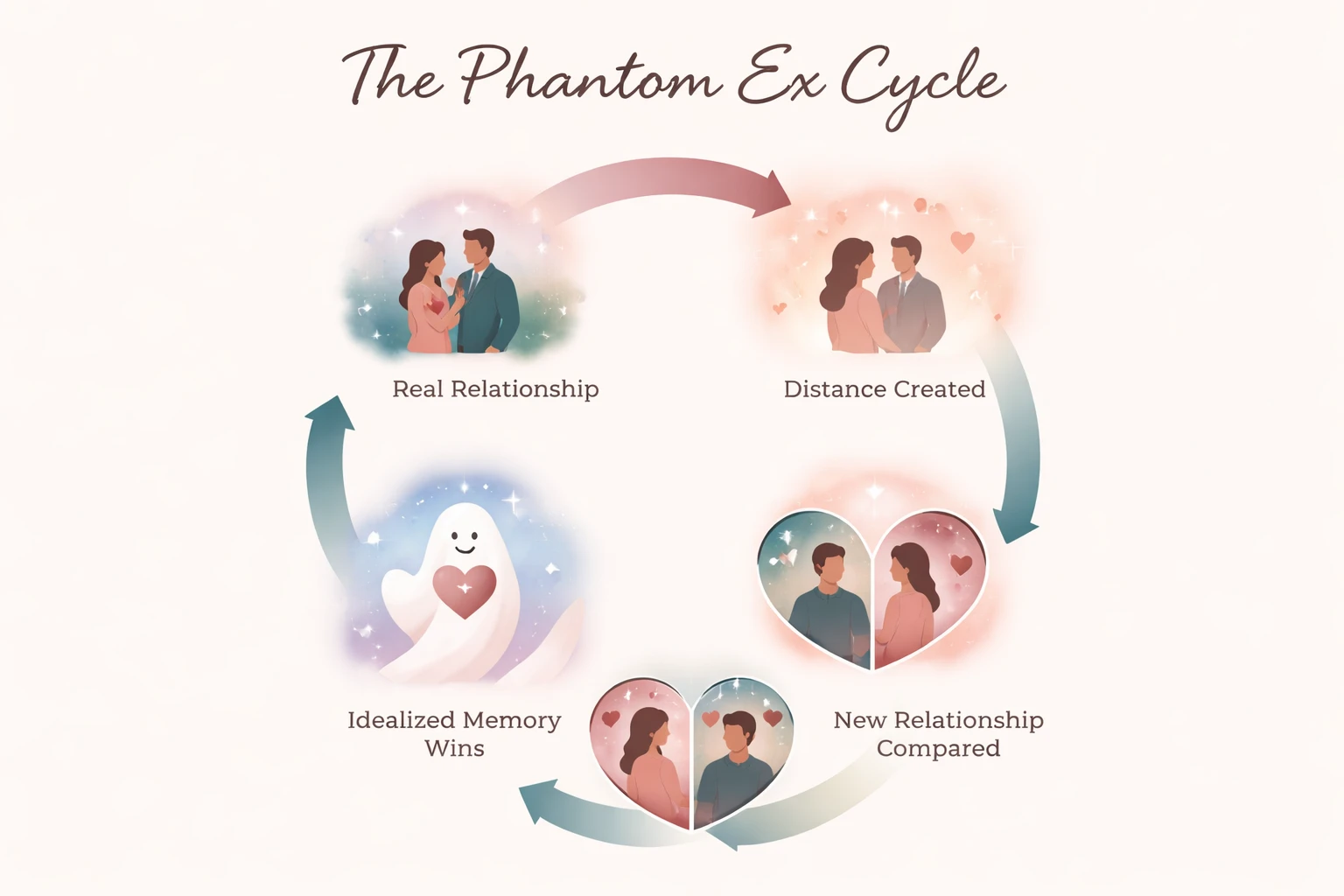
The Distance Allows Idealization
While in a relationship, avoidants feel the pressure of intimacy. Their partner is present, making demands, requiring emotional engagement. This triggers avoidant defenses.
But once the relationship ends and distance is created, something shifts:
- The "threat" of intimacy disappears
- Deactivation systems no longer need to be triggered
- Long-suppressed attachment needs can safely surface
- They can finally feel their feelings without fear
Paradoxically, avoidants are free to long for someone only once that person is unavailable. The very absence that creates a phantom ex is what allows the avoidant to feel love without fear.
The Peak-End Rule
Psychology research shows that people remember experiences based on their peak moments and how they ended, not the overall average. This "peak-end rule" explains why avoidants idealize exes.
They remember:
- The exciting early days
- Moments of deep connection
- Peak positive experiences
They forget or minimize:
- Daily conflicts
- Communication breakdowns
- The reasons the relationship ended
- Their own avoidant behavior
It Serves as a Deactivation Strategy
The phantom ex is ultimately a protection mechanism. By maintaining an idealized past love:
- Avoidants can avoid fully investing in present relationships
- New partners will inevitably fall short of the fantasy
- The avoidant stays emotionally safe from real intimacy
- They have a built-in excuse for why current relationships do not work
The phantom ex and the "perfect future partner" work together to keep avoidants from being present in actual relationships.
Signs Your Partner Has a Phantom Ex
How do you know if you are competing with someone who no longer exists (at least not as they are remembered)?
Verbal Signs
- They mention this ex often, usually positively
- They describe the ex in idealized terms ("We had such a connection...")
- They compare you unfavorably, even subtly
- They become defensive when you mention the ex
- They express regret about how things ended
Behavioral Signs
- They maintain contact or social media connection with this ex
- They get emotional when something reminds them of the relationship
- They seem unable to fully commit to your relationship
- They keep mementos, photos, or other reminders visible
- Their emotional availability changes when the ex comes up
Relationship Pattern Signs
- They pull away whenever your relationship deepens
- They seem to be waiting for something better
- They express dissatisfaction without clear reasons
- They sabotage the relationship when things are going well
- Your relationship feels like it has an invisible third party
Am I Someone's Phantom Ex?
The other side of this dynamic is equally important: you might be someone's phantom ex without realizing it.
Signs You Might Be Their Phantom Ex
- They reach out months or years after the breakup
- They express regret about ending things
- They compare new partners to you (you hear this through mutual friends)
- They idealize your time together despite the real problems
- They seem unable to fully move on
Look for the signs of hidden feelings that indicate you might occupy this space in their mind.
The Uncomfortable Truth
Being a phantom ex might feel flattering—they still think about you. But recognize what you actually represent:
- An idealized fantasy, not the real you
- A safe emotional attachment because you are unavailable
- A comparison tool to keep them distant from others
- An escape from present intimacy
You are not loved as a real person in their current life. You are a memory being used to avoid real connection.
Can Avoidants Get Over Their Phantom Ex?
The honest answer: it is difficult, but possible.
What Keeps the Phantom Ex Alive
- Continued distance: As long as the ex remains unavailable, the idealization continues
- No reality check: Without present interaction, the fantasy cannot be tested
- Unprocessed attachment: The avoidant has not done the internal work to understand their patterns
- Fear of present intimacy: The phantom ex serves a protective function they are not ready to give up
What Helps Release a Phantom Ex
- Awareness: Recognizing the pattern is the first step
- Therapy: Working through attachment wounds that created the pattern
- Reality contact: Sometimes encountering the actual ex shatters the fantasy
- Secure relationship experience: Experiencing what real intimacy feels like
- Time and intentional work: Choosing to invest in present rather than past
The Caveat
An avoidant must want to release their phantom ex. If the pattern is serving a protective function they are not ready to abandon, no amount of logic will change it.
If You Are Dating Someone With a Phantom Ex
This is a painful position. Here is how to navigate it.
Assess the Severity
Is the phantom ex:
- A minor ghost they occasionally mention?
- A moderate presence that affects your relationship?
- A major barrier that makes real connection impossible?
The appropriate response depends on severity.
Do Not Compete
You cannot win against a fantasy. The phantom ex is idealized precisely because they are not present. Trying to measure up to a memory is impossible.
Instead:
- Focus on building genuine connection
- Be yourself rather than trying to be "better" than someone else
- Recognize that their idealization says more about them than about the ex
Have an Honest Conversation
If the phantom ex is significantly affecting your relationship:
"I notice you talk about [ex] often, and sometimes I feel like I am being compared to someone I can never be. I want to build something real with you, but that requires us both being present here, not in past relationships."
Know Your Limits
If your partner cannot or will not release their phantom ex, you face a choice:
- Accept a relationship where you are competing with a ghost
- Leave to find someone who can be fully present
Neither choice is wrong, but be honest with yourself about what you can accept.
If You ARE the Phantom Ex
Perhaps you have recognized yourself in this article—you are the idealized memory someone cannot release.
What This Position Means
Being a phantom ex means:
- They think about you, but not accurately
- They miss an idea of you, not necessarily the real you
- Their feelings reflect their attachment patterns more than your actual worth
- Reconciliation may not match the fantasy they have built
Should You Reach Out?
If you are considering reconnection with someone who holds you as a phantom ex:
Consider first:
- Why did the relationship actually end?
- Have they done any work on their attachment patterns?
- Would reuniting just restart the same cycle?
- Are you drawn to them, or to being idealized?
If you do reach out:
- Be prepared for reality to shatter their fantasy
- Expect potential disappointment on both sides
- Do not assume their longing means readiness for real relationship
For more on whether reconnection is likely, explore will they come back for you.
Processing Being a Phantom Ex
Whether you reconnect or not, being someone's phantom ex can bring up complex emotions. You might:
- Feel flattered by being idealized
- Feel objectified by being reduced to a fantasy
- Wonder if the relationship could have worked
- Question whether you should have fought harder
You can process being a phantom ex with No Contact App to work through these feelings and move forward.
The Deeper Pattern
Phantom ex syndrome reveals something fundamental about avoidant attachment: the safest love is distant love. Present partners trigger fears of engulfment. Only absent lovers can be safely adored.
Whether you are competing with a phantom ex, you ARE one, or you recognize this pattern in yourself—awareness is the beginning of change.
Real love requires presence. Phantom love is safe precisely because it asks nothing of us. Choosing presence over phantom is the work of healing avoidant attachment.
Download No Contact AI
No contact day counter, private journal, and chat support to get through a breakup.
Download the app
Scan with your phone
Redirects to iOS or Android.
Related topics