They pull away when things get close. They deflect compliments, avoid deep conversations, and seem emotionally unreachable. Yet something in their eyes, in the way they look at you when they think you are not watching, tells a different story.
If you are involved with someone who has avoidant attachment, you have probably asked yourself a hundred times: do they actually have feelings for me, or am I imagining things?
Here is what most people get wrong about avoidants: their emotional distance does not mean emotional absence. According to research on attachment styles, avoidant individuals often feel emotions intensely—sometimes so intensely that they bury them as a defense mechanism. Their walls are not proof they do not care. Those walls exist precisely because they care more than they know how to handle.
This avoidant attachment guide will help you understand the bigger picture. But right now, let us focus on the specific signs that reveal hidden feelings beneath that guarded exterior.
Ready to Start Your No Contact Journey?
Track your progress, get AI coaching when the urge to text hits, and become the strongest version of yourself.
Why Avoidants Hide Their Feelings
Before diving into the signs, understanding why avoidants hide their emotions will help you interpret their behavior more accurately.
Avoidant attachment develops in childhood when caregivers are emotionally unavailable or dismissive. Children learn that expressing needs leads to disappointment or rejection. The survival strategy they develop? Suppress attachment needs entirely. Pretend independence. Build walls.
This is not a conscious choice in adulthood—it is automatic. When an avoidant starts feeling deeply for someone, their nervous system registers intimacy as danger. Their brain essentially says: "The last time you needed someone this much, you got hurt. Protect yourself."
So they hide their feelings. Not because those feelings are absent, but because those feelings are terrifying.
Key insight: An avoidant hiding their feelings is not rejecting you. They are protecting themselves from the vulnerability that loving you creates.
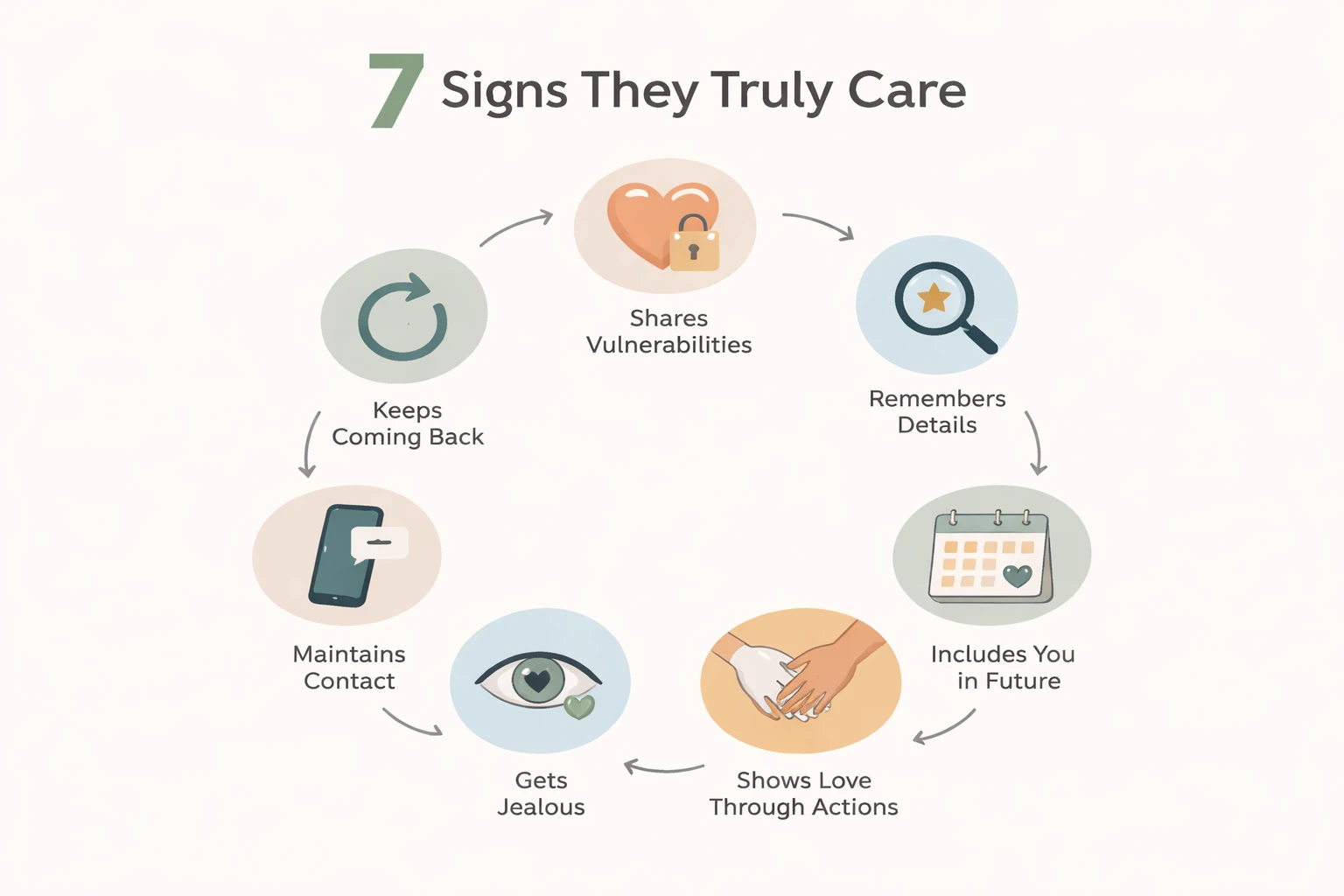
Sign 1: They Keep Coming Back
Despite pushing away, an avoidant who has deep feelings will always find their way back to you.
Watch the pattern: they withdraw when closeness increases, creating distance that feels devastating. But then, something happens. A text out of nowhere. An unexpected call. They show up again, often with a seemingly trivial excuse.
This return is significant. An avoidant who truly does not care would simply stay gone. The pull-push dynamic, while exhausting, actually indicates internal conflict between their protective mechanisms and genuine feelings.
What this looks like:
- They reach out after periods of silence with casual messages
- They find reasons to see you even after creating distance
- They maintain some form of connection even during withdrawals
- Their returns feel relief-driven, like they could not stay away
The cruel irony is that avoidants often do not recognize this pattern as love. They might interpret their discomfort during separation as simply missing "the routine" rather than missing you. But their actions reveal what their words cannot admit.
For more on this return pattern, explore the signs they might return after pulling away.
Sign 2: They Share Vulnerabilities (Rarely)
When an avoidant shares something personal, something from their past, their fears, their true thoughts—pay attention. This is not small talk. This is significant.
Vulnerability feels genuinely dangerous to avoidants. Opening up triggers fears of rejection, judgment, and loss of control. They have spent their lives learning that emotional exposure leads to pain. So when they lower their guard with you, even momentarily, it means you have reached a place in their heart that very few people access.
What vulnerability looks like from an avoidant:
- Mentioning childhood experiences or family dynamics
- Admitting fears or insecurities, even briefly
- Sharing opinions they usually keep private
- Talking about past relationships honestly
- Acknowledging that they struggle with closeness
These moments might be fleeting. They might quickly change the subject or deflect with humor. But do not dismiss the significance of what just happened. An avoidant who feels nothing would never take that risk.
Sign 3: They Remember Small Details
One of the most telling signs an avoidant has deep feelings is their attention to details about you—details they act like they did not notice.

He remembers how you take your coffee. She recalls a story you told months ago. They notice when your mood shifts, even when you have not said anything. They bring up something you casually mentioned wanting, showing they were listening even when they seemed distracted.
This attentiveness reveals investment. Avoidants who do not care genuinely do not pay attention. They are emotionally checked out and it shows. But an avoidant hiding feelings? They are absorbing everything about you, even while maintaining emotional distance.
Signs of hidden attention:
- Remembering your preferences without being told twice
- Noticing changes in your appearance or mood
- Recalling conversations from weeks or months ago
- Anticipating your needs before you express them
- Keeping mental notes of things that matter to you
They might never say "I was paying attention because I care about you." But their memory for your details speaks that truth anyway.
Sign 4: They Include You in Their Future
Even casually mentioning you in future scenarios is significant coming from someone with avoidant attachment.
Avoidants struggle with commitment because commitment means vulnerability. Planning a future together means choosing one person, investing in that person, becoming dependent on that person. These concepts trigger their core fears.
So when an avoidant says things like "when we go there" or "next year we could" or includes you in hypothetical future scenarios, they are telling you something important: they cannot imagine that future without you, even if they cannot explicitly say it.
Listen for phrases like:
- "We should try that restaurant sometime"
- "Next summer, we could take a trip"
- "When you meet my family eventually"
- "I was thinking about where we might live someday"
These statements might seem casual, but for an avoidant, they represent significant emotional territory. They are planting you in their mental landscape of tomorrow.
Sign 5: They Show Love Through Actions
Words of affirmation feel risky for avoidants. Saying "I love you" makes their feelings real and therefore vulnerable. But actions? Actions feel safer.
An avoidant with deep feelings will show care through what they do:
- Practical help when you need it (fixing things, running errands, solving problems)
- Physical presence during difficult times, even if they are awkwardly silent
- Small thoughtful gestures (bringing you food, remembering appointments)
- Protective behavior (checking if you got home safe, warning you about concerns)
- Making effort in areas you have mentioned matter to you
This is their love language: service, presence, and quiet demonstrations of care. They might not say the words you want to hear, but they are trying to show you in the only way that feels safe.
Important distinction: Actions must be consistent, not just occasional grand gestures. An avoidant in love shows up regularly in small ways. Someone who only makes effort sporadically may not be demonstrating hidden love—they may simply be keeping you available when convenient.
Sign 6: They Get Jealous
Here is a sign that often catches avoidants off guard: unexpected jealousy.
An avoidant who does not have feelings would not care who you spend time with, who texts you, or who pays attention to you. But an avoidant hiding deep feelings? They might have surprising reactions to perceived romantic competition.
What jealousy looks like from an avoidant:
- Suddenly asking about someone you mentioned
- Subtle changes in mood when you talk about someone else
- Finding reasons to criticize people who show interest in you
- Increased attention and effort after you spend time with others
- Questions designed to gauge whether someone is a threat
They might not express jealousy directly. They might rationalize it as "just curiosity" or pretend indifference immediately after. But pay attention to those initial, unguarded reactions. Jealousy reveals investment—and avoidants do not get jealous over people they do not care about.
Sign 7: They Maintain Contact After Breakup
If you have been through a breakup or separation with an avoidant, this sign is particularly telling.
An avoidant who has truly moved on will detach completely. They are experts at emotional cutoff—it is a core coping mechanism. So if your avoidant ex maintains contact, finds reasons to reach out, or cannot seem to fully disappear from your life, their feelings likely run deeper than their departure suggested.
Post-breakup signs of hidden feelings:
- Reaching out with excuses (returning belongings, "just checking in")
- Keeping you on social media and engaging with your content
- Responding quickly when you contact them
- Asking mutual friends about you
- Showing up at places they know you frequent
The avoidant who has moved on becomes a ghost. The avoidant with hidden feelings becomes a lingering presence they cannot seem to escape—because letting go would mean acknowledging how much you meant.
What These Signs Mean for You
Recognizing these signs can bring validation: "They do have feelings. I was not imagining things." That recognition matters after months or years of questioning yourself.
But here is the harder truth you need to consider: having feelings is not the same as being capable of a healthy relationship.
An avoidant can love you deeply and still:
- Struggle to express that love consistently
- Withdraw when you need them most
- Prioritize self-protection over your connection
- Leave you feeling emotionally starved
You can decode their behavior with AI to understand what is happening. But understanding their feelings does not obligate you to wait indefinitely for them to change.
Questions to ask yourself:
- Are my emotional needs being met in this relationship?
- Am I constantly anxious about where I stand with them?
- Do I feel secure, or am I always interpreting and analyzing?
- Is this person actively working on their attachment patterns?
- Am I accepting crumbs when I deserve the whole meal?
Someone can have deep hidden feelings for you and still not be capable of giving you what you need. Those two things can both be true.
Moving Forward With This Knowledge
Understanding that your avoidant partner or ex has hidden feelings is just the first step. What you do with this knowledge depends on your situation:
If you are still together: Use this understanding to have compassionate conversations. Name what you observe without accusation. Create safety for them to express feelings gradually. But also communicate your needs clearly—patience has limits.
If you have broken up: Knowing they have feelings does not mean reconciliation is wise. Consider whether the relationship met your needs, whether they are doing active work on themselves, and whether what attracts avoidants aligns with who you want to be.
If you are questioning everything: Trust your observations. You are not crazy for sensing feelings beneath their distance. But also trust yourself to decide whether hidden love is enough—or whether you deserve love that does not require constant excavation to find.
Loving an avoidant is a study in contradictions. They push you away to keep you close. They hide feelings precisely because those feelings are overwhelming. Their walls protect a heart that cares more than they can safely show.
Now that you see the signs, the question becomes: what does this mean for your path forward?
Ready to Start Your No Contact Journey?
Track your progress, get AI coaching when the urge to text hits, and become the strongest version of yourself.
Free to start • No credit card required
Related topics