
Fearful avoidants are a puzzle wrapped in a contradiction. They push you away then miss you desperately. They end the relationship then seem confused about whether they made the right choice. And making them miss you requires understanding this internal battle—not just applying generic "make your ex miss you" advice.
If you want to know how to make a fearful avoidant miss you, you need strategies designed specifically for their unique attachment style. What works with dismissive avoidants or anxiously attached exes will backfire with fearful avoidants.
Ready to Start Your No Contact Journey?
Track your progress, get AI coaching when the urge to text hits, and become the strongest version of yourself.
Understanding avoidant attachment dynamics provides essential context. This guide focuses specifically on the fearful avoidant experience.
Do Fearful Avoidants Actually Miss Their Ex?
Here is the good news: yes, fearful avoidants miss their exes. Often deeply and painfully.
Unlike dismissive avoidants who can suppress emotions for extended periods, fearful avoidants have an anxious component that makes them acutely aware of loss. They feel the absence. They think about you. They may even obsess.
Why fearful avoidants miss exes intensely:
- Their anxious side craves connection and fears abandonment
- They often regret relationship decisions after making them
- They idealize past relationships once safe distance exists
- They genuinely attached to you, even if they could not show it consistently
The challenge is not making them miss you—the challenge is creating conditions where that missing leads to reconnection rather than further retreat.
The FA Missing Pattern
Fearful avoidants experience missing differently than other attachment styles. Understanding their pattern helps you respond strategically.
The Pendulum Effect
Fearful avoidants swing between anxious and avoidant states. Their missing follows this pendulum:
Avoidant swing: "I needed space. This is for the best. I feel relieved."
Anxious swing: "What have I done? I miss them so much. Maybe I made a mistake."
This cycle can repeat multiple times before stabilizing. Understanding FA breakup stages shows this pattern in detail.
When Missing Peaks
Fearful avoidants typically feel missing most intensely:
- Within the first 1-3 months (faster than dismissive avoidants)
- When something triggers positive memories
- When they see you moving forward without them
- When their anxious side is activated
The Timing Challenge
If you reach out when they are in an avoidant swing, they will withdraw. If you stay too distant when they are in an anxious swing, they may interpret your silence as rejection and shut down protectively.
This is why making a fearful avoidant miss you requires careful calibration.
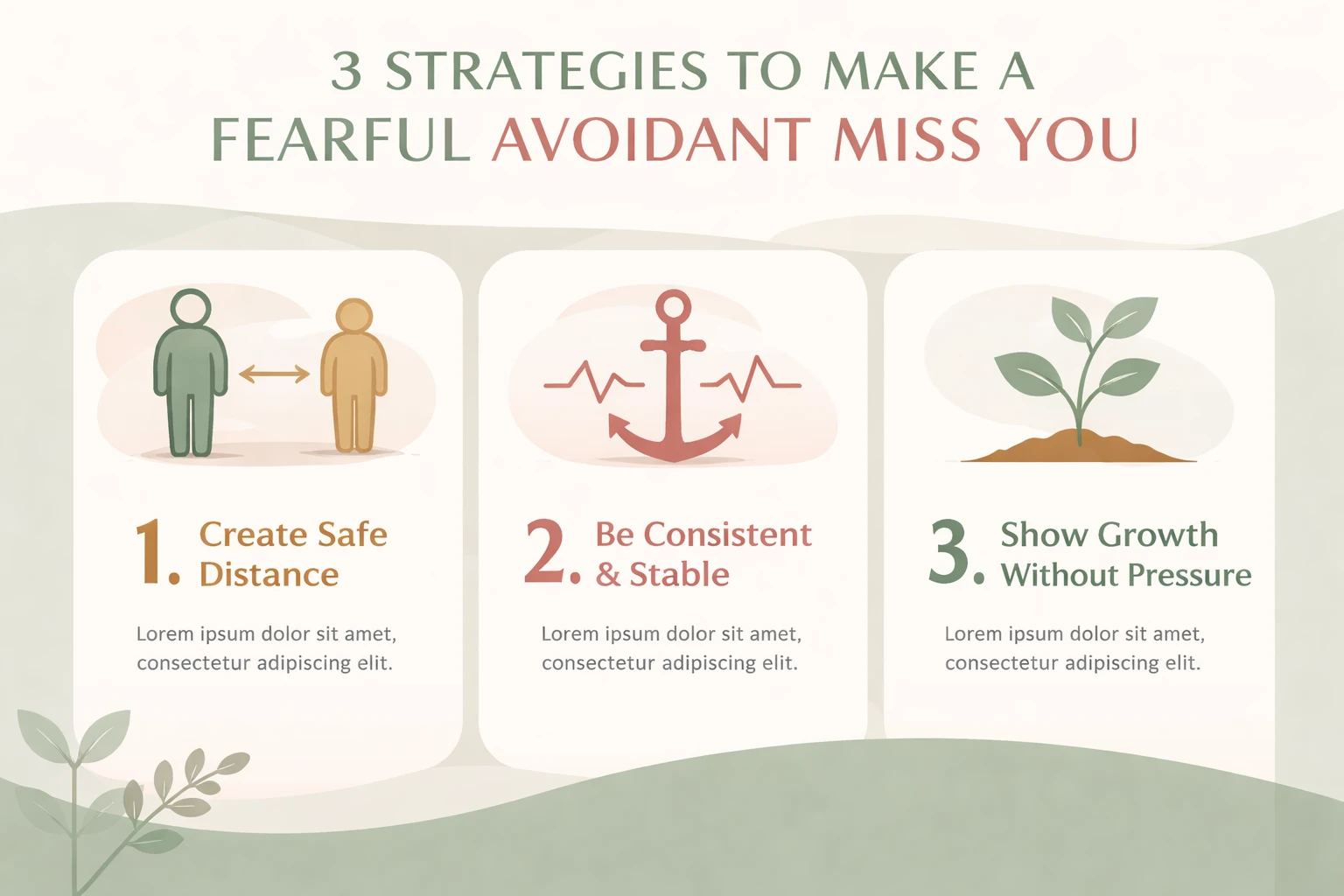
Strategy 1: Create Safe Distance
The foundation of making a fearful avoidant miss you is space—but the right kind of space.
Why Space Works
Space allows fearful avoidants to:
- Regulate their nervous system
- Feel the absence without pressure
- Access their anxious side naturally
- Miss you without feeling trapped
The FA-Specific Approach
With fearful avoidants, shorter no contact periods work better than extended ones:
- Recommended duration: 21-30 days
- Compare to dismissive avoidants: 45+ days
Why shorter? Because fearful avoidants have an anxious component. Too much distance for too long triggers their abandonment fears, causing them to shut down protectively or assume you have moved on.
Safe Distance vs. Cold Distance
Safe distance:
- No initiated contact
- Warm response if they reach out
- Maintained social media presence (not blocking or unfollowing dramatically)
- No punishment or coldness
Cold distance:
- Blocking on everything
- Refusing to acknowledge them
- Punishing silence
- Dramatic statements about needing space
Safe distance creates longing. Cold distance creates fear and protective shutdown.
Strategy 2: Be Consistent and Stable
Fearful avoidants grew up with inconsistent caregiving. Dramatic emotional swings feel familiar but also retraumatizing. Consistency stands out.
What Consistency Looks Like
- Same warm tone whenever you do interact
- No hot and cold behavior from your side
- Predictable, calm responses
- Following through on what you say
Why Stability Attracts
When you remain consistent despite their inconsistency, you demonstrate secure attachment—exactly what fearful avoidants unconsciously long for but have rarely experienced.
Your stability says: "I am not going to punish you with drama. I am not going to abandon you. I am also not going to chase you desperately."
This is remarkably attractive to someone whose experience has been dramatic swings.
The Reassurance Balance
Fearful avoidants need some reassurance, but too much feels suffocating:
Too much reassurance: Constant check-ins, declarations of love, pressure to discuss feelings
Too little reassurance: Complete coldness, ambiguity about whether you care, mixed signals
Right balance: Occasional warmth that confirms connection without demanding response
Example: If they reach out and you respond warmly, that is reassurance. If you then follow up five times asking why they are not responding more, that is pressure.
Strategy 3: Show Growth Without Pressure
Nothing makes a fearful avoidant miss you more than seeing you become a better version of yourself—without any indication that you are doing it to win them back.
Why Growth Matters to FAs
Fearful avoidants often leave relationships partly due to their own fears and patterns. When they see you thriving:
- Their anxious side fears losing you permanently
- Your growth suggests the relationship could be different
- Your independence is attractive rather than threatening
- They start questioning their decision
How to Show Growth
Do:
- Post naturally about your life (not performatively)
- Pursue interests you talked about during the relationship
- Spend time with friends and family
- Take visible steps toward your goals
- Appear genuinely fulfilled
Do not:
- Tag them or reference them in posts
- Make obvious attempts to show them what they are missing
- Post things designed to make them jealous
- Announce your growth with dramatic before/after narratives
Growth They Can Witness
Ideally, your growth should be visible enough that they naturally notice without you directing their attention to it. Mutual friends mentioning your positive changes, social media updates, or simply running into you and seeing the difference.
You can navigate FA dynamics with AI to track your progress and maintain perspective during this period.
What Does Not Work With FAs
Fearful avoidants respond poorly to strategies that work with other attachment styles. Avoid these common mistakes.
Manipulation and Games
Fearful avoidants are hyper-attuned to manipulation because of childhood experiences. They will detect game-playing and interpret it as:
- Confirmation that relationships are unsafe
- Proof that you are not trustworthy
- Justification for their protective distance
Jealousy Tactics
Making a fearful avoidant jealous typically backfires:
- Their avoidant side sees it as confirmation you have moved on
- Their anxious side feels hurt and rejected
- They withdraw rather than pursue
Excessive Pursuit
Chasing a fearful avoidant:
- Triggers their avoidant protective mechanisms
- Makes you seem desperate and low-value
- Removes the space they need to miss you
Complete Disappearance
Going completely silent for extended periods:
- Triggers abandonment fears
- Can cause them to shut down emotionally
- May lead them to assume reconciliation is impossible
Signs a FA is Missing You
How do you know if your strategies are working? Watch for these signs.
Direct Signs
- Reaching out with casual messages
- Viewing your stories consistently
- Liking or engaging with your posts
- Asking mutual friends about you
Indirect Signs
- Posting content that seems directed at you
- Showing up at places you frequent
- Changes in their online behavior when you post
- Hesitation when you run into each other
The Push-Pull Pattern
A fearful avoidant who is missing you may:
- Reach out then pull back
- Seem warm then suddenly distant
- Test the waters without fully committing
This inconsistency is frustrating but actually indicates they are processing feelings. Complete indifference looks different—they simply would not engage at all.
For detailed analysis of return indicators, explore signs of return from avoidant exes.
The Honest Reality
Making a fearful avoidant miss you is possible—they likely already do. The real challenge is creating conditions where that missing translates into healthy reconnection.
Even if you do everything right:
- They may need months to work through their process
- Their return might be tentative and require patience
- Old patterns may resurface without their active personal work
Your goal should not be engineering their emotions but becoming someone who deserves a healthy relationship—with them or with someone new.
If they see you growing, staying consistent, and creating a life you love, they will miss you. What they do with that missing is ultimately their choice.
Ready to Start Your No Contact Journey?
Track your progress, get AI coaching when the urge to text hits, and become the strongest version of yourself.
Free to start • No credit card required
Related topics