


One day they are pushing you away, the next they are reaching out with regret. They end the relationship decisively, then seem confused about whether they made the right choice. If you have ever dealt with a fearful avoidant ex, you know this emotional whiplash intimately.
Understanding the fearful avoidant breakup stages can help you make sense of behavior that otherwise feels impossible to decode. Unlike dismissive avoidants who withdraw cleanly, fearful avoidants cycle through intense emotional phases that create confusion for everyone involved—including themselves.
This avoidant attachment breakup guide covers all avoidant types, but fearful avoidants deserve special attention because their breakup experience is uniquely chaotic. Let us walk through what they go through, stage by stage.
Understanding Fearful Avoidant Attachment
Before examining the stages, it helps to understand what makes fearful avoidants different from other attachment styles.
Fearful avoidant attachment (also called disorganized attachment) develops from inconsistent, unpredictable, or frightening caregiving in childhood. The child learns that the same person who provides comfort also causes distress. This creates an impossible bind: they need closeness AND fear closeness simultaneously.
Core fearful avoidant characteristics:
- Intense desire for intimacy combined with fear of vulnerability
- Push-pull behavior in relationships
- Difficulty trusting themselves and their decisions
- Oscillating between anxious and avoidant behaviors
- High emotional reactivity
- Deep fear of both abandonment AND engulfment
Think of it like having one foot on the gas and one on the brake at all times. They want love desperately while being terrified of what love requires.
This internal conflict does not disappear after a breakup—it intensifies. Here is what that looks like.
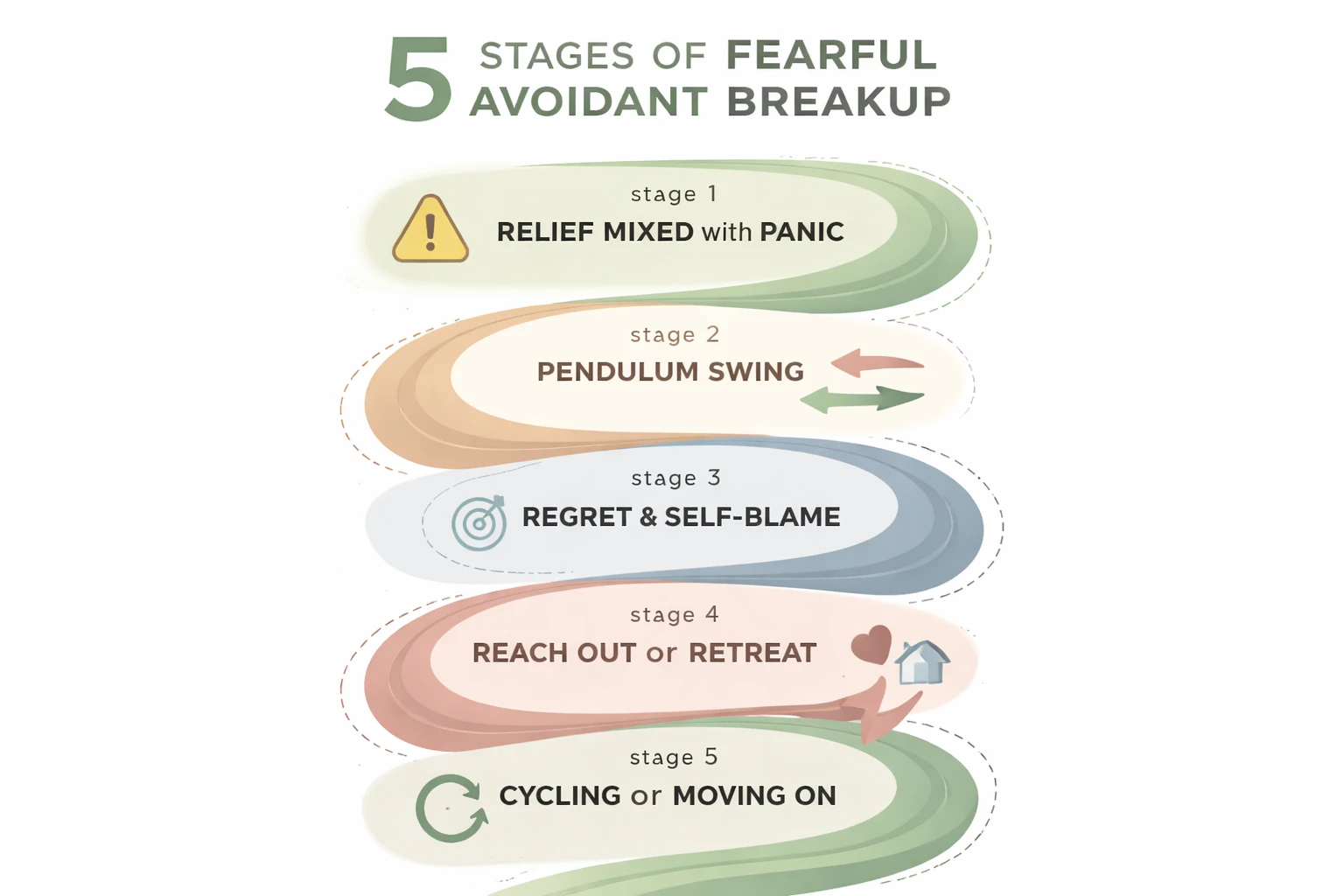
Stage 1: Relief Mixed With Panic
The first stage is defined by contradiction—which perfectly captures the fearful avoidant experience.
The Relief Side
Immediately after the breakup, fearful avoidants often feel genuine relief. Relationships create constant pressure for them: the obligation to be available, the expectations of intimacy, the vulnerability of being known. When that pressure lifts, they experience something like euphoria.
They might think:
- "Finally, I can breathe"
- "The anxiety is gone"
- "I knew this relationship was not right"
- "I feel free for the first time in months"
This relief is real, not performed. The relationship genuinely stressed their nervous system, and ending it provides immediate regulation.
The Panic Side
But here is where fearful avoidants differ from dismissive avoidants: the relief does not last long before panic creeps in.
Unlike dismissive avoidants who can detach cleanly, fearful avoidants also have anxious tendencies. Within hours or days, the relief becomes contaminated with:
- Fear of having made a mistake
- Anxiety about being alone
- Sudden missing of their partner
- Worry about their ex moving on
What you might see: Confusing behavior like reaching out shortly after the breakup, seeming cold one moment and warm the next, or sending mixed signals about whether they want contact.
This stage typically lasts 1-3 weeks, though fearful avoidants who lean more anxious may move through it faster.
Stage 2: The Pendulum Swing
This is the defining stage of fearful avoidant post-breakup behavior: the pendulum swing between their anxious and avoidant sides.
How the Pendulum Works
Imagine their emotional state swinging between two extremes:
Avoidant mode activated:
- "I made the right choice"
- "I need space and independence"
- "The relationship was holding me back"
- "I feel better alone"
Anxious mode activated:
- "What if I lost the best thing I ever had?"
- "I miss them so much it hurts"
- "Maybe I should reach out"
- "What if they find someone else?"
The swing is not random—it is triggered by circumstances. When they feel safe (alone, distracted, busy), the avoidant side dominates. When something triggers attachment fears (seeing your social media, hearing about you, feeling lonely), the anxious side takes over.
What This Looks Like
During this stage, you might experience:
- Hot and cold contact patterns
- Breadcrumbing (small reaches followed by withdrawal)
- Appearing to move on, then suddenly expressing regret
- Anger or blame followed by apologies
- Confusion about what they actually want
Important insight: Research suggests fearful avoidants are not evenly split between anxious and avoidant. Most lean 60/40 or 70/30 toward one side. Understanding which way your ex leans helps predict their behavior:
- More anxious-leaning FA: Will likely reach out sooner, show more visible distress, may try to reconcile within weeks
- More avoidant-leaning FA: Will suppress emotions longer, seem more detached, may take months before feelings surface
This pendulum stage can last anywhere from a few weeks to several months.
Stage 3: Regret and Self-Blame
As the pendulum swings slow and reality sets in, fearful avoidants often enter a painful period of regret and self-blame.
The Inner Critic Awakens
Fearful avoidants generally do not have high self-esteem. Their disorganized attachment created deep insecurity about their own worth and judgment. After a breakup, this inner critic becomes brutal:
- "Why do I always sabotage good things?"
- "What is wrong with me that I cannot do relationships?"
- "I pushed away someone who actually loved me"
- "I am going to be alone forever because I cannot handle intimacy"
This is not productive self-reflection—it is painful rumination that often spirals into shame and self-isolation.
The "Why Did I Do This?" Moment
A common fearful avoidant experience after breaking up with a secure or healthy partner is the devastating realization: "I created the very outcome I was trying to avoid."
They left because closeness felt threatening. But now they are alone, which triggers their abandonment fears. They pushed you away to feel safe, but safety feels lonely. The protection strategy backfired.
What you might see: Depression, withdrawal from social life, increased anxiety, possibly reaching out with emotional vulnerability they could not show during the relationship.
Stage 4: Reach Out or Retreat
This is the decision point stage. After processing regret, fearful avoidants face a choice: attempt reconnection or commit to moving on.
Factors That Influence the Decision
Toward reaching out:
- They lean more anxious than avoidant
- The relationship was relatively healthy
- You have given them space without pursuit
- They have done some self-reflection
- Fear of losing you permanently outweighs fear of intimacy
Toward retreat:
- They lean more avoidant than anxious
- The relationship had significant conflict
- They feel blamed or criticized by you
- They have entered a rebound relationship
- Shame about their behavior prevents contact
What Reach-Out Looks Like
If a fearful avoidant decides to reconnect, expect it to be tentative and testing. They might:
- Send a casual message about something unrelated
- React to social media as a low-risk connection attempt
- Ask mutual friends about you
- Create reasons to contact you (returning belongings, questions)
- Express regret indirectly before directly
For more detailed analysis, explore the signs they might return after the breakup.
The 3-Month Deadline
Research and anecdotal evidence suggest the 3-month mark is critical for fearful avoidants. Around this time, they typically:
- Commit to reconciliation attempts
- Detach and begin investing in new relationships
- Or settle into a pattern of cycling without resolution
If meaningful reconnection has not happened by month three, chances decrease significantly—though they never disappear entirely.
Stage 5: Cycling or Moving On
The final stage is less a destination and more a pattern: either they successfully move forward (with or without you), or they enter a cycling pattern that can persist for months or years.
The Cycling Pattern
Some fearful avoidants get stuck in an endless loop:
- Feel urge to reconnect
- Reach out tentatively
- Get triggered by closeness, withdraw
- Process alone, feel regret
- Return to step 1
This cycling happens because they have not addressed the underlying attachment wounds. Each return is driven by anxiety; each withdrawal is driven by avoidance. Without personal work, the pattern simply repeats.
What cycling looks like from your perspective:
- Periodic contact that never deepens
- Breadcrumbing that maintains connection without commitment
- On-again, off-again dynamics
- Years passing without resolution
Genuine Moving On
A fearful avoidant who genuinely moves on typically shows:
- Consistent distance (not hot and cold)
- Investment in a new relationship
- Evidence of personal growth work
- Changed patterns, not just changed words
- Ability to discuss the relationship with emotional regulation
Moving on does not always mean they stopped caring. It often means they recognized they could not give you what you needed—at least not yet.

FA vs. DA Breakup Differences
Understanding how fearful avoidant breakups differ from dismissive avoidant breakups helps you identify what you are dealing with.
| Aspect | Fearful Avoidant | Dismissive Avoidant |
|---|---|---|
| Initial reaction | Mixed relief/panic | Primarily relief |
| Emotional expression | Volatile, visible | Suppressed, hidden |
| Contact patterns | Hot and cold | Consistent distance |
| Regret visibility | Often expressed | Rarely shown |
| Timeline to feel loss | Weeks to months | Months to years |
| Reach-out style | Emotional, tentative | Casual, detached |
| Cycling likelihood | Very common | Less common |
Key difference: Fearful avoidants are chaotic and confusing because they are internally conflicted. Dismissive avoidants are cold and distant because they have successfully suppressed their attachment needs—at least on the surface.
What This Means for You
Understanding fearful avoidant breakup stages is valuable, but what do you actually do with this knowledge?
During the Early Stages (1-4 weeks)
- Do not chase: Pursuit triggers their avoidant side and pushes them further away
- Do not punish: Anger and blame trigger shame and retreat
- Do stay calm: Your regulated presence feels safer than emotional intensity
- Do give space: Space allows their anxious side to eventually surface
During the Pendulum Stage (1-3 months)
- Do not react to every swing: Hot and cold contact does not require hot and cold responses
- Do maintain boundaries: Respond warmly but do not drop everything when they reach out
- Do live your life: Your moving forward (genuinely, not performatively) creates healthy pressure
- Do not analyze obsessively: You cannot control their process—focus on your own
If They Reach Out
- Be warm but not desperate: Match their energy without overwhelming them
- Do not immediately discuss the relationship: Let connection rebuild before heavy conversations
- Watch for actions: Words from fearful avoidants mean less than consistent behavior
- Protect yourself: Hope is fine, but do not sacrifice your wellbeing for their uncertainty
The Bigger Question
Here is what you need to honestly consider: a fearful avoidant who has not done personal work will likely recreate the same patterns. Their stages are predictable because their wounds are unhealed.
Signs they are genuinely growing:
- They are in therapy or actively working on attachment
- They can discuss their patterns with awareness
- Their behavior is changing, not just their words
- They take responsibility without drowning in shame
Signs you are waiting for someone who is not changing:
- The same hot/cold pattern repeats without progress
- They reach out but cannot sustain connection
- You feel more anxious, not more secure, over time
- Years pass without meaningful change
You can use No Contact App for support while navigating FA unpredictability, but ultimately you must decide whether this dynamic serves your life—regardless of how much you understand their psychology.
Final Thoughts
Loving a fearful avoidant means loving someone at war with themselves. They want you and fear you simultaneously. They leave and regret leaving. They reach out and pull back. The stages are not a straight line—they are a spiral that can repeat indefinitely.
Understanding the fearful avoidant breakup stages gives you clarity. But clarity alone does not create a healthy relationship. That requires two people committed to growth—and commitment is exactly what fearful avoidant attachment makes so difficult.
Whether you wait, move on, or remain open while building your own life, make that choice consciously. You deserve someone who can show up consistently—even if they have to work hard to do it.
If you identify with anxious patterns yourself, exploring if you are anxiously attached may help you understand your side of this dynamic.
 No Contact AI
You can't control if they come back.You can control your silence.
No Contact AI is with you every day you choose not to text.
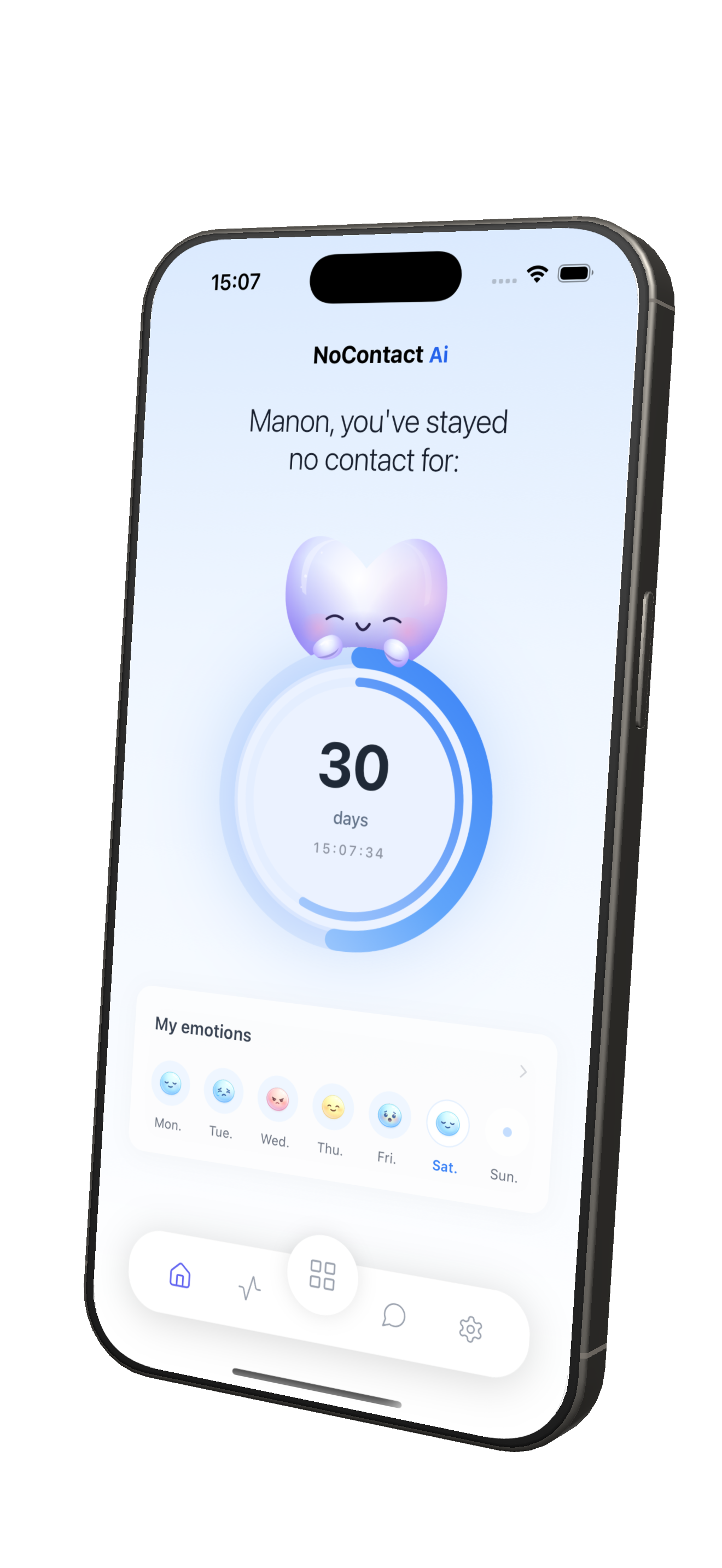
- A No Contact counter that makes every day visible
- An SOS plan when the urge to reach out gets too strong
- An AI coach to talk to, day and night, without judgment
Related topics