One moment everything feels fine. The next, they are distant, unresponsive, and seemingly unreachable. Your texts go unanswered for hours. Your attempts at closeness are met with walls. The warm person you know has suddenly become cold—and you have no idea what you did wrong.
If you are in a relationship with someone who has avoidant attachment, you know this withdrawal pattern intimately. Learning what to do when an avoidant withdraws can mean the difference between escalating conflict and maintaining connection.
Ready to Start Your No Contact Journey?
Track your progress, get AI coaching when the urge to text hits, and become the strongest version of yourself.
This guide will help you understand why they pull away, what responses make things worse, and what actually works. For deeper context on avoidant attachment dynamics, explore our comprehensive guide.
Why Avoidants Withdraw
Understanding the why behind avoidant withdrawal helps you depersonalize behavior that feels incredibly personal.
It Is Not About You (Usually)
When an avoidant withdraws, it rarely means they do not care or that you did something catastrophically wrong. Withdrawal is their nervous system's response to perceived threat—and for avoidants, intimacy itself can feel threatening.
Common triggers for avoidant withdrawal:
- Increased closeness: Moving in together, saying "I love you," making future plans
- Emotional intensity: Deep conversations, expressions of need, conflict
- Perceived pressure: Requests for more time, questions about feelings, relationship discussions
- Feeling engulfed: Too much togetherness, loss of personal space or time
- Vulnerability: Opening up and then feeling exposed
Notice that many of these triggers are positive relationship developments. That is the cruel irony of loving an avoidant: the closer you get, the more their protection mechanisms activate.
The Biological Reality
Avoidant attachment is not a choice—it is a deeply wired survival strategy developed in childhood. When caregivers were consistently unavailable or dismissive, children learned that relying on others leads to disappointment. Independence became safety.
In adulthood, this wiring persists. When intimacy increases, an avoidant's nervous system registers danger. Withdrawal is not conscious rejection—it is automatic self-protection.
This does not excuse harmful behavior. But understanding the mechanism helps you respond more effectively than if you assume they are deliberately hurting you.
The Deactivation Process
What happens inside an avoidant when they withdraw? Understanding this process helps you interpret their behavior accurately.
Phase 1: Trigger
Something activates their attachment fears. It might be obvious (a relationship conversation) or subtle (feeling too comfortable and happy).
Phase 2: Internal Alarm
Their nervous system signals danger. They may not consciously understand why, but they feel an urgent need for distance.
Phase 3: Deactivation Strategies
To create emotional safety, avoidants employ various tactics:
- Physical distance (leaving, avoiding shared spaces)
- Communication shutdown (short responses, delayed replies)
- Emotional walls (seeming cold, detached, irritated)
- Focus on negatives (suddenly finding fault with you or the relationship)
- Idealization of independence (remembering how good life was alone)
Phase 4: Relief
Once sufficient distance is created, their nervous system calms. They may seem completely fine while you are devastated.
Phase 5: Gradual Return
Eventually, without the pressure of closeness, they can reconnect—often acting as if nothing happened.
This cycle can repeat indefinitely without intervention. The goal is not eliminating withdrawal (that requires their personal work) but responding in ways that minimize escalation and maintain connection.
What NOT to Do
Your natural instincts when someone withdraws will likely make things worse with an avoidant. Here is what to avoid.
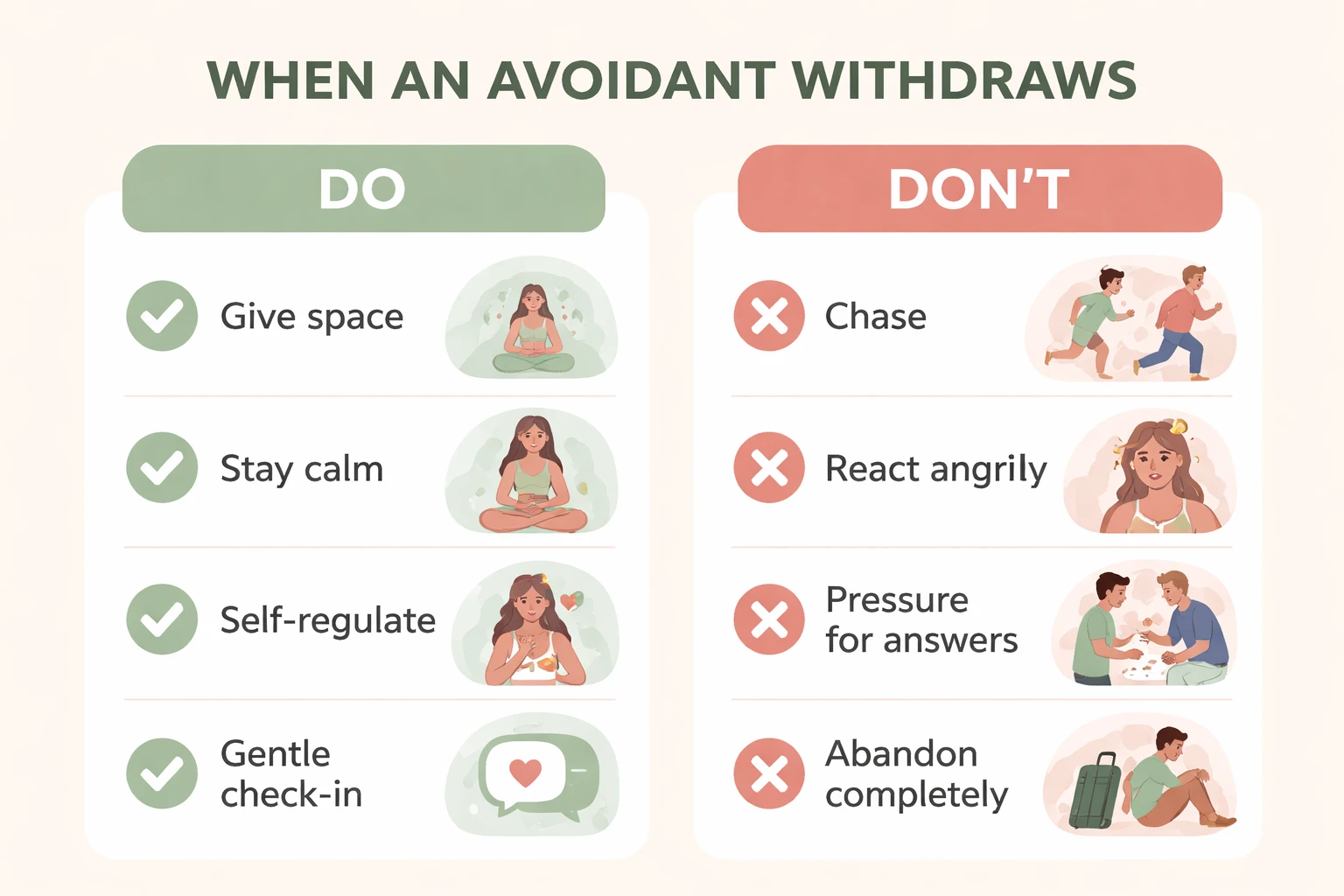
Do Not Chase
Every pursuit instinct you have—texting again, showing up, demanding explanations—will deepen their withdrawal. Pursuit confirms their fear that closeness means losing themselves.
Chasing looks like:
- Multiple texts when they have not responded
- Showing up uninvited to their space
- Calling repeatedly
- Demanding immediate conversation
- Following up on messages to ask why they have not replied
Do Not React with Anger
Your anger is understandable. Being shut out hurts. But angry reactions trigger avoidant defenses even more strongly.
Angry reactions include:
- Accusations about their behavior
- Ultimatums delivered in frustration
- Punishing silence (cold shoulder)
- Bringing up past grievances
- Saying things designed to hurt them back
Do Not Pressure for Answers
Demanding to know what is wrong, what you did, or what they are feeling creates exactly the pressure they are escaping.
Pressure sounds like:
- "Why are you acting like this?"
- "We need to talk about this right now."
- "Tell me what I did wrong."
- "You cannot just shut me out."
Do Not Abandon Completely
While space is essential, complete disappearance can trigger their abandonment fears (yes, avoidants have these too, just expressed differently).
Abandonment looks like:
- Going fully silent in retaliation
- Threatening to leave
- Withdrawing all warmth and connection
- Refusing to engage when they do reach out
Do Not Take It Personally
This is the hardest one. Their withdrawal feels like rejection. But internalizing it as evidence of your inadequacy will poison both your wellbeing and the relationship.
What TO Do Instead
Effective responses balance giving space with maintaining connection—a challenging tightrope.
Give Space Without Disappearing
The most important response is stepping back while remaining available.
What this looks like:
- Reduce contact frequency but do not go silent
- Continue living your normal life
- Be warm when you do interact, but briefly
- Do not ask about the withdrawal
Example: If they are not responding to messages, wait a day or two, then send something light and warm that does not demand a response. "Hope you are having a good day" rather than "Why are you ignoring me?"
Regulate Your Own Nervous System
Your anxiety about their withdrawal can escalate the dynamic. Ground yourself before responding.
Self-regulation strategies:
- Physical movement (walk, exercise)
- Journaling your feelings (instead of texting them)
- Time with supportive friends
- Breathing exercises or meditation
- Remind yourself: their withdrawal is their pattern, not your worth
Look for Signs They Still Care
During withdrawal, avoidants may still show subtle signs of connection. Watch for:
- Brief but warm responses when you do connect
- Continuing to like or view your social media
- Not fully cutting off contact
- Small gestures that show awareness of you
These signs can reassure you that withdrawal is temporary, not terminal.
Communicate Calmly When They Return
When they do come back, resist the urge to immediately process what happened. Let reconnection happen naturally before discussing the pattern.
If you do discuss it (and eventually you should), use calm, non-accusatory language:
Instead of: "You cannot just disappear on me like that." Try: "I noticed you needed some space. I want to understand how I can support you when that happens."
Instead of: "This behavior is unacceptable." Try: "When you withdraw, I feel disconnected and worried. Can we find a way that works for both of us?"
How Long Does Withdrawal Last?
There is no universal timeline. Avoidant withdrawal can last hours, days, or even weeks depending on:
- Severity of the trigger: Small triggers resolve faster
- Your response: Chasing extends withdrawal; space shortens it
- Their awareness: Avoidants working on themselves may return sooner
- Relationship security: More secure relationships have shorter withdrawals
- Life circumstances: Stress in other areas can prolong withdrawal
General patterns:
- Minor withdrawal: Hours to a day or two
- Moderate withdrawal: Several days to a week
- Significant withdrawal: Weeks
- Withdrawal leading to breakup: When space becomes permanent
If withdrawal consistently lasts weeks without communication, this is a more serious pattern requiring direct conversation about relationship sustainability.
When Withdrawal Becomes a Pattern
Occasional withdrawal is part of loving an avoidant. But when does it cross into unhealthy territory?
Questions to Ask Yourself
- Is withdrawal happening more frequently over time?
- Are the triggers becoming smaller and smaller?
- Do you feel you cannot express any needs without triggering withdrawal?
- Are you constantly walking on eggshells?
- Has withdrawal led to missed important events or broken commitments?
- Do you feel emotionally starved in the relationship?
Signs the Pattern Is Unsustainable
- No acknowledgment: They never recognize or apologize for the impact
- No effort: They are not working on their patterns
- Escalating frequency: Withdrawals are becoming more common
- Longer duration: Each withdrawal lasts longer than the last
- You are shrinking: You are becoming smaller to avoid triggering them
The Difficult Conversation
If the pattern is unsustainable, you need a calm, clear conversation during a connected moment (not during or immediately after withdrawal):
"I care about you and I understand that you need space sometimes. And I also need to feel connected and secure in our relationship. Right now, the frequency of withdrawal is making that really hard for me. Can we talk about finding a balance that works for both of us?"
This conversation may trigger withdrawal. But avoiding it indefinitely means accepting a dynamic that harms you.
Protecting Your Own Mental Health
Living with avoidant withdrawal takes a toll. Your mental health matters as much as the relationship.
Build External Support
Do not make your avoidant partner your only source of emotional connection. Cultivate:
- Close friendships
- Family relationships
- Therapeutic support
- Community connections
When they withdraw, you need places to turn that are not them.
Recognize Your Own Patterns
If you have anxious attachment, withdrawal triggers your deepest fears. Understanding your own reactivity helps you respond more consciously.
For support with managing anxious responses, explore attachment-focused resources.
Maintain Your Identity
It is easy to lose yourself trying to accommodate an avoidant. Keep:
- Your own interests and hobbies
- Your friendships
- Your goals and ambitions
- Your sense of self separate from the relationship
Know Your Limits
You cannot love someone into secure attachment. They must choose that path. If the relationship is causing more harm than growth, that information matters.
You can get support during their withdrawal to process your own experience and make clear decisions.
The Balance You Are Seeking
Learning what to do when an avoidant withdraws is ultimately about finding balance: enough space that they feel safe, enough connection that you do not lose yourself.
This balance requires:
- Their awareness: Recognizing their pattern and its impact
- Their effort: Working on their attachment (therapy, self-work)
- Your boundaries: Knowing what you can and cannot accept
- Mutual care: Both people prioritizing the relationship's health
If only one person is doing the work, the balance cannot hold.
You deserve a partner who, even when struggling with closeness, takes responsibility for their patterns and works toward security. Whether your current relationship can become that depends on choices you both make.
Ready to Start Your No Contact Journey?
Track your progress, get AI coaching when the urge to text hits, and become the strongest version of yourself.
Free to start • No credit card required
Related topics