


A phantom ex is a former partner someone keeps idealizing long after the breakup, and uses, out loud or in private, as the yardstick for every new relationship. Memory edits the story: the best moments stay bright, the problems fade. Since no real person can beat an edited memory, the phantom ex keeps new love at a safe distance.
That is the phantom ex phenomenon in one paragraph. It shows up most often in people with an avoidant attachment style, whether dismissive or fearful. If you are new to the topic, our guide to avoidant attachment and breakups explains the bigger pattern this one fits into.
Maybe you are competing with someone who is no longer around, or you suspect you are the ex someone cannot let go of. This guide covers both sides, and if you are trying to stop rewriting the past, No Contact AI was built for exactly that work.
Key takeaways
- A phantom ex is an idealized former partner used, usually unconsciously, as a benchmark no new partner can meet.
- The term was popularized by the 2010 book Attached, which describes it as one of the "deactivating strategies" avoidants use to keep closeness in check.
- Being someone's phantom ex means they miss a version of you, not necessarily the real you.
- Avoidants sometimes reach out to a phantom ex, but a real return tends to reactivate the fears that ended things.
What Is the Phantom Ex Phenomenon?
The phantom ex (also called phantom ex syndrome) describes a pattern, not a person. Someone holds on to an idealized image of a past partner and keeps comparing new partners to it. Sometimes out loud: "My ex would have known what I meant." More often in silence, as a vague feeling that this new person is nice, but not it.
A few things separate a phantom ex from simply having a past:
- The memory is lopsided. The chemistry and the first months are vivid. The fights and the reasons it ended are blurry.
- It shows up at revealing moments. The ex tends to come back to mind when the current relationship asks for more: moving in, meeting the family, saying "I love you."
- It is rarely acted on. Many people never try to get their phantom ex back. The point is not reunion. It is having somewhere else for the heart to live.
A phantom ex does not have to be the most recent partner. It can be a first love or a summer romance from years ago. What matters is the role the memory plays.
Where the Term Comes From
The phrase was popularized by psychiatrist Amir Levine and Rachel S. F. Heller in Attached (2010), one of the best-known books on adult attachment. They describe "deactivating strategies": mostly unconscious habits that avoidantly attached people use to turn down the volume on closeness. Pining after an idealized ex is one of them, alongside fixating on a partner's small flaws or pulling away right when things are going well.
Worth knowing: the phantom ex is not a clinical diagnosis. It is a descriptive label for a pattern many people recognize the moment they hear it named.
Phantom Ex vs. Normal Nostalgia
Everyone thinks about an ex sometimes. That alone does not make someone a phantom ex. The difference lies in what the memory does.
| Normal nostalgia | Phantom ex | |
|---|---|---|
| How the ex is remembered | Good and bad, roughly balanced | Mostly the highlights |
| When the thoughts show up | After a reminder, then they pass | Often when a new relationship gets closer |
| Effect on the current partner | None, or a passing pang | Constant, often silent comparison |
| Reasons it ended | Remembered clearly | Blurred, minimized or rewritten |
| What the person wants | To close a chapter | To keep a door slightly open |
Why the Phantom Ex Happens (Especially With Avoidants)
Anyone can romanticize an ex. But the pattern fits avoidant attachment almost too well.
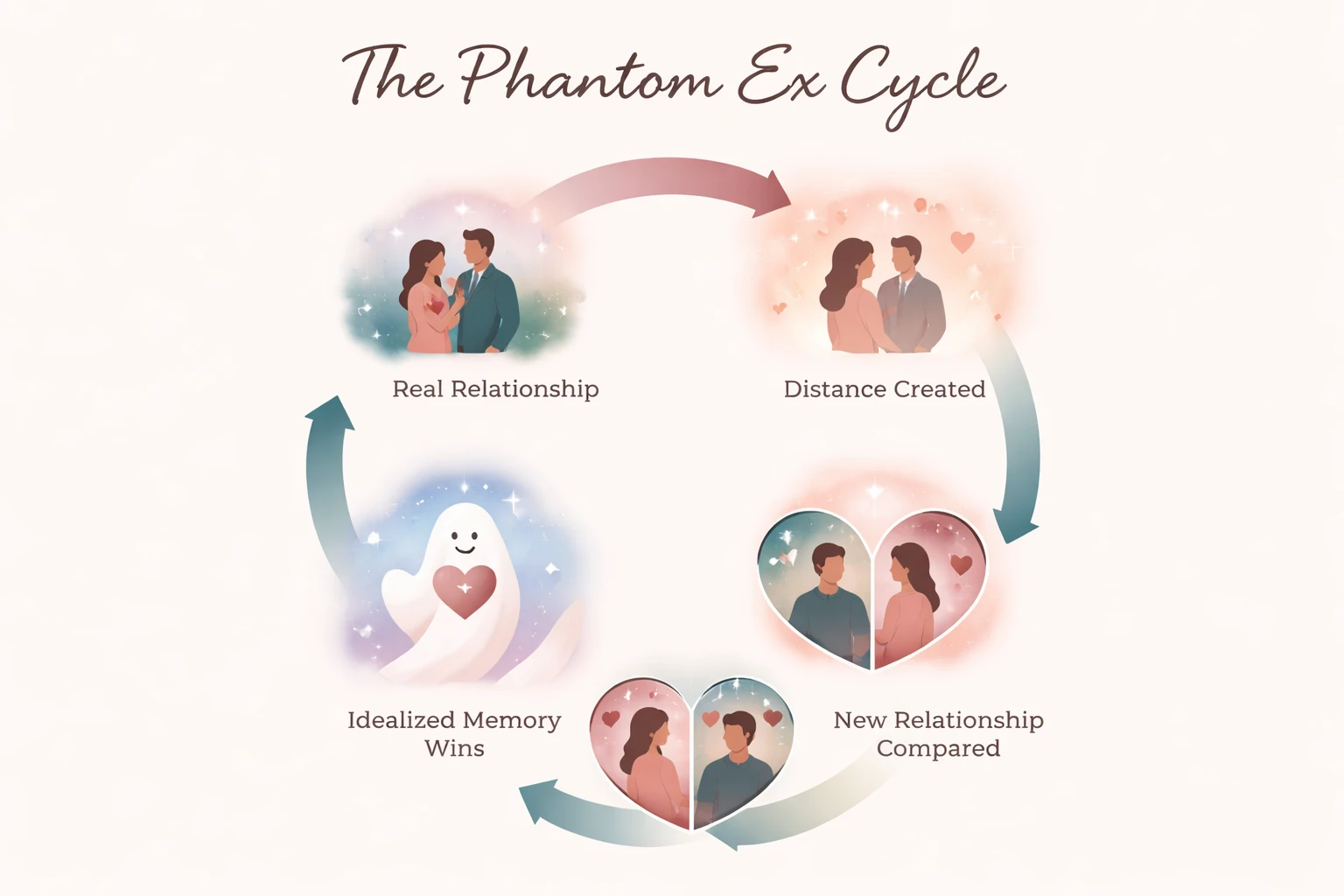
Distance Makes Love Feel Safe
For an avoidant person, closeness comes with a background alarm. When someone needs them or wants more of them, part of their nervous system reads it as pressure. During the relationship, that alarm makes it hard to feel the love that is actually there.
After the breakup, the pressure is gone. The ex is not asking for anything anymore, and the warm feelings that were muted can finally come up. The cruel irony: they can only fully feel for someone once that person is out of reach.
Deactivation: An Exit Door in Every New Relationship
This is the part Levine and Heller emphasize. A phantom ex is useful to the avoidant mind. As long as "the one who got away" exists somewhere, any new partner can be kept at arm's length with a reasonable-sounding thought: this is good, but it is not what I had before.
Nobody plans this. It runs below awareness, and the door simply stays half open.
The Memory Edits Itself
Memory is not a recording. A classic study on the "rosy view" (Mitchell and colleagues, 1997) found that people remembered trips and vacations more positively than they had rated them while living them. The irritations faded. The highlights stayed.
Relationships get the same treatment. Months later, the ex who went silent for days has become "the only person who really understood me." A phantom ex is less a person than a highlight reel.
Suppressed Feelings Don't Simply Disappear
Avoidant people are often good at not thinking about painful things, until they are tired or overloaded. In a 2004 experiment by Mikulincer, Dolev and Shaver, participants tried to push away thoughts about a relationship breakup. Avoidant participants managed it well under light mental load. Under heavy load, the suppression broke down and negative feelings about themselves surfaced.
The study is not about phantom exes directly, but it fits what many people describe: the feelings were held down, not absent. When they leak back, often weeks or months later, they attach to the person who is safely gone.
Dismissive vs. Fearful Avoidants
Both styles can have a phantom ex, but it tends to look different:
- Dismissive avoidants usually keep it private. They rarely mention the ex, yet quietly hold them up as the standard.
- Fearful avoidants swing more visibly. They idealize an ex, reach out, panic when the ex responds warmly, then withdraw. If that push-pull sounds familiar, the stages fearful avoidants go through after a breakup will help you read it.
Phantom Ex Examples From Everyday Life
The pattern is easier to spot in real scenes. These are composites of situations people commonly describe:
- The restaurant comment. On a third date, he says his ex "would have loved this place." Two dates later, he says it again about another place. He does not seem to notice.
- The two-years-later text. One night, out of nowhere: "Saw something that reminded me of you. Hope you're doing well." No question, no plan. Just a door nudged open.
- The perfect fit that never was. "We just got each other without trying." In reality, they had the same argument every month and split because one of them would not commit.
- The private scroll. Nothing is said. But every time the new relationship hits a milestone, like meeting the parents, they end up on the ex's profile.
- The ghost in arguments. During a fight: "This never happened with [name]." Probably true, mostly because that relationship never lasted long enough to get there.
The common thread: the ex is not just remembered. The memory is used, as a comparison point, an escape hatch or a comfort.
Signs Your Partner Has a Phantom Ex
How do you tell a phantom ex from a partner who simply has a past? One of these symptoms alone means little. Several together, over time, usually mean something.
What they say
- They bring up one particular ex far more than any other, almost always in glowing terms.
- They describe that relationship as uniquely deep: "a connection I've never had since."
- They compare you, sometimes directly, more often through small remarks.
- They get vague or defensive when you ask why it ended.
What they do
- They keep a quiet line open: following the ex, liking an occasional post, a yearly birthday message.
- They pull back when your relationship gets more serious, and the ex comes up more often right around then.
- They keep photos, gifts or playlists tied to the ex with unusual care.
And for you, it often feels like there are three people in the relationship.
The signs it is probably not a phantom ex: they talk about the ex in balanced terms, can name what did not work, and the topic does not change how present they are with you. Having loved someone before is not a red flag. Using that love as a wall is.
Am I the Phantom Ex? Signs You're Someone's Phantom Ex
Now the other side. Your ex was avoidant, the relationship ended, and yet you keep hearing about yourself. Signs you might be someone's phantom ex:
- They reach out long after the breakup, often around birthdays or holidays, with messages that open the door without walking through it.
- Mutual friends say they still mention you, or compare new partners to you.
- Their new relationships don't last, or they stay single while seeming fine on the surface.
- They romanticize your relationship in a way that does not match what you lived. They remember the trip to the coast, not the silences.
- They keep a low-effort connection: watching your stories, reacting to an old photo.
- When you talk, it is warm and nostalgic, but nothing concrete follows.
How the two positions compare:
| Your partner has a phantom ex | You are someone's phantom ex | |
|---|---|---|
| What you notice | Comparisons, a third presence, distance when you get closer | Nostalgic messages, social media orbiting, news through friends |
| What it feels like | Never quite enough | Flattered, confused, a little hooked |
| What is really going on | Your partner keeps an emotional exit open | Your ex misses a safe, edited version of you |
| The trap | Trying to outperform a memory | Mistaking nostalgia for readiness |
Several of these overlap with the signs an avoidant is hiding deep feelings. The feelings can be real. The question is what your ex is able to do with them.
How Do You Become Someone's Phantom Ex?
There is no recipe, and it is not a prize. But a few conditions make it more likely:
- You mattered to them emotionally. Phantom exes are rarely flings that meant nothing.
- It ended before it got truly demanding, so the fantasy was never tested.
- You were the one who wanted more. Your need for closeness may have triggered their withdrawal. Once it is gone, only the warmth remains.
- Contact stopped. Ironically, distance is what turns a real ex into a phantom. No new information, no friction, just memory.
- The ending was ambiguous. No betrayal, no villain, just "it wasn't the right time." Plenty of room for "what if."
Being the phantom ex says more about their attachment system than about your worth. You did not become perfect after the breakup. You became unavailable.
Do Avoidants Go Back to Their Phantom Ex?
Sometimes, yes. An avoidant who idealizes an ex may reach out or even ask to try again, especially during a lonely stretch. For the specific signals, see the signs an avoidant ex will come back. But the honest answer has two parts.
Do Avoidants Love Their Phantom Ex?
Often, in their own way, yes. The feelings are not fake. What is skewed is the object. They love the version of you that exists at a safe distance: the one who does not need reassurance or ask where this is going. That version is easy to love because it asks for nothing.
What Usually Happens When They Return
When a phantom ex becomes a real partner again, the distance that made them lovable disappears, and the old alarm comes back. The sequence often looks like this:
- Euphoria. It feels like getting back what was lost.
- Friction. Real life returns: habits, needs, plans.
- Deactivation. The same pulling away, the same "I need space."
- Exit or cycling. Another breakup, or an on-and-off pattern.
The twist many people miss: after the second breakup, the partner they left to come back to you can become the next phantom. The pattern travels because it was never really about the person.
Change is still possible. An avoidant who is genuinely working on their attachment, and can talk about why things fell apart without rewriting the story, is a different situation. Look for changed behavior over months, not intense words.
What to Do If You're Dating Someone With a Phantom Ex
You cannot win a competition against a memory, so don't enter it.
Stop auditioning. Trying to be more like the ex will exhaust you, and the target keeps moving.
Name what you see, calmly. As an observation, not an accusation: "I've noticed [name] comes up a lot, especially when we talk about the future. I'm not asking you to erase your past. I want to know if there's room for us to build something here, now."
Watch the response. A partner who can hear this and gradually show up more is worth some patience. One who gets defensive and keeps comparing is telling you something too.
Know your limit. You can love someone and still decide that this dynamic costs you too much.
What to Do If You Are the Phantom Ex
That message after months of silence can feel like a win. It can also be a trap. Before you reply, check it against reality.
Remember the real relationship, not their version of it. Write down what hurt you, which of your limits were crossed and the red flags you noticed, then reread that list before answering. This is what the personal reminders in the No Contact AI app are for: you save the wounds, crossed boundaries and red flags while you still see them clearly, so they are right there when nostalgia gets loud. Its guided exercises can also help you de-idealize the relationship, or write the reply you want to send without sending it.
Ask yourself four questions:
- Why did it really end, and has that changed?
- Has your ex worked on their patterns, or simply missed you?
- Are you drawn to them, or to the feeling of finally being chosen?
- If it falls apart again in three months, where will that leave you?
If you decide to talk, go slowly. Watch what they do once closeness returns, not how intense the first conversations feel.
If you decide not to, you do not owe anyone a reply. Protecting your recovery is a complete answer. If you wonder how silence lands with this kind of ex, here is how dismissive avoidants respond to no contact.
If You're the One Holding On to a Phantom Ex
That is not a character flaw. It is a protective habit, and habits can change. Write down the relationship as it really was, then notice when your ex comes to mind. If it is mostly when someone new gets closer, that timing is your clue. A therapist who works with attachment can help.
The Bottom Line
The phantom ex phenomenon is not about a great love that can never be replaced. It is about distance feeling safer than closeness. Whether you are competing with a phantom, you are one, or you carry one, the way forward starts in the same place: bring the story back to reality, then decide what you want with clear eyes.
 No Contact AI
You can't control if they come back.You can control your silence.
No Contact AI is with you every day you choose not to text.
- A No Contact counter that makes every day visible
- An SOS plan when the urge to reach out gets too strong
- An AI coach to talk to, day and night, without judgment
FAQ
How do I tell if I'm the phantom ex?
Look for a pattern, not a single message. Your ex reaches out months or years later with nostalgic but vague messages, keeps a low-key connection online, still mentions you to friends, and their new relationships do not last. If they idealize a relationship you remember as difficult, you are probably playing the phantom ex role.
Do avoidants love their phantom ex?
Often they feel real affection, but it is aimed at an edited memory. Distance lets avoidants feel love without the pressure of intimacy. What they cherish is a version of you that asks nothing of them, which is why their feelings can look intense from afar and fragile up close.
How do you become the phantom ex?
Usually by being emotionally important to an avoidant partner, then becoming unavailable. Relationships that ended before long-term closeness was tested, endings without a clear villain and long stretches of no contact all make it easier for their memory to idealize you. It reflects their attachment pattern more than your value.
Do avoidants go back to their phantom ex?
Some reach out, and a few do try again, often during a lonely period or after another relationship ends. But closeness tends to reactivate the fears that ended things, so the reunion often follows the same arc: euphoria, friction, withdrawal. Lasting change usually requires the avoidant to actively work on their attachment.
What is the hardest attachment style to love?
There is no single answer, but many people find fearful avoidant partners the hardest, because they want closeness and fear it at the same time, which creates hot-and-cold cycles. Dismissive avoidants can feel hard in a quieter way, through steady distance. Any style becomes easier to love when the person is aware of it and working on it.
Is phantom ex syndrome a real diagnosis?
No. It is not a clinical diagnosis and does not appear in diagnostic manuals. It is a term popularized by the book Attached to describe a common pattern: idealizing a past partner in a way that blocks closeness with new ones. The pattern is real; the label is descriptive, not medical.
Related topics