


Most advice on how to heal from a breakup either tells you to "give it time" or hands you a self-care checklist and wishes you luck. Neither helps much at 2 a.m., when you're rereading their last message for the tenth time.
Here's the honest version. You heal from a breakup by doing three things, over and over, for longer than you'd like: letting yourself grieve instead of fighting it, putting real distance between you and the constant reminders, and rebuilding a sense of who you are without them. You can't skip the pain or set its pace. You can stop making it last longer than it has to.
This page is part of our guide to getting over a breakup. Below: what to do right now, the four phases of healing, what to do with the love that's still there, and how to tell you're getting better.
Key takeaways
- Healing isn't forgetting them. It's being able to think about the relationship without it running your day.
- The first 72 hours are for stabilizing, not analyzing: food, sleep, one trusted person, no big decisions.
- Still loving them is normal. The feeling usually fades gradually as it stops being fed, not on command.
- Setbacks don't erase progress. Healing comes in waves, and the overall direction matters more than any single day.
What Healing After a Breakup Actually Means
Many people quietly expect a finish line where they feel nothing at all, then panic when it doesn't show up.
| Healing is not... | Healing is... |
|---|---|
| Forgetting the relationship existed | Remembering it without being flattened by it |
| Feeling nothing when you see their name | Feeling a pang that passes on its own |
| Hating them so you can let go | Seeing them clearly, the good and the bad |
| Becoming a completely different person | Feeling like yourself again, with a few new lessons |
The goal isn't to become someone who never loved them. It's to become someone who loved them, lost the relationship, and still has a full life. Small, repeatable actions get you there, which is also the idea behind NoContact AI: a few minutes of structure a day, not a miracle cure.
What to Do in the First 72 Hours After a Breakup
Right after a breakup, your job isn't to understand anything. It's to get through the next three days without making things harder for the person you'll be next week.
- Tell one person. "We broke up. I'm not okay. Can you check on me tonight?" is enough. You don't owe anyone the full story yet.
- Cover the basics. Eat something small every few hours, even without appetite. Drink water. Protect a window for sleep; lying in the dark still counts as rest.
- Make contact harder. Archive the chat, mute their stories, take their number off your favorites. You don't have to make a forever decision tonight. If you choose a full break, here's how the no contact rule works.
- Don't decide anything big. No quitting your job, no public post, no three-page message. Write it in your notes app and leave it there.
- Box up the reminders. Photos, gifts, the hoodie that still smells like them. Not the trash, just a box out of sight.
- Plan tomorrow hour by hour. Empty time is where the spiral lives. Shower, walk, a call, a meal, a show. Boring structure is your friend.
For the worst moments, these coping strategies for the hardest days cover sleep, appetite, and triggers.
And if the pain turns into thoughts of not wanting to be alive, don't wait for it to pass: call or text 988 now if you're in the US, or your local emergency number elsewhere.
The 4 Phases of Healing From a Breakup
Healing tends to follow a rough arc. The four phases below aren't a clinical model and won't line up neatly on a calendar. They're practical landmarks, drawn from patterns that recur in breakup stories, to help you see where you are and where to put your energy.
| Phase | What it often feels like | Your main job | You're moving on when... |
|---|---|---|---|
| 1. Survival | Shock, constant ache, broken sleep, urges to reach out | Stabilize | The pain comes in waves, not a flood |
| 2. Processing | Sadness, anger, longing; replaying everything | Feel it, make sense of it | Okay days outnumber bad ones |
| 3. Rebuilding | More energy, gaps where they used to be | Build a life that's yours | Your plans no longer revolve around them |
| 4. Integration | Calm, some nostalgia, a clearer view | Make meaning, carry lessons forward | You wish them well, or feel neutral |
Some people stay in a phase for weeks, others much longer, and most slide back now and then. For an honest look at timelines, see how long it usually takes to get over a breakup.
Phase 1: Survival
Lower the bar on purpose. Ask for a lighter week at work if you can, and cancel what isn't essential. This is not the moment for deep self-work. If all you did today was eat, shower, and not text them, that was a good day.
Phase 2: Processing
Now the feelings arrive properly, and they need somewhere to go. Many people find a daily grief window useful: 20 minutes to cry, write, read a book about heartbreak, or look at old photos on purpose, then you close it and do something else. Grief gets a place without taking over every hour.
Reflection seems to help most when it rebuilds your sense of self. In a study of 210 recently separated young adults, those who reflected on their breakup in four in-depth research sessions over nine weeks regained a clearer sense of who they were than those who only filled out questionnaires at the start and end. That clearer sense of self went along with less loneliness and fewer intrusive thoughts about the breakup.
Just don't confuse reflection with rumination. Reflection asks "What do I need next time?" and lands somewhere. Rumination asks "Why didn't they..." on a loop. If you've written the same paragraph three days running, switch from why to what now.
Phase 3: Rebuilding
The question here is "Who am I without them?" Start with what you dropped during the relationship: a friend, a hobby, the music they didn't like. Then build routines that are entirely yours, like a new Saturday morning ritual or a class on what used to be "your night."
Invest in friendships, and be a friend too, not only someone who receives support. Dating because you're curious is different from dating to numb the pain. The second usually postpones the grief rather than ending it.
Phase 4: Integration
The breakup becomes part of your story instead of the whole story. Take stock: what you want, what you won't accept again, what you'd do differently. Forgiveness, if it comes, is for your own peace, not a sign that what happened was okay. And stay open. Having healed once is proof you can do it again.
How to Heal From a Breakup When You Still Love Them
Still loving someone after it's over doesn't mean you're healing wrong. Love doesn't switch off when a relationship ends. It usually fades slowly, as it gets less contact and less attention, which is maddening when you want it gone by Friday.
A small lab study offers a useful clue. Researchers asked 24 people who were still upset about a breakup to try different mental strategies before looking at a photo of their ex. Thinking about the ex's flaws lowered their love feelings but left them feeling worse in the moment. Distraction, thinking about something pleasant and unrelated, lifted their mood but didn't change how much they loved the ex. It's a small study measuring short-term effects, but the practical lesson is useful: you probably need both.
- Keep a reality list. Write down the moments that hurt, the needs that went unmet, the boundaries that got crossed. Reread it when nostalgia starts editing the past. In NoContact AI, you can keep this list in the reminders section and reread it before you reach out.
- Plan distraction for the hard hours. Sunday evenings, the drive home, after a few drinks: have something pleasant lined up before they arrive.
- Separate the person from the relationship. You can love who they are and still accept that the relationship didn't work.
- Stop feeding the hope loop. Every profile check is a small dose of them. In a survey of 464 people after a breakup, the more people monitored an ex's Facebook page, the more distress and longing and the less personal growth they reported. It's a correlation, so it can't prove the checking caused the pain (people who hurt more may also check more), but it's a good reason to mute rather than monitor.
- Give the love somewhere to go. Write the letter you'll never send. Then point some of that care at people and projects that can receive it, including yourself.
Loving them doesn't mean you should get back together, or that you can't heal. If missing them is the hardest part, this guide on what to do when you miss your ex so much it hurts goes deeper.
Daily Habits That Help You Heal
Small things done most days do the heavy lifting. Pick two or three, not all of them.

In the morning (5 to 10 minutes)
- Check in with yourself: name the feeling as precisely as you can. "Lonely" or "humiliated" tells you more than "bad."
- Set one small intention: "call my sister," "walk at lunch," "eat a real dinner."
- Move a little, even if it's just stretching or a lap around the block.
In the evening (10 minutes)
- Write three lines: what was hard today, what helped, and one thing you handled well.
- If late-night scrolling is your trigger, charge your phone outside the bedroom.
Once a week
- Compare this week with last week. You'll often spot progress you can't feel day to day.
- Have one real conversation with someone who's good for you.
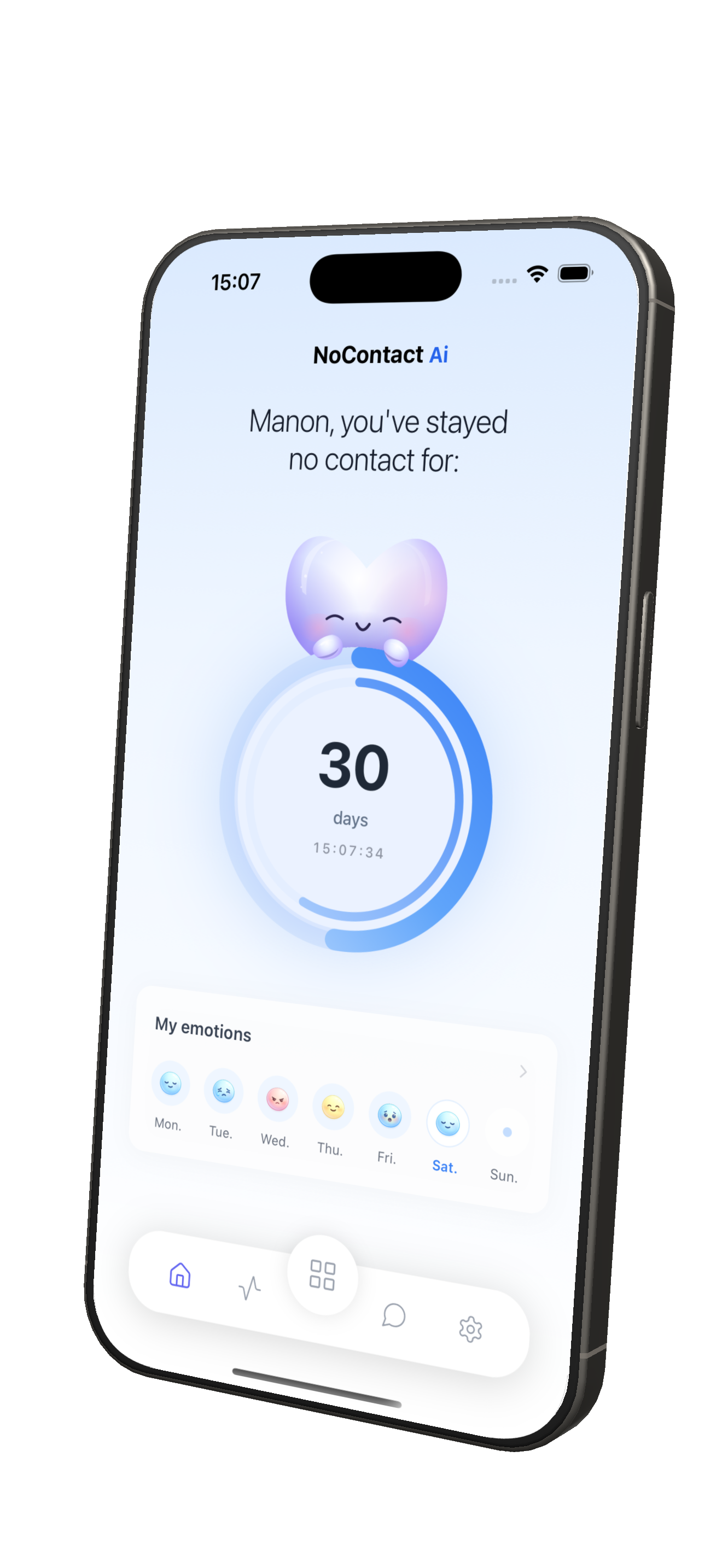
If you like structure, NoContact AI lets you log your emotions in a few taps and see how they shift over the weeks, counts your no-contact days, and offers guided exercises, such as writing the message you're dying to send without sending it. It's a self-help tool, not therapy, and it won't do the healing for you. It makes the daily work easier to stick with. If you'd rather compare options, see our guide to breakup apps, free and paid.
Setbacks Are Part of Healing
You'll have a good week and then a terrible Tuesday. You'll feel done with them and then cry in the cereal aisle. That isn't a reset to zero. It's what healing looks like up close.
The usual triggers: anniversaries and holidays, seeing them (especially with someone new), a song or a place, news through mutual friends, and plain loneliness, stress, or alcohol.
When a wave hits:
- Name it. "This is a wave, not a restart."
- Put time between the urge and the action. Give the urge to text them 20 minutes, and write it out in the meantime.
- Go back to the basics from Phase 1 for a day or two: food, sleep, one person.
- Look at the trend, not the day. This is where weekly notes pay off.
- If you broke no contact, don't spiral. You didn't ruin your healing. Notice what triggered it and start the count again.
Can You Heal From a Breakup Fast?
Not really, and anyone promising a seven-day fix is selling something. Grief takes the time it takes. What you can do is remove the things that drag it out.
| What slows healing | What to try instead |
|---|---|
| Checking their profiles "just to see" | Mute, archive, and make checking a hassle |
| Staying friends right away | Take a real break first; revisit friendship later if you both want it |
| A rebound to numb the pain | Date when you're curious, not when you're desperate |
| Alcohol or endless scrolling every evening | A grief window, plus a plan for your evenings |
| Waiting for them to give you closure | Write your own ending: what happened, what you learned, what's next |
Healing faster mostly means healing without detours.
Signs You're Healing From a Breakup
Progress is often invisible from the inside. Look for these.
Early signs
- You go a few hours without thinking about them.
- You're sleeping and eating closer to normal.
- Crying comes in waves rather than all day.
- You forgot to check their profile and only noticed later.
Later signs
- You laugh and actually mean it.
- You can talk about them without your voice cracking.
- You see the relationship more clearly, good parts and bad.
- You've stopped waiting for a message.
- Their name doesn't make your stomach drop.
- You wish them well, or feel mostly neutral.
You don't need every item on the list. Healing is uneven: you can be at peace about them and still sad about the life you had planned together.
Healing in Special Situations
When You Lived Together
Settle the logistics first (who moves out, by when, how you split things and bills) in one written channel, short and practical. Then change the space: move the furniture, buy new sheets, make it look like your life now.
When You Have a Child Together
Full no contact isn't possible, so aim for low contact: one channel (a co-parenting app or a single email thread), topics limited to your child, short and predictable handoffs. Your healing happens in the space around those exchanges. Never use your child as a messenger, and consider a family mediator if conflict stays high.
If You're a Man Who Was Taught to Handle It Alone
The steps are the same, but grief may come out sideways, as anger, overwork, drinking, or a fast rebound. The most useful step is often telling one person, "This is hitting me harder than I expected."
When to Talk to a Professional
A breakup can knock you flat for a while, and that alone doesn't mean something is wrong with you. But consider talking to a therapist or your doctor if:
- weeks go by and you still can't work, study, or take care of basic needs;
- your sleep or appetite has changed a lot and isn't easing;
- the sadness is getting heavier instead of coming in waves;
- you're relying on alcohol, drugs, or risky behavior to get through;
- the breakup reopened old trauma, or the relationship involved abuse or control;
- you feel hopeless or numb most of the time.
Here's what breakup therapy involves and how to find a therapist, including lower-cost options. NoContact AI can support your daily routine, but it doesn't replace a therapist or medical care.
If you're thinking about suicide or self-harm
Call or text 988 to reach the 988 Suicide & Crisis Lifeline in the US. It's free, confidential, and available 24/7, and you can also chat online. If you're in immediate danger, call 911. Outside the US, contact your local emergency number.
Where to Start Today
Healing from a breakup is built from small, unremarkable days. Pick one thing for today: tell someone how you're really doing, mute their profile, write the message you won't send, or take a walk. Then do it again tomorrow.
 No Contact AI
From heartbreak to peace,one day at a time.
No Contact AI helps you hold on, understand what you feel and find yourself again.
- Track your emotions, day after day
- 40 AI-guided exercises
- A No Contact counter to see how far you've come
FAQ
How do you heal from a breakup when you still love them?
Accept that the love won't vanish on command, then loosen its grip. Limit contact and profile checks, keep a written list of what didn't work, plan pleasant distractions for your hardest hours, and invest in people and projects that are yours. Love that stops being fed tends to fade, gradually and unevenly.
What is the 3-3-3 rule for a breakup?
There's no single definition. Online, it usually means three days to fall apart, three weeks to reflect, and three months to rebuild; other versions describe three-month chapters. It isn't research-based, and it's often confused with the 3-3-3 dating rule or the 3-3-3 grounding exercise for anxiety. Treat it as a loose prompt, not a deadline.
What are the 5 stages of a breakup?
Breakup versions usually list denial, anger, bargaining, deep sadness, and acceptance, adapted from Elisabeth Kübler-Ross's model of grief, which she first described in people facing death. Breakups often follow a similar pattern, but rarely in order, and most people loop back. Our guide to the stages of a breakup maps them in more detail.
What should you do immediately after a breakup?
Stabilize before you analyze. Tell one trusted person, eat and sleep as best you can, mute or archive their chats and profiles, and put visible reminders out of sight. Hold off on big decisions and long messages to your ex. Then plan the next day hour by hour so empty time doesn't swallow you.
Related topics